Abner Brown – A True Son Of The Soil

Wednesday 14th November 2012

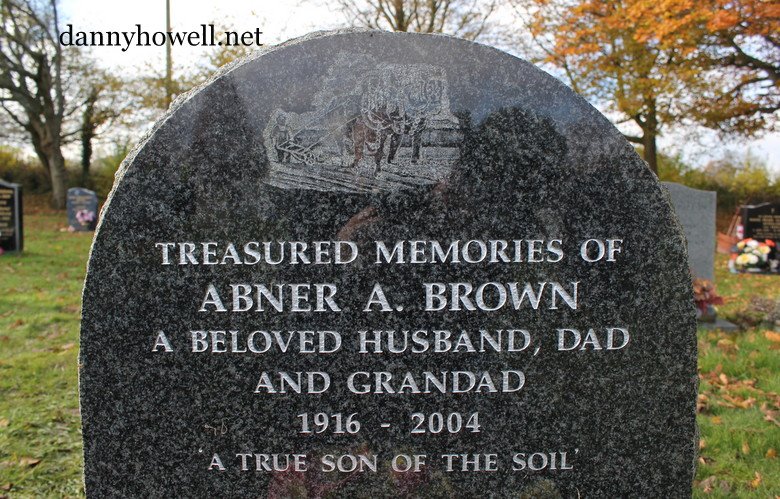
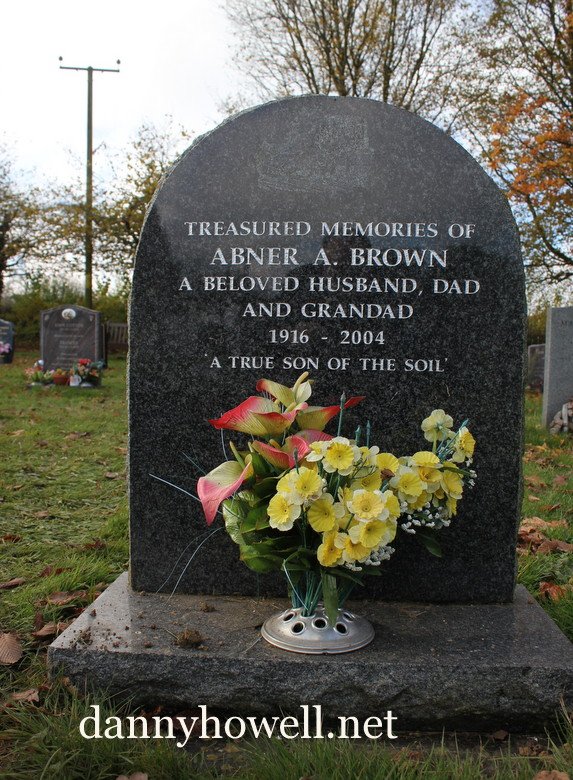
The gravestone of Abner Brown,
at Pine Lawns Cemetery,
at Tasccroft, Warminster.

The inscription reads:

“Treasured memories of Abner A. Brown,
A beloved husband, dad and grandad,
1916 – 2004
‘A True Son of The Soil’

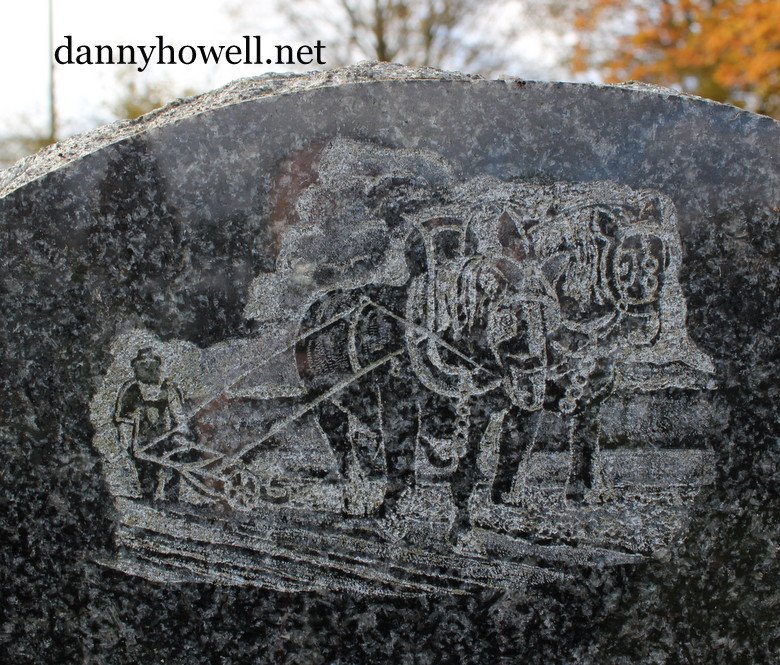
Above the inscription is this illustration of
a man ploughing with a pair of horses,
a fitting to tribute to Abner who was a farmer.

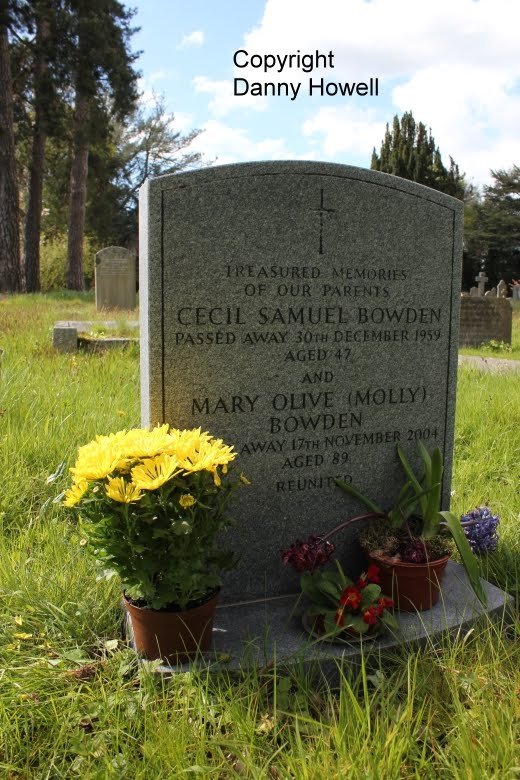
Reunited: Cecil And Molly Bowden

A gravestone at St. John’s Churchyard,
Boreham Road, Warminster,
photographed by Danny Howell
on the afternoon of Monday 30th April 2012.

The inscription reads:

Treasured Memories
of our Parents
Cecil Samuel Bowden
Passed away 30th December 1959
Aged 47
And
Mary Olive (Molly)
Bowden
Passed away 17th November 2004
Aged 89
Reunited.

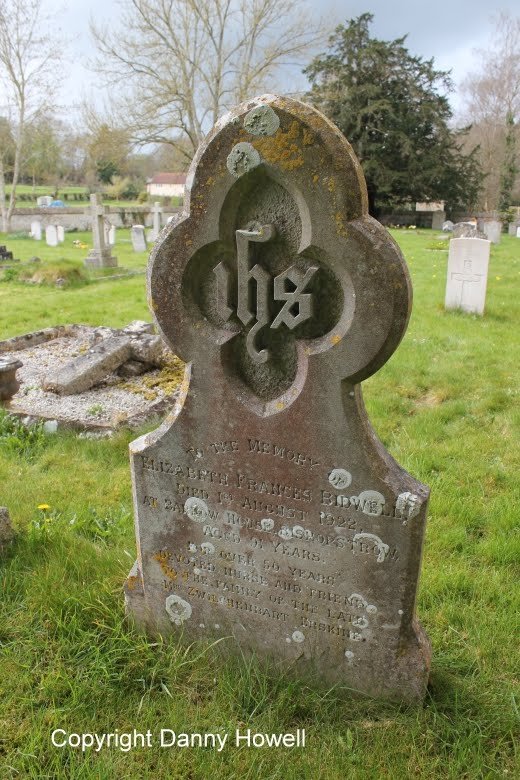
Gravestone At Bishopstrow Of A Devoted Nurse And Friend

Gravestone at St. Aldhelm’s Churchyard, Bishopstrow, photographed by Danny Howell on Tuesday 10th April 2012.

The inscription reads: To the Memory of Elizabeth Frances Bidwell, Died 1st August 1922 At Barrow House, Bishopstrow, Aged 91 years. For over 50 years Devoted Nurse and Friend to the family of the late Mrs. Zwilchenbart Erskine.

Death And Funeral Of Maureen Burtenshaw

Maureen Burtenshaw (nee Trim). Passed away peacefully on 19th March 2012 at her home in Warminster, aged 60. Dearly loved wife of Tony and loving mother to Shelley and Anthony, beloved nanny to Josh and a much loved sister. Funeral service at Longbridge Deverill Church on Thursday 29th March at 1.15pm followed by cremation at Semington. Donations if desired to Dorothy House Hospice c/o F Curtis & Son, 11 Portway, Warminster, BA12 8QG.

Recollections Of Norman And Irene Butler

Thursday 2nd February 2012

Julian Butler, who now lives in Gloucestershire, has very kindly contributed to dannyhowell.net the following transcriptions of recordings he made with his parents, Norman and Irene Butler, who were born in Plymouth, Devon, in 1906 and 1913, respectively. They moved to Warminster just before the Second World War, living first in rented accommodation, before purchasing The Myrtles at Sambourne Road, Warminster.

TRANSCRIPT OF NORMAN BUTLER’S ARMY MEMORIES

Some time before my Dad died I asked him about his experiences in the army during the Second World War. As we spoke I recorded his voice on to an audio cassette. This transcription is the result. Once he got into his stride he talked freely and, because he was in conversation, you will see that he used many colloquialisms that characterised him and the times in which he lived. – Julian Butler.

Because the Army and I didn’t agree I was sent all over the place. To start with I was called up, done my training, got it – waste of time. Then I had to report to Warminster. I didn’t know where Warminster was. I had to look it up on the map. Any rate, the thing was in Warminster Barracks I had nothing to do. So I went to the company office, got it, and saw the sergeant-major and said, “Look, I’m fed up with dodging around. For goodness sake give me something to do!”

So he put me in the sports centre. In there was a corporal. Nothing was up to date. The boots weren’t cleaned. Well, it wasn’t run properly, so I started to organise. All the boots and shirts were kept clean. The corporal went off every week-end. Then it was sports day. Well, that didn’t worry me. I found out what they wanted and had it all lined up ready to be fetched. So I sat there waiting for the van. Two o’clock. Well that was no good. They were starting at three. So I shut the place up, took the key. And, of course, in the army you have to have proof of what to do. So I didn’t go to any Tom, Dick or Harry. I went to the sergeant-major. He’s the key of it all. So I said to the sergeant-major, “Look, you’re going to start in a minute. You haven’t got any equipment here. It’s all in the sports centre.” “Ooh”, he said. “You, you and you . . . . . . . ” And got six blokes and I marched them back. Well, we got back, and this is where the fun starts. There was a van there and an officer. Ooh he was in a tare, got it! “Well,” I said, “it’s all ready there. I went and got these men.” Well, the day went off, and that was the end of it, or so I thought.

Of course, we went on guard duty the next day. The sergeant comes up and says, “You are on a report tomorrow, on a charge.””What have I done?” I said. “I dunno, but you’re on a charge.” I couldn’t think what I’d done wrong. So they marched me in, you see, between two men, one in front and one behind. What happened, you see, was the officer got a bollocking for not getting the sports equipment up, so he was looking for a scapegoat. And they weren’t half going on and I wasn’t even involved. So I thought, “Ah, they’re using me; it’s about time I butted in.” So I said, “Excuse me,” to the officer in charge. The sergeant-major behind me started to pull my jacket: “Shut up, shut up.” But as far as I was concerned he was non-existent. “Excuse me; can I put my words in?” “Oh yes, go on,” he said. “Well, this is EXACTLY what happened and I told them, “It was getting late so I went to the sergeant-major; as proof you can ask him.” And, of course, he had to ask the sergeant-major, and he confirmed it. “Stop!” Immediately it was stopped.

I was just in time to get my last dinner, and I was called to the company office again. I didn’t even have time to finish it. So you know what they said! “You’re transferred to Farnborough.” Just like that. That’s because, you see, they didn’t get away with it. So I was transferred all within the hour. I was gone the next day to Farnborough. And my name went before me. I was detailed for office duty, but they put me on the toilets. A trouble maker! I never knew where I was going next.

Mum came to Farnborough with me. We had a lovely time there. This is before we had children. I got to driving tanks, testing them. It was a lovely job. I was second driver to a civilian. We drove tanks “til they dropped, out at Cove.

I came back to Warminster with another chap. I wasn’t much good at driving, but this bloke was a bloody sight worse than me – ordinary vehicles this was! They took him out for a test . . . . they took him up Battlesbury Hill, really steep. Oh God, when they came back they were all white as ghosts. He nearly killed them up there. Now it was my turn. Now, they were afraid to take me up so they said, “Drive around the square.” They were looking for a driver and that’s an awful job. “Ah,” I thought, “well, they want a good driver do they? Well here’s a bloody bad one.” So I went into first gear and never came out of it. He said, “Stop and get out!” That was that.

I was working for a Major Leightman. He was a nit! – an inventor. I said, “You aren’t half wasting the Government’s money while men abroad are getting killed.” Well, that upset him. And so I was put on going around and picking up metal so that it wasn’t wasted. That’s how he quietened me down. That went on for about a year.

Then the Government decided Leightman’s REME crowd should go down to Tidworth, but he wasn’t allowed to take all the men; only a few. They were making target practice machines. He had a lieutenant called Pollyblank, and his name fitted – typical. Any rate, when it came to moving, a list went up who was going and who was staying. Pollyblank was staying and all his creepers were staying with him, and all who he didn’t like, including me, were going. So we were marched down to Warminster station and were all lined up. Major Leightman gave a speech and expected a cheer. He didn’t get that. Then Pollyblank came along to shake hands. All twenty of us turned our backs on him. All the wives were looking on. The result was I was transferred to Yorkshire.

Up there I was supposed to go in the office, but I was put on ablutions. I was on tanks again – drove lots. You see, I was unfit for overseas service because of my knock-kneed leg.

Later on another chap and I were on guard duty on top of Battlesbury Hill at night. It was black as hell. All you could see was little hooded car lights. There was a rumour of Germans about. This chap and I were alike; if we were given a job we did it well. So what we decided to do was to stand in the road while the other chap hid behind bushes to protect the other – live ammunition. Up came a brass hat in a staff car. He had a woman officer with him. We stopped him. He was a high official with no passes. I said, “I’m sorry, we can’t let you through.” So we phoned through to the main office. And when the sergeant came up and saw two brass hats he nearly messed himself. They were there for two hours. They had to ring through and confirm it. Well, when it was all over the brass hat congratulated us for doing the job properly. But the sergeant wasn’t at all happy with us.

Another time the duty officer came and saw only one of us. He started to rant and rave at me. I said, “Do you know we could shoot you. There’s a gun with a live one up the spout looking at you, so don’t come any silly nonsense with me.”

I came out of the army in ’45. I had been studying accountancy. I passed my intermediate. I was studying for the finals. Five years in the army – what the hell was I going to do? To pass my finals I had to go back and start practically from scratch again. The war service finished a lot of people like that. Then there was an advert in the Journal for an established clerical officer. I had to pass an exam. So, I thought, here goes. The Civil Service is alright – end up with a pension. So I passed, and I passed high up. And I was then offered the job, so I took it. I don’t regret it because, you see, being in Warminster I was then sent to REME as a clerical officer.

Before I went to REME I worked in the Ministry of Buildings and Works, just over the bridge along Imber Road. That was my first job after passing my exams. But I wasn’t long in that. Then I was transferred to REME. I was given the library job. Well, a shambles that was. I catalogued everything. I couldn’t work in a muddle. Each charge-hand had a card. All the vehicles were listed. Everything. So what happened was, once I got it going, I sat down and there was nothing to do. And then of course I started cataloguing the bible. I sat down all day long a the REME, got it? All except for cycling there and cycling home. So when I got home I had plenty of energy to start on the Myrtles. Don’t forget, I worked on the Myrtles every evening.

I worked in the library all the time I was there. I used to represent the Civil Service in the association. At that time they didn’t want to join the TUC. I said, “You should the join the TUC,” but they didn’t want to. Eventually they did. I went to Bournemouth as an observer for the committee. We went on holiday there.

_______

TRANSCRIPT OF IRENE BUTLER

When we moved to Warminster we were first of all living in West Parade with the Trollopes. They had three little girls. Then we got out of there and went to Nancy and Percy Minty in Lower Marsh Road. He was a ‘right so-and-so’, a right Welsh berk. And I lived there until I found I was pregnant; and then we had to go because they just didn’t have the room.

We were out looking for places, and we went and looked at the Myrtles [at Sambourne Road]. Do you remember Dad? We walked down Primrose Lane and there was that great big house all covered with ivy; and we went over, rang the bell, knocked on the door, looked through the glass. Nobody lived there. The place was empty. So I thought. I don’t know whether I’d like to live in there anyway. Then we walked up Princecroft. It was in the black-out and there was a door open and the light was shining out, and smoke coming out. Somebody had left the frying pan on. And we knocked on the door. Poor old Mrs. Mogg, Joan’s Mum, answered the door. And we asked if she had any rooms. “Come in,” she said. She was right rough and ready – you know, big arms. She says, “Well, my daughter rents a cottage in West Street but she doesn’t live there. So wait until she comes in.” So she came in. Then we rented it furnished with all her bits and pieces in there. I had Moreen, Muriel and Julian there. It was like most cottages. You open a cupboard door and there were the stairs.

When we lived down with Nancy there was all this activity one night you could hear and that was Bath being bombed. You could see the explosions and the fires from Warminster and that was eighteen, nineteen miles away. Percy Minty said, “Oh, that’s Bath going up.” We could see it from the bedroom window in Lower Marsh Road. The Germans were off course for Bristol.

We lived in West Street until suddenly the farm changed hands and they wanted the cottages. I was expecting Sue. And we had to find somewhere else and I wasn’t in any fit state to go round looking. I nearly had a miscarriage there. And Dad came home one day and said, “I’ve got a house. I want you to come and look at it.” Dad was looking for big houses. He didn’t wait for houses to come to him. He went to them. Every big house he saw, he knocked on the door and asked if they were selling.

Then he knocked at the Myrtles. They were looking for a buyer. They were a funny lot – the Davis’s. The top flat was let, they had the whole family living with them. We got it for a song – £2,500. So Dad came down and said “I want you to see it tonight.” So, I don’t know whether Joan came or not. But I was always up there or she was down. So, “Will you come down? Norman’s got a house.” All the ivy was gone. I didn’t really recognise it. I didn’t realise it was the same house. And they let us in, and as soon as I went in a chill feeling came over me. I said to Joan, “I don’t like this!” She said, “Neither do I.” Anyway, we went all over the house. And the more I went over it the less I liked it. Dad could see the possibilities – “I knew it could be done up and something made of it.”

We had seen a place in Boot Hill [Deverill Road]. You wouldn’t believe it, the wall paper was nailed to the wall! The house was built bang up against a bank.

Anyway, when we first took the Myrtles the railings were mucked up. Mr. Bundock [the neighbour] said, “That was a tank that did that.” He always wore that hat. I think he wore it in bed!

The bedroom all you four slept in was a bed-sit. Mr. Armitage lived in there. I always remember his name from The Children Of The New Forest. The two rooms in the front were terribly damp. Remember when we went into the kitchen? There was that beautiful Welsh dresser against the wall. I said, “Oh, you can leave that; that’s lovely.” I opened the cupboard door and there was huge great rat holes!

Rats were in the house. You know? Where we kept the coal in the coal house, the Davis’s kept a pig in there. They kept a lot of dogs as well. And they used to make up all the food in the kitchen – it was absolutely filthy. It was a rat’s paradise. We had rats running around the garden. We could sit and watch them play. Moreen remembers sitting in the conservatory watching rats in the garden. Soon after we moved in, Moreen went to that horrible little loo next to the kitchen and she came out screaming. There was a rat behind the toilet. We had the rat catcher. He said he’d never seen such rats – as big as cats they were; dozens of ’em. We had a chicken-run just outside the kitchen window. There was a rat in there. Dad got a big trap. They would go in and couldn’t get out again. And you would drown it or whatever. Anyway, this rat got in there, that big trap, and he got out! He jumped and that rat went all over the run. The rat catcher put poison down and they disappeared. That was the beginning of the Myrtles!

Warminster References To The Buckler Family

Dictionary Of National Biography:
BENJAMIN BUCKLER (1718 – 1780), antiquary, son of Thomas Buckler of Warminster, Wiltshire, was born at Warminster, Wiltshire, in 1718, and matriculated on 15 Feb. 1732 as a member of Oriel College, Oxford, where he took the degrees of B.A. in 1736 and M.A. in 1739. In the latter year he was elected a fellow of All Souls, and became B.D. in 1755 and D.D. in 1759. In 1755 he was appointed to the vicarage of Cumnor, near Oxford, and he also held the small rectory of Frilsham in Berkshire. As an industrious student of the past history of his university, he was with peculiar appropriateness elected as keeper of its archives in 1777. He died at Cumnor on 24 Dec. 1780, and was buried there. Blackstone was elected a fellow of All Souls’ College in 1743, and to Buckler, as his attached friend and his successor in the burarship in 1752, he addressed a description of the mode of keeping the college accounts. In a book in the possession of the warden of All Souls there is written against Buckler’s name the character, ‘Integer, doctus, sale Attico abundans.’ A portrait of him, usually assigned to Gainsborough, hangs in the warden’s dining-room.

The members of All Souls’ College have for many years celebrated a mallard by an annual gaudy on 14 Jan. Its origin is lost in the mist of ages, but the tradition generally accepted refers it to an overgrown mallard found in a drain when the foundations of the college were laid. Several passages relating to this entertainment, and some speculations as to its meaning, will be found in an appendix to Professor Montagu Burrows’s ‘Worthies of All Souls College,’ pp. 429-37. The Rev. John Pointer having, in his account of the antiquities of Oxford (1749), degraded this illustrious bird to the level of a common goose, the spirit of the fellows of All Souls was roused, and Buckler brought out anonymously ‘A Complete Vindication of the Mallard of All Souls College,’ which was published in 1750, and republished in 1751. This provoked an ironical prospectus, usually attributed to Edward Rowe Mores, announcing as ‘Preparing for the press … A Complete History of the Mallardians …. in three parts,’ 1752, and in the same year there was printed ‘The Swopping-Song of the Mallardians, an ode as it is to be performed on Tuesday the 14th of January,’ the original of which is among the Tanner MSS. at the Bodleian Library. A satirical tract by Buckler, entitled ‘A proper Explanation of the Oxford Almanack for the present year, 1755,’ alludes to thecelebrated election for the county of Oxford in that year. The Oxford proctors for 1756, of whom Buckler was one, claimed the right of appointing a delegate of the press without consulting the vice-chancellor. That dignitary, Dr. Huddesford, thereupon issued a pamphlet of ‘Observations relating to the Delegates of the Press, with an account of their succession from their original appointment,’ 1756, and was promptly met by the proctor with ‘A Reply to Dr. Huddesford Observations.’ The interest of these pamphlets has now passed away, but Buckler’s labours as a genealogist have been more lasting. He assisted his friend Blackstone in his ‘Essay on Collateral Sanguinity,’ relating to the fellowships at All Souls, and in 1765 passed through the press, but without his name, his ‘Stemmata Chicheleana,’ containing the genealogies of the families entitled to its fellowships through descent from Archbishop Chichele. When the college acquired some of the manuscripts of John Anstis, on the sale of his library, Buckler compiled a supplement to this work (1775). He was one of the candidates for the task of completing the history of Northamptonshire by John Bridges, but he withdrew from the competition, and the duty fell to Rev. Peter Whalley. A single sermon (‘The Alliance of Religion and Learning considered,’ 1759) is his sole publication as a divine. For the ‘Bibliotheca Topographica Brit.,’ vol. iv. No. xvi. 12-25, he wrote a short history of his parish of Cumnor. [Gent. Mag. 1791, p. 1129, 1792, p. 224; Burrows’s All Souls, 12, 400-36; Rawlinson MSS. fol. 16, 328; Gough’s British Topog. (1780), ii. 137, 153-4; Nichol’s Lit. Anecd. ii. 107, iii. 427, 679, 684, v. 404, vi. 401, viii. 253; Illustr. of Lit. iii. 528-35.]

JOHN BUCKLER (1770-1851), topographical artist, was born 30 Nov. 1770 at Calbourne, Isle of Wight. He was articled for seven years to Mr. Cracklow, an architect in Southwark, and was himself an architect until 1826, when he resigned that branch of his profession to his eldest son. He was known to Dr. Routh, president of Magdalen College, Oxford, and under his patronage published in 1797 two aquatint engravings of Magdalen College. In 1799 he published a similar view of Lincoln Minster, and from that year until 1815 continued to publish aquatint engravings of cathedrals, collegiate and abbey churches, and a few other churches and private mansions. His son, John Chessell Buckler, published in 1822 ‘Views of Cathedral Churches in England,’ which are principally copied from his father’s previously published prints. John Chessell Buckler also contributed to ‘ Views of Eaton Hall’ in 1826, and in 1827 to ‘Sixty Views of Endowed Grammar Schools,’ chiefly from his father’s drawings. An ‘Historical and Descriptive Account of the Royal Palace at Eltham’ in 1828, ‘Remarks upon Wayside Chapels’ in 1843, ‘History of the Architecture of the Abbey Church at St. Albans’ in 1847, are by John Chessell Buckler. His son Charles, afterwards Charles Alban Buckler, co-operated in the last two. John Chessell Buckler also made the drawings for a description of the cathedral of Iona (1866), and published a ‘Description of Lincoln Cathedral’ (1886). He published in 1823 an anonymous work upon the architecture of Magdalen College, Oxford.

Sir R.C. Hoare employed John Buckler to make drawings of ancient buildings in Wiltshire, Lord Grenville gave him a similar commission for Buckinghamshire, Dr. Whitaker for Yorkshire, H.S. Pigott for Somersetshire, and W. Salt for Staffordshire. From 1796 to 1849 he contributed water-colour drawings yearly to the Royal Academy. He was elected F.S.A. in 1810. He died in London 6 Dec. 1851, leaving six surviving children. A portrait by Sir W. Newton has been engraved. John Buckler (d. 4 Dec. 1857), secretary to the Wanstead Orphan Asylum, was distantly, if at all, related. [Gent. Mag. for January 1852; Redgrave’s Dictionary of Artists; A. Grave’s Dict. of Artists; information from the family.]

WILLIAM BUCKLER (1814-1884), entomologist, was born 13 Sept. 1814, at Newport, Isle of Wight. He was the son of William, brother to John Buckler, F.S.A. [q.v.] He showed much taste for drawing; became a student of the Royal Academy, and from 1836 to 1856 exhibited sixty-two pictures, chiefly portraits in water-colour. About 1848 he settled at Emsworth, Hampshire, and took to entomology for an amusement. In 1857 he began to contribute drawings of the larvae of the Tineinae to the ‘Entomologist’s Weekly Intelligencer,’ to which he had previously contributed some articles. After three years, in the course of which he sent about 120 figures, he found the labour too great. He continued his studies and contributed descriptions of larvae to the ‘Weekly Entomologist’ in 1862, and afterwards to the ‘Entomologist’s Monthly Magazine.’ He was preparing a work on the larvae of the Macro-Lepidoptera of Great Britain.. He had made at least 5,000 careful drawings by 1873, figuring more than 850 species in various stages of growth. He was much inconvenienced by ‘writer’s cramp,’ and found relief in cabinet work. His sight was not good enough for collecting, and all his work was done at home with a magnifying lens. His friend, the Rev. J. Hellins, sent him specimens in return for drawings. After his sixty-eighth birthday he began to learn German to be able to correspond with foreign devotees of entomology. He died 9 Jan. 1884. [Entomologist’s Monthly Magazine, vol. xx.]

IGI:
Elizabeth Buckler married Thomas Francis, 4 January 1667, at Warminster.

The Lord Weymouth School Register 1707 – 1895:
Under Mr. R. Barry, pre-register:
Buckler – Benjamin, born 1716. Son of Thomas, gent, Boreham Manor, Warminster; brother of William Buckler (below); ? at L.W.S. 1724 – 32, to Oriel College, Oxford (matriculated 15th February 1732/3, aged 16. B.A. 1736; M.A. 1739; Holy Orders; Fellow, All Souls College, Oxford, 1739; B.D. 1755; D.D. 1759; Vicar, Cumnor, Oxon, & Rector, Frilsham, Berks, 1755 – 80; an antiquary; keeper of the Oxford University Archives, 1770 – 80; author of several learned works including “Stemmata Chichellanea”; died at Cumnor Rectory, 24th Dec 1780.

IGI:
Sarah Buckler married Giles Hill on 14 June 1716, at Warminster St. Denys.

IGI:
Katherine M. Buckler married Joseph White, at Warminster, on 3 May 1729.

IGI:
John Buckler married Hannah Warren on 23 February 1748, at Warminster.

IGI:
William Buckler christened 29 June 1763, son of John Buckler and Hannah Warren Buckler.

IGI:
George Buckler, christened 15 May 1764. Son of Humphrey Buckler and Nancy Yockney Buckler.

IGI:
Mary Buckler, christened 6 February 1766. Daughter of Humphrey Buckler and Nancy Yockney Buckler.

IGI:
Sarah Buckler christened 2 May 1768. Daughter of Humphry Buckler and Nancy Yockney Buckler.

IGI:
John Buckler christened 13 April 1776. Son of John Buckler and Ellen Peach Buckler.

IGI:
Elizabeth Buckler, christened 8 July 1777. Daughter of John Buckler and Ellen Peach Buckler.

IGI:
Benjamin Peach Buckler, christened 13 May 1779. Son of John Buckler and Ellen Peach Buckler.

IGI:
Nathaniel Peach Buckler, christened 20 September 1780. Son of John Buckler and Ellin Peach Buckler.

Bailey’s Directory 1783:
Warminster. Alexander Buckler, manufacturer of Supefine and Second Cloth.
Warminster. John Buckler, manufacturer of Superfine and Second Cloth.

IGI:
Catherine Buckler married Richard Fry. 7 January 1784.

IGI:
William Buckler christened 14 January 1784. Son of Jno. Buckler and Ellin Peach Buckler.

IGI:
Maria Buckler, christened 28 October 1784. Daughter of Jno. Buckler and Ellin Peach Buckler.

IGI:
Ann Buckler christened 29 November 1786. Daughter of Jno Buckler and Ellen Peach Buckler. At Warminster Old Meeting House, Presbyteran or Unitaran.

Barfoot & Wilkes Directory 1793-98:
Warminster. Gentry: Mrs Thomas Buckler.
Warminster. Traders: Benjamin Buckler, brewer.
Warminster. John Buckler, clothier.

IGI:
Hannah Cakey Buckler, christened 20 February 1798. Daughter of Thomas Buckler and Hannah Sarah Buckler.

IGI:
Washington Buckler, christened 20 February 1798. Son of Thomas Buckler and Hannah Sarah Buckler.

IGI:
Cornelia Buckler, christened 29 April 1804. Daughter of Thomas Buckler and Sarah Buckler.

IGI:
Julia Buckler, christened 7 January 1805, at Warminster Common Close Independent Chapel. Daughter of John Buckler and Sarah Elizabeth Buckler.

IGI:
Joshua Vardy Buckler, christened 6 July 1807, at Warminster Common Close Independent Chapel. Son of John Buckler and Sarah Elizabeth Buckler.

IGI:
Louisa Peach Buckler, christened 6 July 1807, at Warminster Common Close Independent Chapel. Daughter of John Buckler and Sarah Elizabeth Buckler.

IGI:
Elizabeth Anne Buckler, christened 13 December 1810. Daughter of John Buckler and Sarah Elizabeth Buckler. At Warminster Common Close Independent Chapel.

IGI:
Matthew Henry Buckler christened 13 December 1810, son of John Buckler and Sarah Elizabeth Buckler. At Warminster Common Close Independent Chapel.

IGI:
Ellen Peach Buckler, christened 20 May 1816, daughter of John Buckler and Sarah Elizabeth Buckler. At Warminster Common Close Independent Chapel.

IGI:
Fanny Washington Buckler, christened 17 December 1820. Daughter of Washington Buckler and Fanny Buckler. At Warminster Common Close Independent Chapel.

Pigot’s Directory 1822:
Warminster. Academies: Misses Buckler, George Street.
Warminster. Common brewer: Washington Buckler, West Street.

IGI:
Thomas Benjamin Washington Buckler, christened 24 March 1822, at Warminster Common Close Independent Chapel. Son of Washington Buckler and Fanny Buckler.

IGI:
Anne Bruttan Buckler. Christened 16 January 1825. Daughter of Washington Buckler and Fanny Buckler. At Warminster Common Close Independent Chapel.

Warminster. Boreham Road Non-Conformist Cemetery Register:
Sarah Buckler, buried 7 October 1825. Aged 53. Plot B6.

Warminster. Boreham Road Non-Conformist Cemetery Register:
Ann Buckler, daughter of Washington Buckler, buried 14 May 1826. Aged 3. Plot B6.

Warminster. Boreham Road Non-Conformist Cemetery Register:
George Alfred Buckler buried 15 May 1826. Aged 10 months. Plot B6.

IGI:
George Alfred Buckler, christened 22 July 1827. Son of Washington Buckler and Fanny Buckler. At Warminster Common Close Independent Chapel.

Warminster. Boreham Road Non-Conformist Cemetery Register:
Thomas Buckler buried 1 September 1827. Aged 76. Plot B6.

Pigot’s Directory 1830:
Warminster. Washington Buckler, gent, West Street.

Warminster. Boreham Road Non-Conformist Cemetery Register:
Cornelia Buckler, daughter of Thomas and Sarah Buckler, buried 27 October 1830. Aged 11 weeks.

Warminster. Boreham Road Non-Conformist Cemetery Register:
John Buckler, of Warminster, buried 4 February 1831. Aged 79.

Warminster. Boreham Road Non-Conformist Cemetery Register:
Ellen Bucker, wife of John Buckler, buried 8 February 1832. Aged 74.

Warminster. Boreham Road Non-Conformist Cemetery Register:
Washington Buckler buried 18 November 1841. Aged 43. Plot B6.

Pigot’s Directory 1844:
Warminster. Gentry: Mrs Fanny Buckler, West Street.

Warminster. Boreham Road Non-Conformist Cemetery Register:
Fanny Buckler buried 22 September 1845. Aged 49. Plot B6.

Warminster. Boreham Road Non-Conformist Cemetery Register:
Henry Buckler, of George Street, buried 31 March 1846. Aged 50. Plot B17.

Kelly’s Directory 1867:
Warminster. Private residents: Henry Peach Buckler, esq., Boreham Road.

Warminster Journal, Saturday 24 January 1903:
Death. Buckler, January 22, at Gadara House, Upper Eastville, Bristol, George Alfred, beloved husband of J.E. Buckler, and son of the late Washington Buckler, of Warminster.

Warminster Journal, Saturday 17 June 1905, page 1, column 1:
BUCKLER. June 13, at Collingham Gardens, South Kensington, John Russell Buckler, J.P., third son of the late Henry Peach Buckler, of Warminster, aged 74.

Warminster Journal, Saturday 17 June 1905, page 4, column 5:
“In our obituary columns will be found the announcement of the death of Mr. John Russell Buckler, of South Kensington. The deceased gentleman came of an old Warminster family, the Bucklers who at one time were the proprietors of Boreham when that hamlet was a separate manor.”

Warminster Journal, Saturday 22 July 1905, page 4, column 6:
Will of John Russell Buckler.

Warminster Journal, Saturday 3 January 1913:
Death. Buckler, December 23, at “Landour,” Bexhill-on-Sea, Sarah Roberts Buckler, daughter of the late Henry Peach Buckler, of Warminster, Wilts.
The Buckler Family

Tuesday 12th December 2006

Information compiled by Bernard Buckler, of 7 Old Malt Way, Horsell, Woking, Surrey, GU21 4QD, given to Danny Howell by Helen and Ken Duffield of 93 Sussex Road, Coundon, Coventry, CV5 8JW, telephone 01203 592838:

The Buckler Family, Connections in Southern England:

Causeway, Radipole, Dorset.
Warnald, alias Causeway a Manor, tyhthing and farm in the parish of Radipole, near Weymouth formerly the seat of the Buckler family occupied successively by John Buckler in the time of Edward IV, by Sir Walter Buckler in the time of Henry VIII and Edward VI; and by his nephew and heir Richard Buckler who, dying without issue in 1580, left it to his wife Katherine for her life, and after her decease to William Buckler of Wolcombe Maltravers, son and heir to Alexander Buckler. Causeway House still exists today but only part of it dates back to 1500, there have been various alterations over the years. Mr. E.J. Ricketts, an architect, interested in local history has all the details. It is now owned and occupied by the Hon. Mrs. Bailwood who would be pleased to show anyone around who is interested.

Radipole, Dorset.
St. Ann’s Church. To the left of the entrance overlooking the public footpath is a monument surrounded by iron railings, erected by Sir John Hesketh Lethbridge in 1855.

“In memory of the Right Honourable Sir Walter Buckler of Causeway, in this parish, Fellow of Merton College, Oxford, M.A. 1526, B.D. 1534, but did not take orders; 1528, Proctor and Canon of Cardinal College, and student of the University of Paris. Promoted by Henry VIII to be a Canon of his college at Oxford, and sent to Paris on affairs of state. Knighted by Edward VI and on Queen Elizabeth’s accession made one of her Privy Council. Married the widow of Sir Edmund Tame, Knt. Lord of the Manor of Fairford, in the County of Gloucester and was buried in that church.”

Arms: Sa on a fess between three dragons heads erased or three estoiles.

Crest: A dragon’s head erased.

Wyke Regis, Dorset.
The church of All Saints where the Church booklet says that Edward Buckler was rector in the year 1650.

Catistock.
Catistock Church. Around the verge of a flat stone, upon a tomb is the following inscription:

“Hie jacet Guilielmus Bishop, nuper de Holwaye, cum Brida, uxore sua ante annos novem prius defuncta: oblit 26 due Decembris 1621, acetatis suae 83.”

Bride, daughter of Alexander of Wolcomb buried 1613.

Batcombe, Dorset.
Church of St, Mary Magdalene. Entering the town on the right hand wall is a tablet, readable and easy to photograph, to Frances Buckler.

“NEARE THIS PLACE LYETH THE
BODIE OF FRANCES BUCKLER
WIFE OF ANDREW BUCKLER OF
WAYMOUTH GENTLEMAN, ELDEST
DAUGHTER OF JOHN MYNTERNE
OF BATCOMB, Esq DECEASED
IVLY 29th ANNO DOM’NI. 1648.”

Melbury Bubb.
The church of St. Mary the Virgin stands at the foot of Bubb Down which derives its name from Bubba, a Saxon, who lived there. The presence of a Saxon font in Melbury Bubb church suggests that there has been a church here from very early days. Nothing remains prior to 1474 when the church was rebuilt during the time of the Rector Walter Buckler (brother of John of Causeway), whose initials are carved on some shieldson the tower. This tower, so beautiful against the hill, is almost all that remains of his church. The rest was virtually rebuilt in 1854, probably reproducing the main features of the older church and incorporating some of the stained glass.

The grave of Alexander Buckler, is just outside and opposite the church door. The Buckler family at one time lived in the Old Manor House next to the Church. A descendant of the family still lives in the parish at Holywell. Next to Alexander’s tomb is the tomb of his grandson Thomas who died in 1634.

Lower part of the west window. This was put there in 1886 and bears a Latin inscription which translates:

“Sacred to the memory of William Buckler, a descendant of Alexander, nephew of Sir Walter, who settled in Maryland in 1793. Erected by the filial peity Thomas Hepburn Buckler in 1886.”

Stockwood, Dorset.
Stockwood Mill. Used for tucking and dying, and was owned by Alexander and Elizabeth Buckler sometime between 1560 and 1590. It is recorded in their wills of 1567 and 1579. The present owner is Mrs. Kenneth Chant, Stockwood Mill, Dorchester Dorset. It is only a couple of miles by road from Melbury Bubb.

Bradford Abbas, Dorset.
St. Mary and Virgin. Edward Buckler (1610 – 1706) was Clerk and preached in this church but the only reference is given in Sherbourne Division, Sherbourne Hundreds, B.V.2 – Bradford Abbas 27th Feb (1641).

Yeovil, Somerset.
Buckler’s Mead Road in north Yeovil, just off the A359 Mudford Road. There is also Buckler’s Mead County Secondary School & Buckler’s Mead Sports Centre. Buckler’s Mead belonged to Benjamin Buckler (1757 – 1819) in 1792. It has always retains his name. (A mead was always near a stream and in the days before grass seed was obtainable, this was the only hay available to a community).

Ilchester, Somerset.
Church of St, Mary Major. To the left of the church is a tomb with railings, where William Buckler (1809 – 1876) and his wife Mary Ann are buried. He was Rector of the parish for 40 years and died in the present Rectory in 1876, aged 66. (Younger brother of John Chessell Buckler). Inside, on the north side is a plaque to son William and his mother Mary Ann Buckler. On the south side a stone tablet to Rev. William Buckler and at the east end is a framed list of incumbents. The present Rector is the Rev. Daniel Richards, The Rectory, Ilchester, Yeovil, Somerset, BA22 8LJ. Tel: 01935 840296. He would be delighted to show anyone around.

Batcombe, Somerset.
Church of St. Mary the Blessed Virgin. Inside is a list of incumbents:

Humphrey Buckler, Vicar 1689 (born Warminster 1664, M.A. Rector of Batcombe, Vicar of Chew Magna, Somerset. Died 1724).

Thomas Buckler, Vicar 1724 (son of Humphrey, born 1691, died 1727).

Horningsham, Wiltshire.
Horningsham Chapel. The oldest Free Church in England, built in 1566 by Non-conformists or Dissenters as they were earlier called. Edward Buckler (1610 – 1706) and his nephew John (1651 – 1738) both preached there. Both Dissenters and number of Buckler children were baptized there, recorded in a special book as children of Dissentersit. It was also known as Horningsham Old Meeting House. Nearby is Buckler’s Wood, common land given to the Buckler of Warminster.

Bishopstrow, Wiltshire.
Church of St. Aldhelm. There is a brass plaque on the wall behind the choir stalls to Abigail Buckler (1655 – 1676) born in Calbourne, Isle of Wight, daughter of Edward Buckler (1610 – 1706). It is in Latin but easy to read and photograph.

Warminster, Wiltshire.
The Bucklers came to Warminster in the mid-1500s and were prominent citizens for the next 200 years. The register of baptisms, marriages and burials, record Bucklers from 1613 to 1818.

St. Denys Church, south aisle: A monumental inscription to Thomas Buckler (1637 – 1704) died 22nd August 1704, circiter aetat 67. Somewhere in the church is a plaque to William and Frances Buckler 1708. Outside a coffin shaped stone on the north side of the churchyard John Buckler April 29th 1700, Edward 26th Jan. 1707 and his wife Elizabeth 21st March 1722. Almost next to it is a flat stone to Sarah Elizabeth Buckler 25th March 1824, but it is very hard to read. The Chapel of St. Lawrence was another place of worship for the Buckler family. They were often included in the twelve feoffees to administer the Chapel (The History Of Warminster).

Miss Etheldred Benett, 1775-1845

Vivian Stevens and Maria Mayall penned the following notes, which were published in The Upper Wylye Parish News, November 2006:

Local And Notable – Past And Present
Miss Etheldred Benett, 1775-1845

Etheldred Benett was born on 22nd July 1775 at Pyt House, Tisbury, one of five children of Thomas Benett and his wife Catherine (nee Darell). In 1802 they moved to Norton House, Norton Bavant, which had been owned by the family since the Reformation. One of Etheldred’s brothers, John, married Lucy Lambert, half sister of Aylmer Bourke Lambert of Boyton, and it was the latter who encouraged her interest in fossils, and her sister Anna Maria’s in botany. Etheldred lived at Norton House for most of her life, spending many summers at Weymouth “where I cannot help collecting the fine fossils of the place.” She has been described as “the first woman geologist”. Mary Anning may have become more famous, but she was not born until 1799.

By 1809 Etheldred had already collected or acquired an impressive collection of fossils which she showed to the archaeologist William Cunnington of Heytesbury. She corresponded with the leading geologists of the day, including William Smith, James Sowerby, and Gideon Mantell, the discoverer of Iguandon and other British dinosaurs. She recognised the importance of stratigraphy and commissioned a bed-by-bed stratigraphic section of Upper Chicksgrove quarry. She also kept the first specimens of fossil molluscs, demonstrating that soft anatomy could be preserved. She established a “stratigraphically controlled, geographically documented, working collection” (Torrens). In 1831 details of her collection were published as part of Sir Richard Colt Hoare’s “History Of Modern Wiltshire”, and later that year she had an illustrated edition published privately. “A catalogue of the Organic Remains of the County of Wilts.” was mostly distributed among her friends. Her letter to Hoare accompanying her catalogue summarises her findings:

“Our county, and particularly the southern part of it, is exceedingly rich in Organic Remains; and is not less interesting to the Geologist than to the Antiquary. Numerous Elephants’ Teeth were dug up some years since at Fisherton Anger, near Salisbury, proving the Diluvian Detritus to exist there.

“The London Clay is found at Clarendon Park, in a field on the road side leading to Romsey. The Plastic Clay occurs on Chittern Down, near Heytesbury; and the Beach pebbles found there, form the pavement of the ladies’ grottoes of the surrounding neighbourhood.

“The downs are of great extent, on this side of the County; and the fossil contents of those of Norton Bavant, Heytesbury, and their immediate vicinity, bear a close resemblance to those of Sussex; but those of Warminster and Clay Hill [Cley Hill], are essentially different, and much more sparing in their fossil contents; while on the contrary, the Chalk of Pertwood, Chicklade, Berwick St. Leonard, and Wiley [Wylye], all near Hindon; and Ditchampton, near Wilton; is remarkable for the abundance of its Alcyonic Remains, chiefly in Flints, Echini, etc.; all of which vary materially from of the other places specified.

“The Chalk Marl, which is so local as to have been altogether unnoticed by Mr. Wm. Smith, is exceedingly well defined at Norton Bavant, at Bishopstrow, and at Stourton.

“The town of Warminster stands on the Green Sand; and the remains of Alcyonia with which it abounds, more particularly on the west of the town, seem almost inexhaustible; a few remains of Testacea are sparingly scattered among them, but at Chute Farm [Shute Farm], near Longleat, in a field called Brimsgrove, it would seem, said the late Mr. Wm. Cunnington, as if a cabinet had been emptied of its contents, so numerous, and so various, were the Organic Remains found there; now become scarce; but chiefly small species.

“At Crockerton, south-west of Warminster, the Clay from below the Sand makes its appearance, with its accompanying fossils; and the same occurs at Rudge, near Chilmark. Fossil Remains, similar to that at Highgate, is found at both places, but very sparingly, and at both the Clay is used for brick and pottery . . . . . .”

Etheldred was under no illusions about the difficulties women found in her field. She remarked that: “Scientific people in general have a very low opinion of my sex,” and that “a lady going into the quarries is a signal for men begging money for beer.” She was justifiably irritated when the Imperial Natural History Society of Moscow made her a member, but sent the diploma to “Dominum Etheldredum Benett.” However, she was not entirely above vanity. In 1837 she sent a silhouette of herself to Samuel Woodward, commenting: “Such as [the artist] has made me in bonnet, cap and velvet spencer you have me; or rather, I should say, you have me not, for I do not think it will give you the least idea of me. The dress I am never seen in but in my pony carriage and it makes me look at least ten years older than I am.” An acquaintance took a less flattering view: “Old Miss Bennett (sic) was a masculine and eccentric old subject. She used to ride into Warminster shopping in an old gig (driven by her manservant) wearing a drab coachman’s sort of great coat with six or eight capes to it, and a cottage bonnet of the old type – like looking up a tunnel to find her face at the extreme end of it.”

Despite indifferent health towards the end of her life, Etheldred was heavily involved in village affairs. In a letter to Gideon Mantell in 1837 she bemoans the loss of their vicar: “who is known, beloved and respected by all the lower classes as well as the higher wherever he has been,” and his replacement by “the Archdeacon of Barbados, who has been twelve years in the West Indies and is returning in broken health wanting a quiet cure and little to do when no place in the Kingdom requires a pastor than this village does at the present time.” A year later she was worrying about the restoration of the church: “My mind has been occupied, I may say entirely engrossed, by one subject the last three or four months at least: the pulling down and rebuilding our Parish Church, a work in which there is always many difficulties to encounter; and as this Place has been our family residence for more than four hundred years, and the old Church contained the remains of our Ancestors for that period we know; we mean to lie there ourselves, it is a work of more than common interest to us; Parish Committees are naturally for doing things at the least possible expense to themselves, while we as naturally want it well done . . . . . “

Etheldred Benett died on 11th January 1845 at Norton House. She has already donated duplicates in collection to friends and various institutions. The major part of the remainder was bought by Dr. Thomas Bellerby Wilson shortly after her death and presented by him to the Academy of Natural Sciences of Philadelphia, where it still is. H.S. Torrens wrote that: “In addition to identifying numerous fossils, Benett named an ammonite, a gastropod, four bivalves and twenty sponges . . . . ” Her memorial tablet in the Benett chapel in Norton Bavant church says simply: “In memory of Etheldred, second daughter of Thomas Benett Esq., of Pythouse and Catherine his wife, who died January 11th 1845 aged 69. She had been 43 years an inhabitant of the mansion house in this Parish of Norton Bavant.”

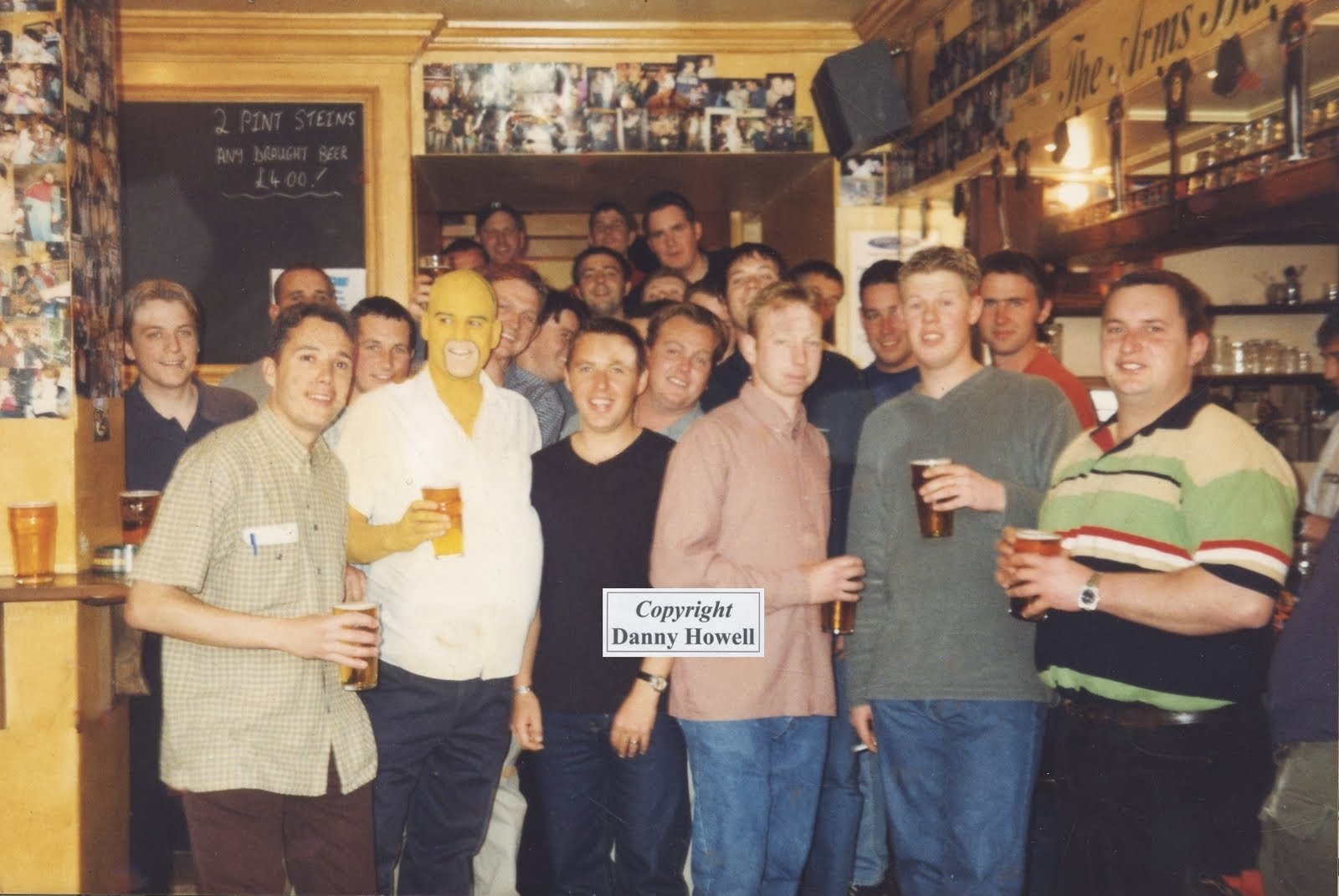
Celebrating Brett Ball’s Stag Night At The Weymouth Arms, Warminster

Brett Ball celebrated his stag night at the Weymouth Arms, Emwell Street, Warminster.

Among the revellers in the photo are: Brett Ball (in the guise of Homer Simpson); Steve Ball, Rowan King, Matthew Carpenter, Alex Marlowe, James Theobald, Mark Jones, Gary Lewis, Tony Casson, Mark Lowther, Mark Bryant, Che Paxton, Vincent Wright, Matthew Hutchins, Mark Harris, Alan Casson and Tony Sheppard.

Brett Ball married Lucy Eyres in June 1999.

William Edwin Brown ~ Warminster Watch And Clock Repairer

Two advertisements appear for William Edwin Brown in Coates Directory For Warminster And District 1922. The first refers to him as the proprietor of the Central Café at 34 Market Place, Warminster. The second shows him trading as a confectioner, tobacconist and seller of ices at the same address. A year later 34 Market Place was in the hands of Charles Edward Hill. This property, opposite the Town Hall, was later used by Parker’s Bakeries as a bread and cake shop until they moved to the Three Horseshoes Mall, Warminster. The shop was then used for selling long-playing records by Music Man in the 1980s but is now [1998] the offices of Independent Financial Services, with the re-numbered address of 15 Market Place.

On leaving the Market Place, Brown moved to 1 Boreham Terrace, Warminster, where he continued to trade as a watch and clock repairer. This three-storey house at the eastern end of the terrace now has the address 34 Boreham Road and was in recent years the home of the well-known Warminster dancing teacher Miss Gloria Sloper (died December 1995). It is now [1998] the home of Mark Gibbs.

An advertisement for William Brown at Boreham Terrace in the West Wilts Directory 1923 says he then had 32 years practical experience of watch and clock repairs. Brown is listed among the Warminster residents in the West Wilts Directory of 1926 but there is no mention of him as either a resident or a trader in Kelly’s Directory 1927. He does not appear in any further Warminster directories.