Friday 4th April 2003
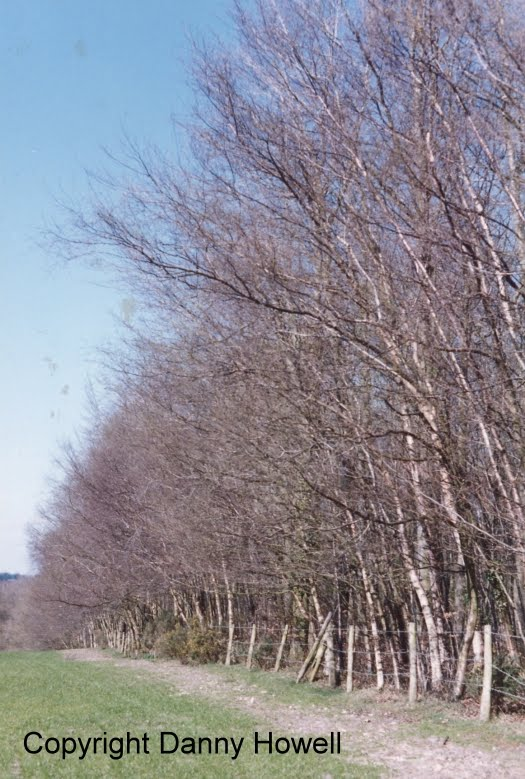
Silver birch trees on the western edge of Dertford Wood, Corsley. The field on the left is Norton Common,
part of High House Farm. The photograph was taken by Danny Howell on Friday 4th April 2003.
Friday 4th April 2003
Silver birch trees on the western edge of Dertford Wood, Corsley. The field on the left is Norton Common,
part of High House Farm. The photograph was taken by Danny Howell on Friday 4th April 2003.
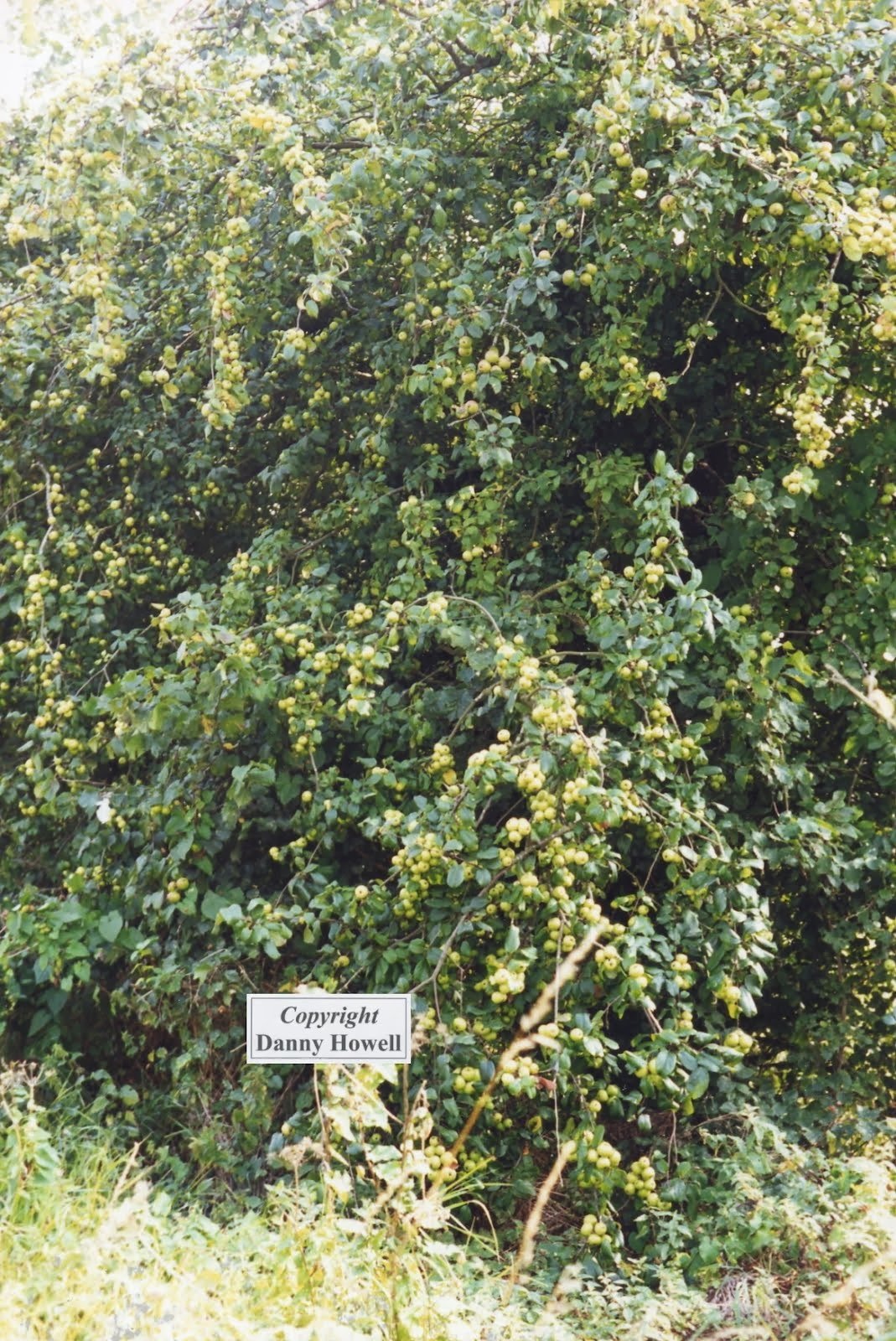
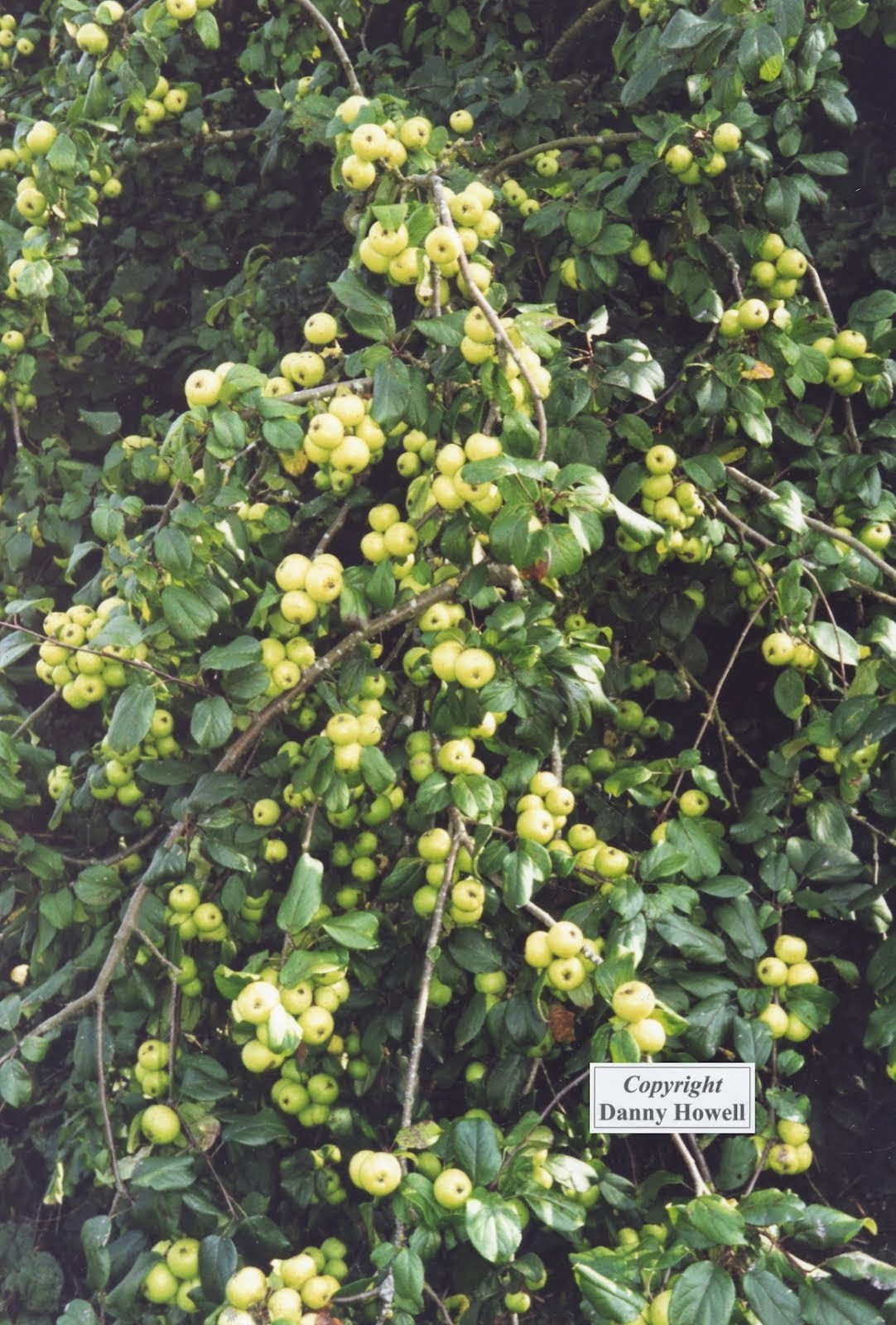
Crab apples weighing down the branches near the junction
of Mill Lane, Bishopstrow, with the B3414 road. They look tempting but taste bitter of course. The apples here usually go unpicked, only to fall on to the bank to be devoured by insects, birds and animals, while those apples that roll out into the road end up squashed under the tyres of passing vehicles.
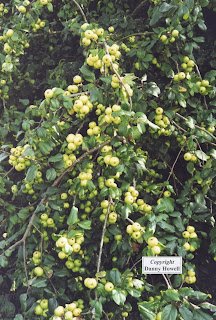
The photographs were taken by Danny Howell
on 22nd September 1998.
From the Wylye Valley Life magazine, Saturday 15th August 1987:
The Queen Mother’s Tree Again!
On August 4th was celebrated the Queen Mother’s 87th birthday. For the benefit of newcomers to the valley it seems worth recalling the tale of the Queen Mother’s tree. A letter appearing in one of the local papers prior to her eightieth suggested that a tree be planted in the town to honour the occasion. The idea appealed to the Warminster Town Council of the time. Wits and pencils were sharpened and to it they went.
I have no idea what attendance money is paid to a town councillor, and I doubt whether others do either or even much care, but the matter of the Queen Mother’s tree proved to be one of the most intractable problems undertaken in council. What sort of tree? Suppose it was vandalized? Ah, we’d all look silly then! And so on, proving how any simpleton can make a suggestion that wise heads take time to carry out.
In an effort to revive the council’s flagging hopes of success, a further letter appeared in one of the local papers, signed this time on behalf of the Warminster Civic Trust. (I must be careful here. I am a wholehearted supporter of the aims of the Trust and pay my annual subscription as I know all members do). A single tree to mark the event? queried the letter. Never! A single tree? No, let us do a deed worthy of the occasion. Not one tree but eighty – nothing less! We need an avenue of trees, one that will stretch from the Western Car Park to Weymouth Street. Boldness, imagination! Come on Warminster!
The Council caught its collective breath over this vision on the grand scale. Eighty trees! Pencils were re-sharpened, heads bent over the Council table, designs were drawn, considered, pronounced on, agonized over. Ah, the cost! Too expensive. Out of the question. Can’t be done. After the heady consideration of a whole avenue of trees, to plant a single sapling now seemed futile, even ludicrous, an idea to be abandoned.
Not entirely. One councillor more determined than the rest went ahead and planted a tree. But the place chosen was unfortunate, so out of the way that scarcely anyone knew of its whereabouts. Feeling itself inadequate, unwanted, unworthy of any plaque even, the tree grew depressed. It lingered on and then died. When I visited the spot recently I saw the dead tree had been removed, only its wooden support remained to record its shame.
Ma’am (if the Royal eye should ever light on these words) bear with us and forgive. We may yet do you justice. We have a bypass under construction, the result of more than eighteen years of struggle by our local member of Parliament, a specialist in foreign affairs, who found this one as stubborn as any he involved himself in, I mean in goading successive Secretaries of State for Transport to get the thing started. Wait until you are ninety. Ma’am, we beg you, and we could have planted along its ample margins an avenue of trees worthy of a Queen. And have room for ten more. The contractors (Alfred McAlpine) building the bypass might well co-operate and suggest where a minimum of 87 trees would look their best. I know of at least one local organisation whose patron is the Queen Mother and which would be proud to donate a tree. There could well be others who would wish to do the same. Yes, I bear in mind there may be other and better ideas. There is no monopoly in dreaming.
Contributed by Michael Joscelyne, Manor Gardens, Warminster.
Wednesday 2 April 1986
The pleasant avenue of beech trees at Corton Wheatsheaf, which form a nave over the back road through the Wylye Valley, particularly splendid as one enters Corton from the Tytherington direction, have unfortunately been ravaged by bark disease (not for the first time), and remedial action is currently taking place.
Forty trees here were felled seven or eight years ago (circa 1978), and a further 40 are being cut down now. The owner of the trees, Mr. William Witt, of Sundial Farm, Corton, says he is not sure how many trees will survive the current action but at least 30 are still standing.
The trees have offered welcome shelter to Mr. Witt’s other holding, Model Farm, on the bend of Corton Wheatsheaf, during some recent gales, and the loss of these beeches is now keenly felt. Two dozen young trees have been planted as replacements.
Mr. Witt, who has a herd of Friesian dairy cattle, has been farming at Corton for 54 years. He says he does not know how old the beech trees are at Corton Wheatsheaf Avenue but they had been planted far too close together. Some have grown too high, making 60 or 70 feet, instead of the usual 30 to 40 feet to be expected; growing narrow and tall instead of forming a wider shape had they been planted at a more suitable distance apart.
Sunday 24th May 1981
From a Nature Diary, writer unknown:
24th May [1981]. Went to Stourhead Gardens. Rhododendrons out & azaleas with their very strong perfume. The colours of some trees were amazing – not just red or gold but henna & red & mixture of all these. Bluebells were still out in abundance & primroses & Lady’s Smock (cuckoo flower). Though noticed red clover blooming on the way didn’t actually notice any in the Gardens. Goldilocks & Buttercups everywhere as were campion and speedwells. Found beautiful yellow pimpernel and saw not 3 feet away a tree creeper, quite oblivious to us, climbing in its creeping mouse like fashion up a large exotic tree. There was Tufted Ducks on the Lake and robins everywhere. Saw the Chinese Dove Tree (Handkerchief tree) in flower, really beautiful. Flowers are in fact tiny but these are hidden by snowy white bracts which look like doves or handkerchieves. Noticed stitchworts keeping flowered guard on exits, and yellow hammer nearby, hammered by our car. Rain kept off – just about.
Wilfred Middlebrook, in The Changing Face Of Warminster, first written in 1960, updated in 1971, noted:
A yew tree on the Salisbury road [between Bishopstrow and Norton Bavant] is said to have given shade or shelter to Oliver Cromwell while he breakfasted there on his way across the downs after the Battle Of Newbury, 1643.
The yew tree, known locally as Cromwell’s Yew, still stands hard by the main Salisbury road just outside the village. It may be tradition but legends die hard in the Wylye Valley. The Jew’s Wall at Longbridge Deverill is an example, with its metal reinforcements to ensure that the wall does not collapse and leave the way open to the fulfilment of the Jew’s curse – that the Thynne family would die out when the wall collapsed! Cromwell’s Yew, hated by farmers as a poisonous menace to cattle, is still given sanctuary in a corner of the field, in a tiny enclosure of barbed wire.
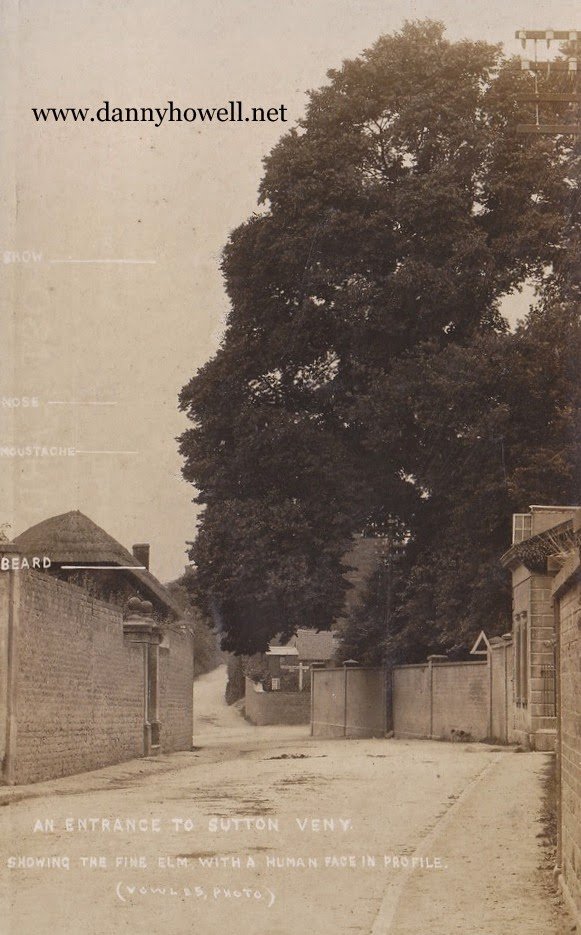
A picture postcard produced by Alfred Vowles showing the view west along Norton Road, Sutton Veny, from near the south lodge of Greenhill House (later renamed Sutton Veny House) looking towards the crossroads by the Woolpack.
Mr. Vowles, who was from Somerset, took many photographs of scenes in the Warminster area, particularly of the military  camps during the First World War. He usually penned a title for each scene he depicted and this card was no exception.
He titled it: ‘An entrance to Sutton Veny showing the fine elm with a human face in profile.’ The outline of a forehead, eyebrow, nose, moustache, mouth, chin and beard can be seen on the left side of the tree’s branches and foliage.
The photograph was taken in 1915.
The Reverend John Jeremiah Daniell, in his book The History Of Warminster, first published in 1879, noted:
Among the ancient forests of Britain, none was of much greater extent than the Forest of Selwood, called expressly COTT MAUR, or the Great Wood. Contracted as it was, century after century, yet Leland writes, temp. Henry VIII,
“The Forest of Selwood, as it is now, is a 30 miles in compace, and streatchith one way almost unto Warminster, and another way unto the quarters of Shaftesburie, by estimacion a 10 miles.”
It extended westward far into Somerset, then passed in a easterly direction round Chapmanslade to Westbury, skirted the foot of the Downs north and east of Warminster, and enclosing Black-Dog, Norridge, Longleat, Southleigh, and Eastleigh woods, reached its southern limit at Pensilwood [Pen Selwood], near Mere. Here were formerly to be seen, distinctly traceable, though now much overgrown with copse-wood, hundreds of hollows and excavated pits, covering an area of six or seven hundred acres, which with fair reason may be believed to be, as those at Hisomleigh, on the northern edge of the Forest, near Thoulston, and others more recently discovered and carefully examined, near Salisbury, subterranean habitations of the old Celtic tribes.
The woods above-named were no doubt a part of Selwood Forest. One portion is frequently mentioned in old deeds as “Warminster Wood.” A perambulation of the Forests of our Lord the King was made 28 Edward I, whereby it was ascertained that all the bailiwick of Selwood, which was in the county of Wilts was appropriated to the Forest after the coronation of King Henry, great grandfather of the then King, except the wood of Heghtreborn, and the wood of WERMYNSTRE, and the wood of Westbury, which were in the Forest. The office of Forester of Selwood remained with the Crown till Charles I empowered a Commission to disforest Selwood and disperse the deer, with reservation, as royalties, of one third of the woods, while another third was assigned to the Lords of the adjacent Manors, and another to those Commoners, who by ancient prescription, had acquired right of depasturing cattle on the open heaths of the Forest.
But the old country families, settled in or near the Forest, seem from ancient time to have exercisedthe privilege of hunting deer within its limits; and therefore when Sir John Thynne enclosed a large area for a deer park, and laid restrictions on the chase of deer, (although apparently some compromise had been offered for a supply of venison), on one occasion, in September, 1580, the principal gentlemen of the two counties into which Sir J. Thynne’s newly-granted lands extended, including Mr. Popham, the Queen’s Attorney, Sir Amyas Paulett, Sir Gen. Rogers, with representatives of the families of Wadham, Coles, Sydenham, Willoughby, Hopton, Horner, Leversedge, Colthurst, Smith, Daniell, Wynter, Chamberlayne, Gisborne, Player, and others, nearly a hundred in number, with forty dogs, entered the Park mounted, and proceeded to hunt. Hugh Stowe, the Head Keeper, boldly protested against the invasion of his master’s property, but, threatened by one of the chief hunters with personal assault, – “he told me,” writes Stowe to his master who was absent, – “that I should run the risk of his dogs if I durst deny him; that Somersetshire or elsewhere should be too hot for me, and that he would cuff me, or would cause who should do it;” and powerless to resist so formidable a body, the chase went on, and three bucks were killed.
The trees of Selwood were all Oak or Beech. The Elm is supposed not to be indigenous to Britain. But it has been remarked that this noble tree has gained for itself and its numerous congeners such a settlement in this country, that but for the plough and scythe, almost every valley and lowland of Wilts would become in fifty years as dense a forest as any that ever covered this Island.
From The Warminster Herald, Saturday 15 June 1872:
The largest tree on the Longleat estate, says a correspondent of the Garden, is an oak growing in a grove in the park; the dimensions are as follows: girth of stem at one foot from the ground, thirty-four feet; girth of stem five feet up, twenty-two feet; contents, upwards of 1,100 feet of timber.
From The Warminster Herald, Saturday 11 June 1870
It may interest some of your readers to know the dimensions of a very remarkable yew growing on the Marquis of Bath’s estate at Temple Farm, Corsley, Wilts: Height, 50 ft.; circumference of branches, 164 ft.; spread of branches from north to south, 53 ft.; and from east to west, 60 ft.; girth of stem at 1 ft. from the base, 32 ft.; smallest girth of stem, 24 ft. 7 in.; the stem at 7 ft. up branches into several limbs. The age of yew trees may be pretty nearly calculated by allowing one century for every foot in diameter of the stem; thus this grand old tree may be guessed at from ten to eleven hundred years old, and is healthy, growing, and in full foliage, forming a perfect cone in shape, and a lease of its life for another century or two might safely be taken. I should be glad to learn through the columns of Land And Water if any of your readers could give the dimensions of a larger yew than the one I have just recorded. George Berry, Longleat, May 3, 1870.