March 2023
According to the Longleat Forestry website, the number of recorded trees in Longleat commercial forest is 549,020.
www.longleatforestry.co.uk/visitor-info/about
Information and pictures about wildlife and nature.
March 2023
According to the Longleat Forestry website, the number of recorded trees in Longleat commercial forest is 549,020.
www.longleatforestry.co.uk/visitor-info/about
Monday 20th February 2023
Frome Town Council have announced:
On Wednesday 1 March 2023, Friends of the River Frome (FORF) and the Wild Trout Trust will be starting this year’s practical conservation work in Rodden Meadow, to improve habitat for birds, fish and insects as part of the TWIST (Transforming Waterways in Somerset Towns) project.
Historically, the trees along the river in Rodden Meadow were managed by rotational coppicing, but this has lapsed in recent years, so the river has now become too shaded, and even hidden from view. On this volunteer work day, the team will be:
Cutting back overhanging laurel bushes, and carefully thinning other bankside vegetation, to increase the amount of light that can reach the river, and open up better views of the waterway for local people.
Building a dead hedge, using trimmings from our willow pollarding work in October 2022, to create habitat for insects, birds and small mammals, as well as protecting part of the river bank from excessive erosion, and possibly preparing the area to be planted with pollen-rich native plants later this spring.
Planning future habitat improvement works to take place along the river in Rodden Meadow. This will include a small number of “tree kickers’; selected trees which will be carefully felled into the river to provide valuable complex habitat for many species, and securely tethered so they won’t wash away.
The overall Rodden Meadow Tree Plan can be found here.
The TWIST project is funded by the Environment Agency.
Monday 13th February 2023
Restoration Ecology have published a research article: New woodlands created adjacent to existing woodlands grow faster, taller and have higher structural diversity than isolated counterparts.
Abstract
Creating native woodland is a policy goal globally, and one strategy to maximize woodland creation benefits in limited space is to target efforts to extend existing woodlands. There is evidence to support spatially targeting habitat creation for biodiversity, however, there is little evidence of how this affects a habitat’s structural development. Here, a space-for-time study using light detection and ranging (LiDAR) data assesses how the structure of recently created woodlands, are affected by the presence of an adjacent older woodland. Recently created native woodlands were identified across the Isle of Wight UK using historical maps and satellite imagery. Canopy height and foliage height diversity were derived for all woodlands from LiDAR data collected at two different time points (2011 and 2021), and linear models were used to test for any differences in these structural metrics between sites with an adjacent older woodland, and those without. The percentage change in woodland height between the two time points was also tested. In woodlands created adjacent to older woodlands, canopy height was found to be higher by an average of nearly 2 m, and foliage height diversity was found to be on average 4.7% higher, using the 2021 data. Growth rates between 2011 and 2021 were not significantly different between the groups, although young adjacent woodlands grew the most on average. This research shows that creating woodlands adjacent to existing older woodlands reduces the time taken to create tall and to a lesser extent structurally diverse habitat, which may lead to early biodiversity benefits.
To read the full article, click on:
https://onlinelibrary.wiley.com/doi/10.1111/rec.13889#.Y_SivEm1Qw8.twitter
Saturday 4th February 2023
Grovelands Flora And Fauna @Grovelandssite has tweeted this wonderful photo:

Grey Heron on a roof top in Russett Court, Warminster, today. Probably surveying Grovelands for a fishing spot. Taken by Carolyn, 04/02/2023.
Wednesday 1st February 2023
An Environet map shows that there have been eight occurrences of Japanese knotweed in an area with a 4km radius in and around Warminster.
November 2022
Harriet James, of Sustainable Warminster’s Smallbrook Toad Patrol, has written the following report:
Since February [2022] Warminster’s Toad Patrollers have been recording and rescuing amphibians on Smallbrook Road.
Toads, frogs and newts are now safely hibernating on higher ground, so the patrollers have hung up their torches for the year. They have made 153 volunteer trips totalling 76 hours out on the road at night. 149 female toads, 1655 male toads, 53 frogs and 253 newts were recorded between February and October. Of these, 18% had been killed by cars.
This year the patrollers wore new printed hiviz jackets and put out reflective “Caution Toads Crossing’ signs for motorists during patrols. These were bought with a grant from the Wiltshire Wildlife Community Energy Fund. One of the patrollers’ fixed triangular toad warning signs was stolen and other vandalised, but these have been replaced or repaired.The patrollers are hopeful that the Town Council’s resolution to set up meeting with Wiltshire Council Highways will bear fruit. In April they asked the Council to discuss closing the road to vehicular traffic next Spring to turn it into a safer route for migrating toads as well as walkers, cyclists and horse riders.
Wednesday 29th September 2021
Warminster Town Councillor John Syme writes:
Wheelers Lane is a migratory route of toads from the north side to Smallbrook land. It is also an important area for bats. The loss of a mature hedge is detrimental to nesting birds some of which return each nesting season to the same nest. Help needed to monitor biodiversity in this sensitive area. I am not against development as long as it takes account of wildlife and habitats.
Wednesday 5th May 2021
Clare Hancock on the Facebook page of Sustainable Warminster writes:
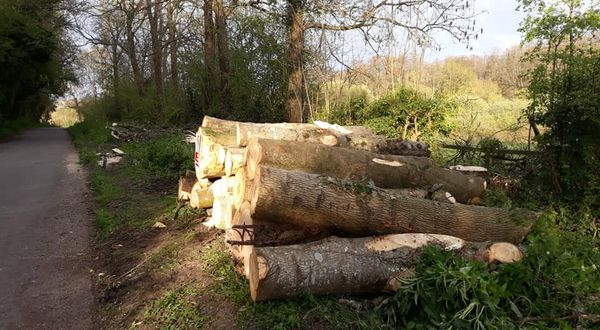
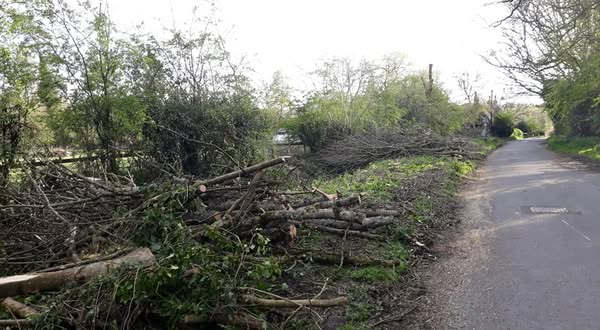
It’s so sad to see the line of ash trees being felled along Smallbrook Road [Warminster] due to Ash Dieback disease. On a national scale this will be devastating and catastrophic.
Tuesday 29th September 2020
Maggie & Steve Dettmar, Members of Sustainable Warminster, write:
Of more than 2,500 species of moth in the UK, 400 are macro moths and the rest are the more difficult micro. In comparison, there are only 60 butterflies – native and immigrant ones grouped into 19 families. Only five of these species of moths can damage clothes and carpets.
The life cycle starts as an egg, which then turns into larva (caterpillar) which can moult up to four times as it grows. It then becomes a pupae, which mostly over winters, and lives on twigs, dead trees and shrubs. A moth usually lives up to five weeks and the males’ sole purpose is to mate. The female will stay around its food source where she will lay her eggs. Two of the largest UK moths are the Clifden Nonpareil (41-48mm) and the Emperor Moth (35-41mm) sadly neither of which we have had in our garden.

Elephant Hawk Moth sitting happily on a piece of an egg carton.
All the traps for recording moths have a mercury vapour bulb but you can use a bright light with a white sheet. We have a Robinson’s trap, which we use approximately two to three times a month, never more than once a week as you are at risk of trapping the same moths. The best months for species and quantity are in the summer, with most of the beautiful hawk moths in June and July. There are only a few moths about in the winter.

Hawkmoth.
Encouraging moths to the garden with a wide variety of flowers and plants will also encourage other important insects, like butterflies and bees.
For identification, we use the Field Guide to the Moths of Great Britain and Ireland by Paul Waring and Martin Townsend, illustrated by Richard Lewington. It is not always easy to sex the moths without looking at their genitalia – this is beyond our ability! We keep a record of all we see and send the results to the Wiltshire Moth recorder, which we have been doing for the past five years. If we are in any doubt, there is always plenty of help at hand, including a very good Wiltshire Face Book Group.

Leopard Moth.
In total, we have seen 141 species of moth in our garden in Warminster.
It is a great hobby and amazing to see such beautiful creatures that usually stay hidden or only come out at night. More information can be acquired from Moths UK Web site and also the Butterfly Conservation.