Friday 4th April 2003
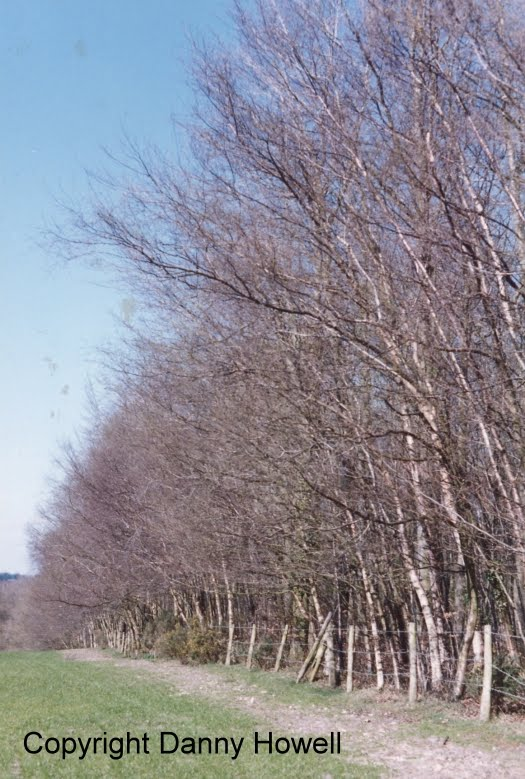
Silver birch trees on the western edge of Dertford Wood, Corsley. The field on the left is Norton Common,
part of High House Farm. The photograph was taken by Danny Howell on Friday 4th April 2003.
Information and pictures about wildlife and nature.
Friday 4th April 2003
Silver birch trees on the western edge of Dertford Wood, Corsley. The field on the left is Norton Common,
part of High House Farm. The photograph was taken by Danny Howell on Friday 4th April 2003.
From The Warminster And District Companion, Volume One, published in April 2003:
THE BUSTARD
Some notes by Danny Howell, John Daniell, and Richard Cope.
Danny Howell writes:
The Great Bustard (otis tarda) is the heaviest flying bird in the world, with the fully adult cock birds weighing more than 50 lbs. Extinct in Britain since the 1870s, it was until 1830 a common sight on Salisbury Plain, hence its depiction on the crest of Wiltshire County Council.
The Reverend John Jeremiah Daniell, in his History Of Warminster, published in 1879, noted:
“The Bustard might have been seen on Warminster Down about the year 1800. A man, on horseback, crossing the Plain to Tilshead, early on a morning in June, saw over his head a large bird; it alighted on the ground in front of his horse, which it seemed disposed to attack: he dismounted, and after nearly an hour’s struggle, secured it. It proved to be a Bustard, and was sold to Lord Temple for thirty guineas; it ate birds, mice, and almost any animal or vegetable food. About a fortnight after, a farmer returning from Warminster Market, was attacked in the same way, it is thought by the mate of the former bird; his horse being high-mettled, took fright, and became unmanageable, so that he could not capture the Bustard.”
An attempt was made in the 1970s to breed Great Bustards in captivity at Porton Down, with hopes of re-establishing them on the Plain, but this proved unsuccessful.
As this volume of The Warminster & District Companion was nearing completion it was announced in the press that a new attempt was going to be made to re-introduce the Great Bustard on to Salisbury Plain.
The Great Bustard Group, working in collaboration with the Zoological Society of London and Stirling University were planning to bring at least 25 Bustard chicks from Saratov in Russia, having obtained a licence from DEFRA (the Department of the Environment, Food and Rural Affairs) after four year’s preliminary work. Six Russian experts were due to arrive on Friday 18th April 2003, and would be staying, rather appropriately, at the Bustard Inn, near Rollestone. As well as concentrating on the all-important avian matters, the experts were hoping to visit Stonehenge Ales, at Netheravon, to try a pint or two of Great Bustard beer.
The new project has been heralded as part of an effort to restoring a grassland corridor across Europe for the birds. The new chicks have been hatched from eggs removed from fields where they would have been destroyed by the use of agricultural machinery. Following quarantine precautions, the birds would be acclimatised in a release pen, prior to being let free on to the Plain. Human contact would be minimised.
The hope has been expressed that the project, if successful this time, could attract more visitors to Wiltshire, thus adding to the local income for those in the tourist trade.
The Warminster & Wylye Valley Society For Local Study wishes the new project well, and by way of celebrating this initiative, shares the following article with readers and interested individuals. It was originally included in Richard Cope’s Complete Natural History (compiled from the works of Buffon, Goldsmith, Cuvier, Shaw, Vaillant, “The Bustard is the largest native land-bird in Britain. It was once much more numerous than it is at present; but the increased cultivation of the country, and the extreme delicacy of its flesh, has greatly thinned the species; so that a time may come when it may be doubted whether so large a bird was ever bred among us. It is probable, that long before this the bustard would have been extirpated, but for its peculiar manner of feeding. Had it continued to seek shelter among our woods, in proportion as they were cut down, it must have been destroyed. If in the forest, the fowler might approach it without being seen; and the bird from its size, would be too great a mark to be easily missed. But it only inhabits the open and extensive plain, where its food is to be found in abundance, and where every invader may be seen at a distance.
The bustard is much larger than the turkey, the male generally weighing from twenty-five to twenty-seven pounds. The neck is a foot long, and the legs a foot and a half. The wings are not proportionable to the rest of the body, being four feet from the tip of the one to the other; for which reason the bird flies with great difficulty. The head and neck of the male are ash-coloured; the back is barred transversely with black, bright, and rust colour. The greater quill feathers are black; the belly white; and the tail, which consists of twenty feathers, is marked with broad black bars.
These birds are frequently seen in flocks of fifty or more, in the extensive downs of Salisbury Plain, in the heaths of Sussex and Cambridgeshire, the Dorsetshire uplands, and even as far north as East Lothian in Scotland. In those extensive plains, where there are neither woods nor hedges to screen the sportsman, the bustards enjoy an indolent security. Their food is composed of the berries that grow among the heath, and the large earth-worms that appear in great quantities on the downs before sunrise in summer. In vain does the fowler creep forward to approach them; they have always sentinels placed at proper eminences, which are ever on the watch, and warn the flock of the smallest appearance of danger. All, therefore, that is left the sportsman, is the comfortless view of their distant security. He may wish, but they are in safety.
It sometimes happens that these birds, though they are seldom shot by the gun, are often run down by greyhounds. As they are voracious and greedy, they often sacrifice their safety to their appetite, and over-feed themselves to such an extent, that they are unable to fly without great preparation. When the greyhound, therefore, comes within a certain distance, the bustard runs off flapping its wings, and endeavouring to gather air enough under them to rise; in the mean time, the enemy approaches nearer and nearer, till it is too late for the bird even to think of obtaining safety by flight; for just at the rise there is always time lost, and of this the bird is sensible; it continues therefore, on foot until it has got a sufficient distance before the dog to allow it to prepare for flight, or until it is taken.
As there are few places where they can at once find proper food and security, so they generally continue near their old haunts, seldom wandering above twenty or thirty miles from home. As their food is replete with moisture, it enables them to live upon these dry plains, where there are scarcely any springs of water, a long time without drinking. Besides this, nature has provided the males with an admirable magazine for their security against thirst. This is a pouch, the entrance to which lies immediately under the tongue; it is capable of holding nearly seven quarts of water. This is probably filled upon proper occasions, to supply the hen when sitting, or the young before they fly.
Like all other birds of the poultry kind, they change their mates at the season of incubation, which is about the latter end of summer. They separate in pairs if there be a sufficiency of females for the males; but when this happens to be otherwise, the males fight until one of them falls. In France, some of these victims to gallantry are often found dead in the fields, and no doubt the finders are not displeased at the occasion.
They make their nests upon the ground, merely scraping a hole in the earth, and sometimes lining it with a little long grass or straw. There they lay two eggs only, almost the size of those of a goose, of a pale olive brown, marked with spots of a darker colour. They hatch in about five weeks, and the young ones run about as soon as they are out of the shell.
The bustards assemble in flocks in the month of October, and keep together till April. In winter as their food becomes scarce, they support themselves indiscriminately, by feeding on moles, mice, and even little birds, when they can seize them. For want of other food, they are contented to live upon turnip leaves, and such little succulent vegetables. In some parts of Switzerland, they are found frozen in the fields in severe weather, but when taken to a warm place, they again recover. They usually live fifteen years, and are incapable of being propagated in a domestic state, as they probably want that food which best agrees with their appetite.”
The Bustard as illustrated in Complete Natural History compiled by Richard Cope LL.D., F.A.S. 1840.
The Great Bustard s depicted on the crest of Wiltshire County Council.
Saturday 18th September 1999
A little monkey which had escaped from Longleat was shot and killed in the Lake Pleasure Grounds (Town Park), Warminster, this afternoon, Saturday 18th September 1999.
It seems death by rifle bullet was necessary “amid fears for public safety”.
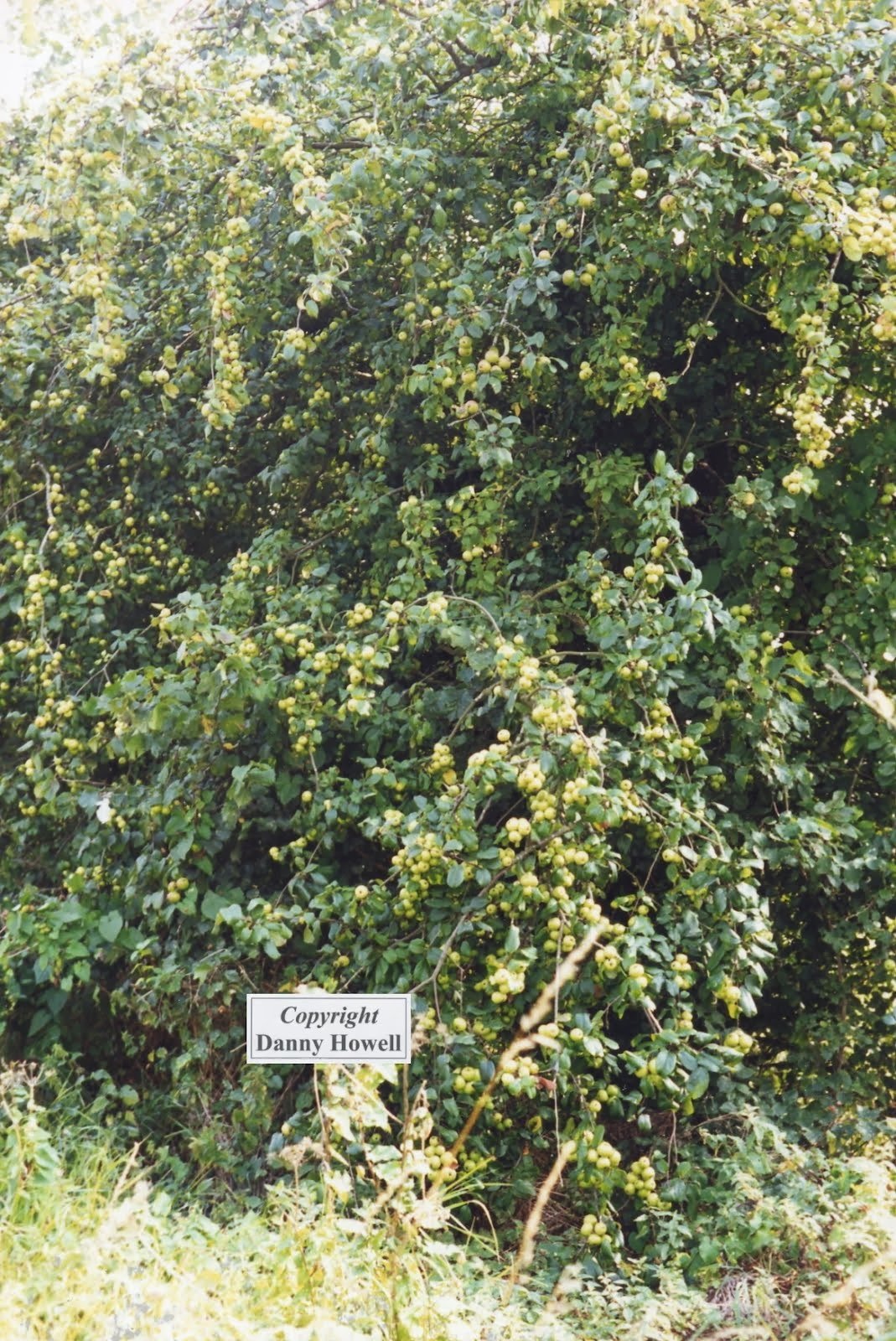
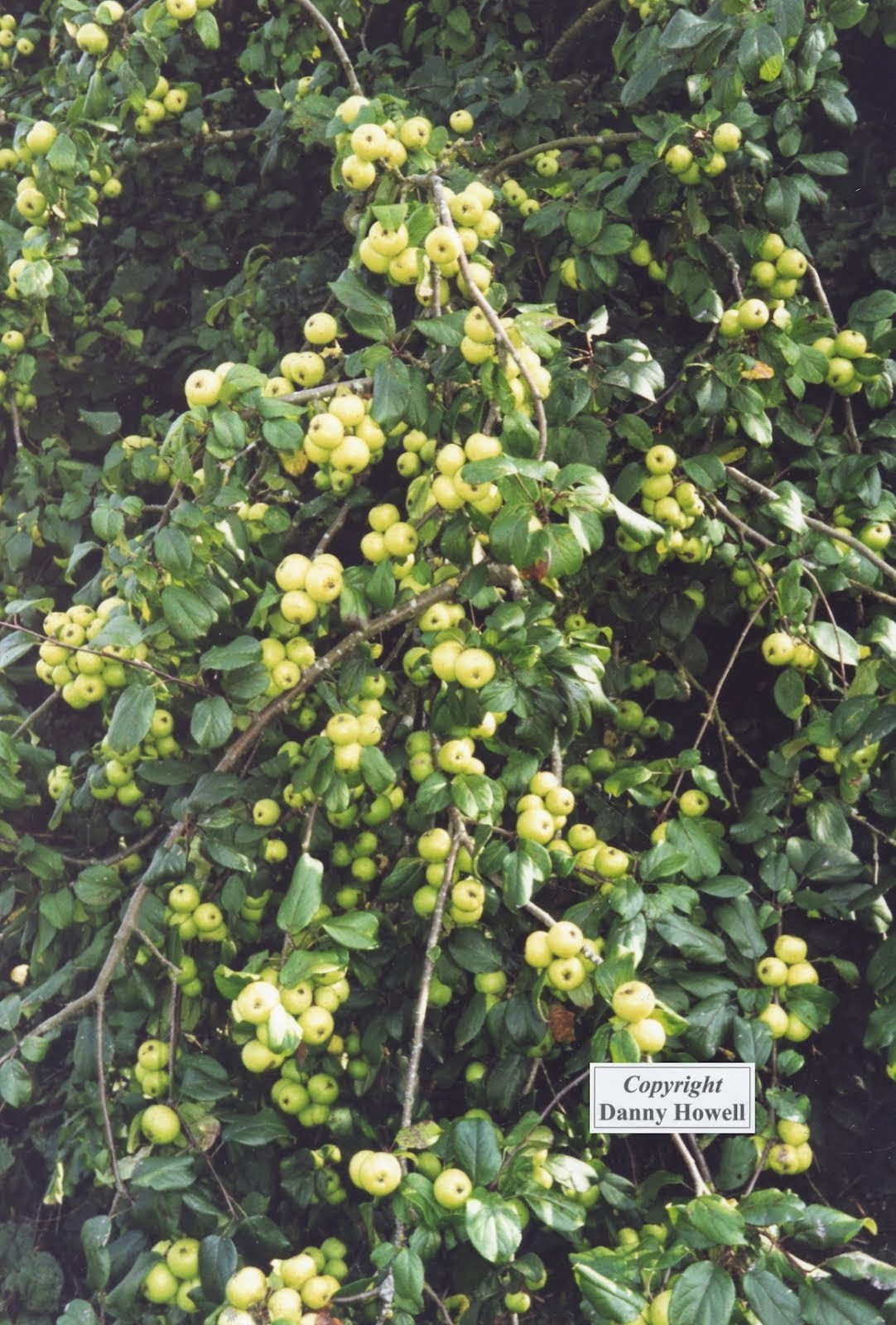
Crab apples weighing down the branches near the junction
of Mill Lane, Bishopstrow, with the B3414 road. They look tempting but taste bitter of course. The apples here usually go unpicked, only to fall on to the bank to be devoured by insects, birds and animals, while those apples that roll out into the road end up squashed under the tyres of passing vehicles.
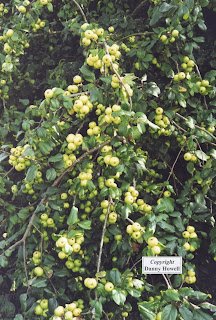
The photographs were taken by Danny Howell
on 22nd September 1998.
From the Wylye Valley Life magazine, Saturday 15th August 1987:
The Queen Mother’s Tree Again!
On August 4th was celebrated the Queen Mother’s 87th birthday. For the benefit of newcomers to the valley it seems worth recalling the tale of the Queen Mother’s tree. A letter appearing in one of the local papers prior to her eightieth suggested that a tree be planted in the town to honour the occasion. The idea appealed to the Warminster Town Council of the time. Wits and pencils were sharpened and to it they went.
I have no idea what attendance money is paid to a town councillor, and I doubt whether others do either or even much care, but the matter of the Queen Mother’s tree proved to be one of the most intractable problems undertaken in council. What sort of tree? Suppose it was vandalized? Ah, we’d all look silly then! And so on, proving how any simpleton can make a suggestion that wise heads take time to carry out.
In an effort to revive the council’s flagging hopes of success, a further letter appeared in one of the local papers, signed this time on behalf of the Warminster Civic Trust. (I must be careful here. I am a wholehearted supporter of the aims of the Trust and pay my annual subscription as I know all members do). A single tree to mark the event? queried the letter. Never! A single tree? No, let us do a deed worthy of the occasion. Not one tree but eighty – nothing less! We need an avenue of trees, one that will stretch from the Western Car Park to Weymouth Street. Boldness, imagination! Come on Warminster!
The Council caught its collective breath over this vision on the grand scale. Eighty trees! Pencils were re-sharpened, heads bent over the Council table, designs were drawn, considered, pronounced on, agonized over. Ah, the cost! Too expensive. Out of the question. Can’t be done. After the heady consideration of a whole avenue of trees, to plant a single sapling now seemed futile, even ludicrous, an idea to be abandoned.
Not entirely. One councillor more determined than the rest went ahead and planted a tree. But the place chosen was unfortunate, so out of the way that scarcely anyone knew of its whereabouts. Feeling itself inadequate, unwanted, unworthy of any plaque even, the tree grew depressed. It lingered on and then died. When I visited the spot recently I saw the dead tree had been removed, only its wooden support remained to record its shame.
Ma’am (if the Royal eye should ever light on these words) bear with us and forgive. We may yet do you justice. We have a bypass under construction, the result of more than eighteen years of struggle by our local member of Parliament, a specialist in foreign affairs, who found this one as stubborn as any he involved himself in, I mean in goading successive Secretaries of State for Transport to get the thing started. Wait until you are ninety. Ma’am, we beg you, and we could have planted along its ample margins an avenue of trees worthy of a Queen. And have room for ten more. The contractors (Alfred McAlpine) building the bypass might well co-operate and suggest where a minimum of 87 trees would look their best. I know of at least one local organisation whose patron is the Queen Mother and which would be proud to donate a tree. There could well be others who would wish to do the same. Yes, I bear in mind there may be other and better ideas. There is no monopoly in dreaming.
Contributed by Michael Joscelyne, Manor Gardens, Warminster.
Ron Fear (born 22 July 1912), in a tape-recorded interview made by Danny Howell, on 4th April 1986 (transcribed extracts of which were published in Remember Warminster Volume Three, by Danny Howell), said:
“When you used to go along the Crockerton road you would come to a very sharp turn on the right. My uncle George Titford used to go out there every spring to see a white blackbird. He would make a point of doing that. He went out there every year. This is 50 years ago. Once he’d seen that white blackbird he’d be happy until the next year. Somebody would say “Where’s going then George?’ He’d say “I’m going out to Emmet Lane.’ That’s what they called it, Emmet Lane. Why it’s called that I don’t know. It’s past the farm, what was Mr Greening’s farm, about a hundred yards further on and you go round a sharp corner. I think it’s all been altered now. They’ve done the new A350 road.”
Wednesday 2 April 1986
The pleasant avenue of beech trees at Corton Wheatsheaf, which form a nave over the back road through the Wylye Valley, particularly splendid as one enters Corton from the Tytherington direction, have unfortunately been ravaged by bark disease (not for the first time), and remedial action is currently taking place.
Forty trees here were felled seven or eight years ago (circa 1978), and a further 40 are being cut down now. The owner of the trees, Mr. William Witt, of Sundial Farm, Corton, says he is not sure how many trees will survive the current action but at least 30 are still standing.
The trees have offered welcome shelter to Mr. Witt’s other holding, Model Farm, on the bend of Corton Wheatsheaf, during some recent gales, and the loss of these beeches is now keenly felt. Two dozen young trees have been planted as replacements.
Mr. Witt, who has a herd of Friesian dairy cattle, has been farming at Corton for 54 years. He says he does not know how old the beech trees are at Corton Wheatsheaf Avenue but they had been planted far too close together. Some have grown too high, making 60 or 70 feet, instead of the usual 30 to 40 feet to be expected; growing narrow and tall instead of forming a wider shape had they been planted at a more suitable distance apart.
From the Wylye Valley Life magazine, Friday 5 April 1985:
Danny Howell writes:
Robin’s Nest
A couple of times last week when I went to get the car out of the garage, I found a bird flying about inside. As I went in, the bird would fly out, fluttering so fast that I was unable to recognise what species it was, except that it was smaller than a blackbird and bigger than a wren.
Nothing unusual about that, or so I thought, especially when you take into consideration the fact that the garage has an open doorway on its north-facing side that allows birds to fly in and out at their own free will.
However, when it happens that every time you go in, a bird flys out, it calls for a little ornithological Sherlock Holmes investigating. And that’s exactly what I did.
I stood in a corner, keeping still, and waited for our feathered friend to return. And she did, quite quickly. She flew up from the lawn, with some bits of dead and dried hedge trimmings in her beak, and perched upon a rung of the trellis work that supports the porch around the garage doorway. She sat there for a moment, looking at me, turning her head slightly to one side, with her red breast shining. She tipped her head from side to side a couple of times, looking at me inquisitively, as if to say “What are you doing in my garage?”
Then she flew into the north-west corner of the garage and into a little cardboard box hidden behind an old battery-charger and some wood, stacked out of the way with some old newspapers, about four or five feet above the garage floor.
Then she flew out of the garage with her beak empty and then returned a little while later with some more bits of hedge-trimmings; and then again and again.
She was, of course, a robin building her nest, choosing the comforts of my garage to lay her eggs and rear her young ones. Robins are notorious for nesting in garden sheds and open outbuildings, and often pick old kettles, saucepans and discarded teapots as likely places to nurture their broods. The robin in my garage is obviously no exception. Strangely enough, on the exterior side of the wall where she is nesting, there is a little wooden birdbox, specially made and erected a few years ago to encourage the birds to nest in my garden. Lady Robin Redbreast has decided to ignore my provided home and opted for her own chosen place to go about maternal matters.
Although they are known as redbreasts, the throat, chest and forehead are in fact more of a bright orange, while the upper-parts are olive brown and the under-parts are whitish. They are resident in this country and both sexes are similar in appearance but it is the female that takes the task of incubating the eggs.
The breeding season usually begins in late March in the south and is later, sometimes into July, in the north. The nest is lined with dead leaves, moss, wool and hair. Each clutch consists of five to six eggs which are white with red or sometimes sandy blotches and spots. Incubation takes twelve to fifteen days and the young birds leave the nest after about two weeks. Often, two broods in quick succession are reared.
It looks like for the next few weeks a certain corner of my garage is going to be out of bounds, and the use of the battery-charger is definitely going to be out of the question. Not only that, I’m going to have to keep a watchful eye on my cat – otherwise he’s going to be keeping more than a watchful eye on something else!
Wednesday 20th March 1985
Danny Howell writes:
Toad In The Hole
The recent nationwide news and publicity given to toads and also to frogs as they head once more to their spawning ponds at this time of year, has prompted me to ponder upon that old and much maligned creature, the toad.
Maligned because he is often the subject of derision when some of us scold people with phrases as “you lying toad, you” or “he’s such a miserable toad”. Such terms are most likely due to toad’s somewhat unsightly appearance; he’s usually sporting more than a few warts and the fact he secretes a poisonous substance in his skin to protect himself from one or two would-be predators. This defence is not totally successful; some birds like the heron and the crow have no problems with this, they disembowel them, and the brown rat resolves the situation by skinning his toad meal.
This curiosity was mentioned by the late Rev. Gilbert White in a letter he wrote on June 18th, 1768, that was included in his “Natural History of Selborne’ published in 1860.
He wrote: “It is strange that the matter with regard to the venom of toads has not been settled. That they are not noxious to some animals is plain; for ducks, buzzards, owls, stone curlews, and snakes, eat them, to my knowledge with impunity. And I well remember the time, but was not an eye-witness to the fact (though numbers of persons were), when a quack at this village ate a toad to make the country people stare; afterwards he drank oil. I have been informed also, from undoubted authority, that some ladies (ladies, you will say, of peculiar taste) took a fancy to a toad, which they nourished, summer after summer for many years till he grew to a monstrous size, with the maggots, which turn to flesh flies. The reptile used to come forth every evening from a hole under the garden steps; and was taken up, after supper, on the table to be fed. But at last a tame raven, kenning him as he put forth his head, gave him such a severe stroke with his horny beak as he put out one eye. After this accident, the creature languished for some time and died.”
The fact that toads feed upon maggots and insects including caterpillars, woodlice, ants and many other pests including snails and slugs, make them particularly beneficial to gardeners, who never seem to mind the presence of a toad in their garden or greenhouse. A toad will often study its prey for several seconds before sticking out his tongue to capture his dinner. The move takes about one tenth of a second!
In the British Isles there are two species of toad. The Natterjack Toad has yellow-green to olive-grey colouring, with brown and red markings, and it is rarely seen in our part of the country. Unlike the Common Toad, which is muddy brown, olive or grey in colour, and is found throughout England, Scotland, parts of Wales and Ireland. The Natterjack is smaller than the Common toad and has larger and flatter warts on his skin.
Toads hibernate in October and November, choosing holes in the ground, and emerge in late March and April to head for their breeding pond. They use the same pond as the one they were born in themselves and will pass other ponds and ditches en route when travelling to their birthplace-spawning site. This migration can take ten days and they often stay on the move both day and night until they reach their destination. Many are often killed when crossing roads; hence the recent publicity and the help that some nature lovers and organised groups are now giving to see that the toads now cross the roads safely in their trek to the spawning pond. Strangely enough, although they can swim and use ponds to breed, they spend most of their lives on land, living in holes beneath tree roots or under hedges.
John Aubrey, who is credited with the discovery of the stone circle at Avebury in December 1684, mentioned a toad in a tree in his “Natural History of Wiltshire,’ that was first published in 1847. He noted: “Toades are plentifull in North Wiltshire; but few in the chalke countreys. In sawing of an ash 2 foot + square, of Mr. Saintlowe’s, at Knighton in Chalke parish, was found a live toade about 1656; the sawe cutt him asunder, and the bloud came on the under-sawyer’s hand; he thought at first the upper-sawyer had cutt his hand. Toades are oftentimes found in the milstones of Darbyshire.”
And so to another curiosity! Toads that have been found alive in blocks of limestone without any visible openings to the outside world.
One of the first recorded of such discoveries was in 1579 by a French scientist called Ambroise Pare.
Another instance was at Westmorland in 1832 and was described in a letter to “The Gentleman’s Magazine,’ as follows: “We the undersigned John Stockdale, Thomas Steel, John Mason and Michael Steel, of Brough, in the county of Westmorland, masons and quarrymen, do hereby solemnly make an oath, that on the 25th day of July 1832, being employed on Stainmoor, about three miles from Brough, at a place called Little Raize, preparing blocks of stone for re-building a public highway called the Bayside, adjoining the river which runs through Brough, commonly called Brough Beck, were astonished on splitting a large block of more than a ton weight, by a lively yellow toad springing out of a cavity in the centre of the said solid rock, where it had been as closely embedded as a watch in its outer case, without any communication with the surface greater than eight inches. The said toad was taken up by us, when it discharged a considerable quantity of black fluid; it was safely conveyed to Brough and given to Mr. Rummey, jun., Surgeon, in whose possession it now continues in a lively state.”
Another case, more closer to home, was recorded by the Rev. John J. Daniell in his book “The History of Warminster‘.
He wrote: “In the month of August 1816, as some workmen were quarrying stone on the east side of the town, near the garden of Mr. John Daniell, on the Boreham Road, they discovered in the middle of a stratum of sandstone, a live toad and a newt. The interior of the shell in which they were found was perfectly smooth, without the least aperture, and at least nine feet below the surface. On their being exposed to the air the colour of both animals altered, and life for a few minutes seemed suspended. They revived, and lived for about four hours, exhibiting occasionally symptoms of pain, and convulsive motions about the throat. Their mouths seemed to be firmly closed, in so much that on being immersed in alcohol though producing violent strugglings, they did not open them, being closed with a kind of glutinous matter. How long they might have lived cannot be known but probably not long, as during the first four hours they continued torpid.”
All of this, of course, poses the question: how did the toads (and the newt for that matter) get inside such stones and how could they live trapped inside. It is most likely that with the coming of winter, the toad hides itself away for hibnernation by crawling into a crack in a block of limestone. While inside, drops of water dripping on the stone become mixed with dissolved calcium carbonate, which seal the toad in its prison cell. Toads, like snakes, are cold-blooded creatures and can live for a few years off the fat reserves under their skin, burning energy slowly while they are inactive during hibernation. Obviously, there must be a limit to how long they can survive in this way; and those that have been discovered so by workmen splitting such rocks, were within their limits for survival in this way.
Sunday 31st May 1981
From a Nature Diary, writer unknown:
31st May [1981]. Lovely walk along Warminster lanes with John. The boys and I had a fight with sticky willy. Saw first fly-catcher of the year. Lovely river and river beds. Heard Whitethroat & willow warbler.
sticky willy = Galium aparine, also known locally as cleavers and goosegrass.