During September and October 1993, Danny Howell (Assistant Curator) and Glenn Head (Projects Officer), at the Dewey Museum, Warminster, presented an exhibition called Yanks In Town, marking the 50th anniversary of the time when American soldiers arrived in Warminster for training on Imber ranges. The following notes were featured in the exhibition:
From 1943 onwards, American troops were billeted throughout the town at East Street, Market Place, the Old Brewery at High Street, Craven House at Silver Street, and St Boniface College at Church Street – to name but a few of the billets.
The REME Workshops at Beggars Bush, east of Imber Road, became Depot 642 for the U.S. Ordnance Corps until 1945 when they were handed back (later becoming 27 Command Workshop, REME).
Prestbury House, on the Boreham Road, was used as an American Red Cross Service Club, “to do everything possible for our cousins from overseas, to make them less conscious of the fact that they are many miles from home.â€
The Club was informally opened on Thursday 11 November 1943, and featured a snack bar, lounge, reading room and games area.
The social side was under the direction of Miss Ruth Hauck, a vivacious little brunette from Pennsylvania. The manager of the Club was John Sullivan.
The Yanks had plenty of everything from sweets and cigarettes to groceries and nylons, which made them very popular with local people.
Warminster children soon found themselves invited to parties, including the annual Christmas treat at the Depot Ordnance Theatre at the Recreation Centre in Woodcock Road (near Boreham Camp).
Each child was collected and personally escorted to and from the “smashing show†by an American soldier from 642 Depot, by kind invitation of 1st Lieutenant James Hildebrandt.
The influx of G.I.’s also provided a boost to the local dance scene. It was reported that by September 1944 over 600 British women had married American soldiers. No surprise then that some local lasses became G.I. brides.
Among them were Joyce Bigwood who married Charles Warner Osler; Alma Burrage (Ernest Bonner); Pearl Andrews (Horace Haynes); Vera Holton (Albert Foley); Margaret Hodge (Joseph Shingle); and Peggy Payne of the Angel Inn, Upton Scudamore (John Alexander Zook).
Several well-known names came to Warminster to visit the American boys.
Filmstar James Cagney, of Yankee-Doodle-Dandy fame, stayed at the Bath Arms, in the Market Place, in February 1944, during a tour of U.S. bases and hospitals.
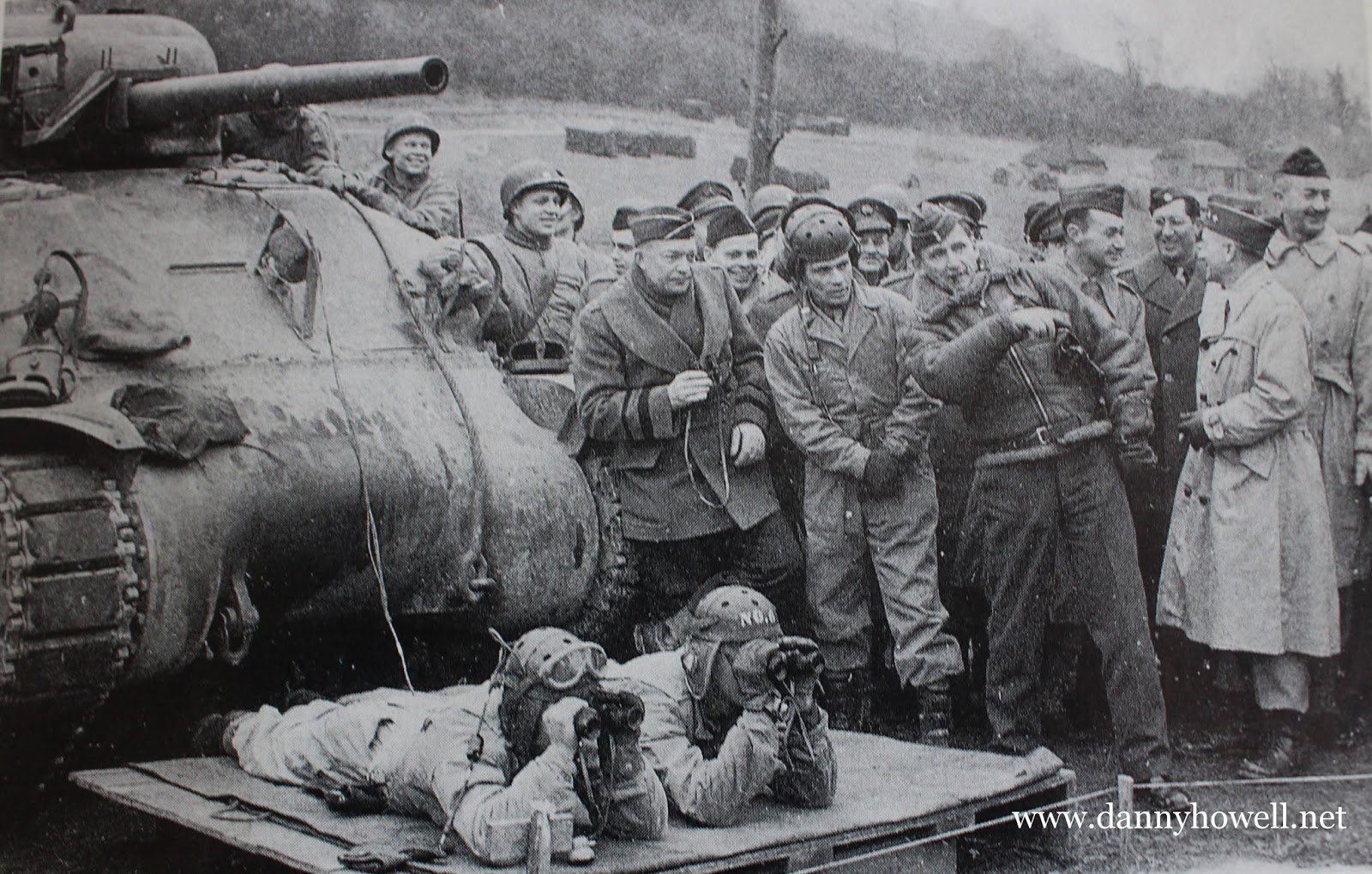
General Eisenhower and Air Chief Marshal Arthur Tedder also visited Warminster in February 1944, to observe members of the U.S. 33rd Armoured Division firing Sherman tanks on Warminster Ranges.
The world heavyweight boxing champ Joe Louis, nicknamed the Brown Bomber, then a serving American G.I., performed a demonstration bout of pugilism on the playing field at Lord Weymouth’s Grammar School.
There were other Americans making the news too. One American soldier shot and killed one of his fellow G.I.s on Copheap during the autumn of 1944, which resulted in much speculation and rumour around the town. This sensational incident was referred to at a U.S. Court Martial in March 1945, when the fantastic career of Private Malcolm Thornley, one of America’s most notorious prison-breakers, was brought to an end with a sentence of life imprisonment. Thornley’s ‘wanted’ picture was displayed at Warminster Police Station and all U.S. Military Depots throughout England. He was found guilty of desertion, theft of Army motor vehicles, theft of 39,000 francs, refusing to surrender his weapon to an officer, twice breaking out of military confinement, and taking liberties with a child. He was found not guilty of another charge – rape.
A more lasting reminder of the sojourn in Warminster by U.S. Military Forces was the planting of an oak tree next to the Swan River [The Were] in the Lake Pleasure Grounds on Sunday 7 January 1945. Present at the ceremony were an American Army Guard; Colonel Haffner; an Army Cadet Company under Captain E.G. Williams; the Warminster A.T.C. under Pilot Officer Roy Low; and members of the Warminster Urban District Council, including its chairman Algy Dart. Mr. Dart said: “The present generation would remember the fact that the American nation had helped us during the last war, but the period was much shorter than in this war. The friendships made would always be remembered, and the associations between the Americans and the townspeople had been most cordial.†Colonel Haffner replied by thanking the public of Warminster for their hospitality during their stay in the town. He said his colleagues had been most happy, and the memories would remain.â€