Sharing Local Knowledge About Warminster And District
Category: Military
Information and pictures about the military in Warminster and district including The Tank Barracks, The School Of Infantry, The Land Warfare Centre, Boreham Barracks, Battlesbury Barracks, Knook Camp, Sutton Veny, Boyton and Corton, Codford, Longbridge Deverill, Salisbury Plain, etc.
The Local Walks page on the Warminster Town Council website includes:
Copheap Copheap, the hill closest to Warminster, just north of the town, was purchased by the Warminster Urban District Council and soon afterwards it was agreed at a public meeting in 1947 that it should become a war memorial for the town. The purchase price was met by public subscription.
Members of the R.A. and Old Comrades associations constructed the Path of Remembrance from Copheap Lane to the base of the hill, with regimental badges being incorporated into the walls at the lower end of the path.
A lych gate at the entrance to Copheap is inscribed: “As an everlasting tribute of pride and gratitude to the sons of Warminster who gave their lives in the great World Wars this archway was constructed and Copheap preserved for the perpetual use and enjoyment of all.”
Quick Facts: Steep walk leads to a barrow on the top. The uphill walk, leading though a Memorial Lych Gate. The wood is surrounded by chalk grassland owned by the MOD.
Landmarc and the Defence Infrastructure Organisation (DIO) have opened a new footbridge between the North and South areas of Knook Camp on Salisbury Plain to create a safe pedestrian route across the B390 main arterial road, which connects Shrewton to the A36.
Knook Camp training camp is split into north and south areas that sit either side of the B390. It is used throughout the year by the regular army and the cadet force with capacity for some 720 exercising soldiers across the two locations.
The B390 is a busy road so, to prioritise the overall safety of local road users, employees and visiting units, a new pedestrian footbridge has been installed to enable safer transit between the two camps.
Lt Col Tim Jalland, Commander South West Defence Training Estate for Defence Infrastructure Organisation (DIO) said, “The safety of estate users and our local communities is our absolute priority.
“Previously, local Army Cadet Forces have not been able to fully utilise Knook’s northern Camp due to safety issues linked to crossing the busy road, affecting training objectives. The new footbridge will now enable safe transit, allowing cadets and other Training Estate users to fully utilise both sides of the camp and the training areas on the north side of the Plain, whilst also protecting local road users.”
Robert Johns, Project Manager at Landmarc, added, “After some research, it was decided that installing a pedestrian footbridge would be the best way to provide safe passage for all those using the camps, which includes not only military training users but also Landmarc and DIO employees and local contractors. The benefit of a footbridge is that it completely removes the risk by separating pedestrians from road users, enabling them to cross safely without slowing down the traffic, which can also cause collisions.
“We have also future-proofed the camp by installing brackets along the bridge to carry trunking for various utility services. This means that if there’s a need for any future work to link the two camps, we won’t need to close the road to dig the appropriate trenches.”
Knook Camp’s southern site is located within the Cranbourne Chase Area of Outstanding Natural Beauty (AONB), so the project team worked closely with the Cranbourne Chase AONB Board to ensure the design of the bridge complemented the local environment. Visual impact assessments from a range of different angles were a critical part of the process to ensure the design of the new bridge does not detract from the overall beauty of the area.
The new footbridge is also one of a number of recent improvements to the camp, which has received 10 new carbon-negative accommodation facilities through the Ministry of Defence’s Net-Zero Carbon Accommodation Programme (NetCAP).
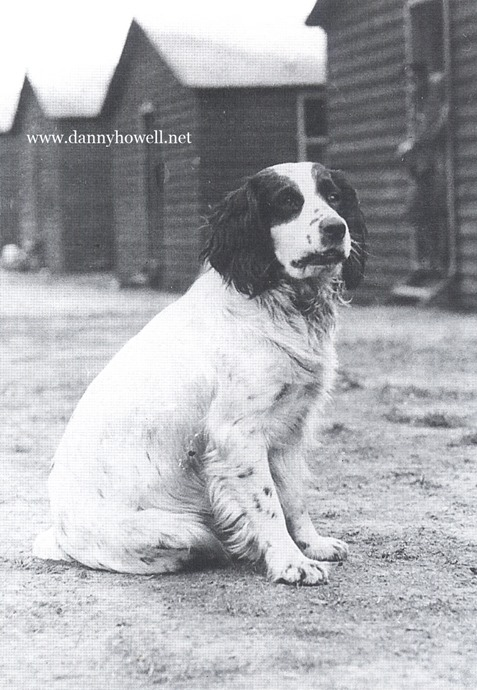
For all the dog-lovers out there, here’s a photograph taken about 104 years ago by S.J. Vowles whose images of military scenes in Warminster and in the army camps around the district during the First World War appeared on many (now very collectable) postcards. But the subject of this photograph is not a soldier, at least not a human one. It portrays Pongo, the much-loved mascot of the 7th Wiltshire Regiment, recorded by the camera outside some of the wooden huts in one of the army camps at Sutton Veny. I love this photograph and I consider myself lucky to have it among my collection. Thought I would like to share it here. Enjoy!
Pam Mitchell, in a message she sent to Danny Howell in June 2019, wrote:
I was born in 1939. I can remember living at Portway, Warminster, during the Second World War years. There were Americans stationed in the building [the Old Brewery] behind what is now the carpet shop at the High Street. Mum and Dad [Frederick and Nora Byrne] invited two of them in and they played cards. They also gave us sweets. When the two Americans we befriended went back to the States they kept in contact and sent us food parcels. Wonderful memories.
Carved Reminders In Arn Hill Wood Of The American Soldiers Who Left Warminster To Take Part In The D-Day Landings.
Danny Howell writes:
“Whenever I take a walk along the path that climbs up through the woodland on the south-facing front of Arn Hill, Warminster, which is something I do fairly often, I always take time out to look at the initials carved in many of the trunks of the beech trees.”
“Most of these pieces of arboreal graffiti feature the initials of courting couples and maybe the date, with a depiction of cupid’s arrow through a heart. Some of these go back to the 1920s and 1930s, and some are more recent.
Arn Hill Wood has been a public open space since Lord Bath donated it to Warminster back in the first decade of the 20th century, and it has also been for some years now, a nature reserve. It certainly continues to be a popular place for those of us in Warminster who enjoy the outdoors and nature.”
“Apart from the many tokens of love inscribed by young lovers years ago, a few of the tree carvings serve as reminders of a very interesting connection concerning Warminster and the USA during the latter part of the Second World War.”
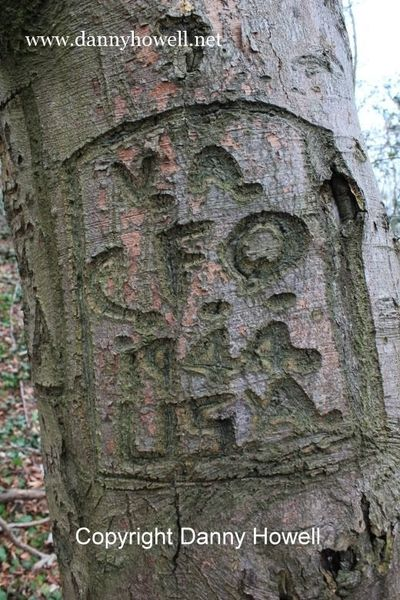
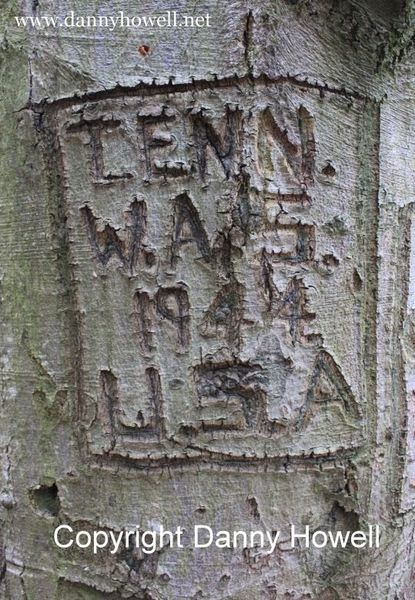
“Here are a couple of examples. These two photographs which I took on the afternoon of Saturday 31st March 2012, show carvings made on the Arn Hill beeches 75 years ago.”
The first one reads:
“V.A. C.F.O. 1944 U.S.A.”
The second one reads:
“TENN. W.A.S. 1944 U.S.A.”
“No doubt these were carved in the trunks of the beeches by American soldiers who were billeted in Warminster (at the Old Brewery and elsewhere around town) from 1942 to 1944. Many of these men had previously been employees of the John Deere tractor-making business stateside and while in Warminster they established the workshops that later became the 27 Command Workshops REME at Imber Road, Warminster.”
“So there you have it, visible reminders of an unusual kind, that have remarkably out-survived nearly all of the American troops who were in Warminster prior to D-Day.”
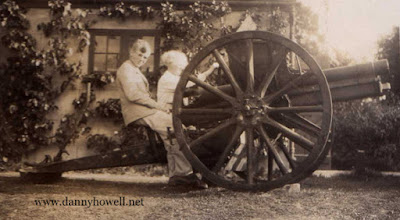
Dear Danny, You often have information that others don’t. Any comment on this intriguing little story please? I want to write it up for the Heytesbury Parish Magazine. The story concerns the field gun depicted in the photograph below:
First World War German Field Gun at Bunters.
The story began when I (in my capacity as a Heytesbury Parish Councillor) was tasked with taking an Inventory of all the benches in our Parish for the Parish Asset Register. Most benches are very easy to record as they have brass plaques with a dedication either in memory of a person or in commemoration of an event.
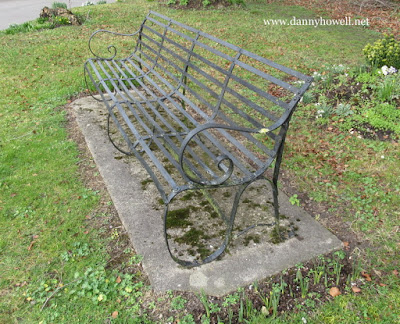
The black-painted bench on the corner opposite St. John’s Hospital. Photograph taken by Danny Howell on Wednesday 21st February 2018. .
I was, however, a little stumped by the black-painted, long, wrought-iron bench on the grassy area opposite the corner of St. John’s Hospital. An elderly village resident remembers it as having been there all her life and suggested to me that it might have been put there for Queen Victoria’s Diamond Jubilee as a commemorative bench. It has always been known to her as ‘The Jubilee Bench’.(Sadly, the design and style of the bench are not quite old enough to allow that I’m afraid) – and anyway the real story that I am uncovering is far more intriguing.
The gun in the picture above came to Heytesbury from the 6th Earl of Radnor, via his cousin Nancy Pleydell Bouverie who lived at Bunters in Heytesbury from 1923 until she died in 1976. (She and her sister are both buried in Heytesbury Churchyard). Incidentally, Nancy and two other of Anthony Wilson’s cousins (Margaret Makgill Crighton Maitland and Esther Makgill Crighton Maitland who owned Knook Manor at the time) actually PAID £150 for the Raymond Hall, Heytesbury, in the conveyance dated 7th December 1935, so we all owe them rather a debt?
The Earl of Radnor was probably rather too old to have fought in the First World War himself* but I guess that I could research him and his career through army records? So how did he get his hands on this booty of war?
Between the two of them, they decided to mount the gun on the site where the wrought iron bench stands today and once there it was to act as our War Memorial to those from the village who had died fighting in The Great War.
This field gun therefore became Heytesbury’s First World War Memorial and was maybe there for two or three years before our present War Memorial in the churchyard was erected in 1921. I am hoping to research that monument too (now Grade 2 listed)- as nobody really seems to know whether the Church owns it (it stands on Church land, of course) or whether Heytesbury Parish Council own it and must insure it and maintain it as a part of the Parish Asset Register.
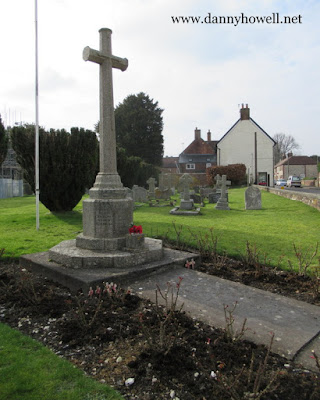
The War Memorial in the north-east corner of Heytesbury Churchyard. Photograph taken by Danny Howell on Wednesday 21st February 2018. .
Anyhow I have now discovered that the wrought iron bench opposite St. John’s Hospital dates to around 1935 and the reason is as follows:
When Siegfried Sasson bought Heytesbury House in 1933 he was definitely not at all enamoured of anything German. In 1935 he suggested that if the village agreed, the German Field Gun should be removed and that he would replace it with something rather less Germanic at his own personal expense. So, the Sassoon bench was bought and apparently installed to commemorate the Silver Jubilee of George V which occurred in 1935. (The King died the very next year, in January 1936). And, the gun was removed to the garden of Bunters where the picture above of Nancy and her nephew was taken, and there it remained for many years. No-one, at the moment, appears to know where the gun eventually went.
How was it that the First World War connection was so easily written off the corner site? Of course the traditional War Memorial had been erected in the corner of Heytesbury Churchyard for 14 years by the time the gun was removed from opposite St. John’s Hospital to Bunters.
I shall have to find out more. Might you know anything about our War Memorial by the Church in Heytesbury and anything about the men who are commemorated on it?
I hope you are well?
Best wishes, Trish Fellowes. __
Danny Howell replies ~
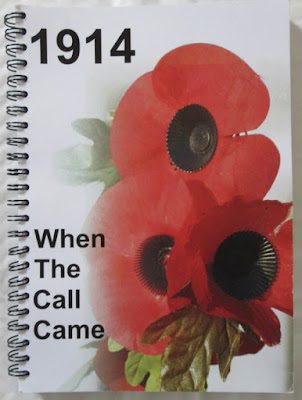
Thank you Trish for your interesting and intriguing story. To answer your question about the War Memorial in Heytesbury Churchyard and your request for information about the men commemorated upon it, rather than write the facts again here or repeat the biographies, I would suggest you acquire a copy of the book ‘1914 – When The Call Came’ which was compiled by Heytesbury C of E Aided Primary School. This was the children’s Heytesbury and Norton Bavant War Memorial Project and formed part of the Wylye Valley 1914 Commemoration Project.
This superb book will tell you not only about the lives of the men commemorated on the memorials at Heytesbury and Norton Bavant (the remit of the project also featured recording details for the men who returned from the War); but also the background (featuring newspaper cuttings) with regard the erection of the War Memorial at Heytesbury Churchyard in 1921. If you can’t source a copy of the book for yourself, then Warminster Library has a lending copy. I have one too in my own personal collection.
Jacob Pleydell-Bouverie, 6th Earl of Radnor.
With regard your comment that the 6th Earl Of Radnor “was probably rather too old to have fought in the First World War” if you ‘google’ him you will soon find that Jacob Pleydell-Bouverie, 6th Earl of Radnor, CIE, CBE, (1868 – 1930), who was Viscount Folkestone from 1889 to 1900, was a Lieutenant Colonel (and a Brevet Colonel) commanding the 4th Battalion of the Wiltshire Regiment, serving in India from 1914 to 1917. . As to the demise of the First World War German Field Gun which was removed to Bunters, whenever I mentioned it to any Heytesbury villagers, they all seemed to suggest that it may have been cut up for scrap either for recycling for munitions as part of the war effort during the Second World War, or that it may have gone for scrap or was sold at a later date, but no one had any printed record of it. No-one seemed sure. Perhaps some new research will provide the answer. To that end, if any readers of dannyhowell.net have any memories of the gun or information as to what became of it, perhaps they will get in touch and let us know.
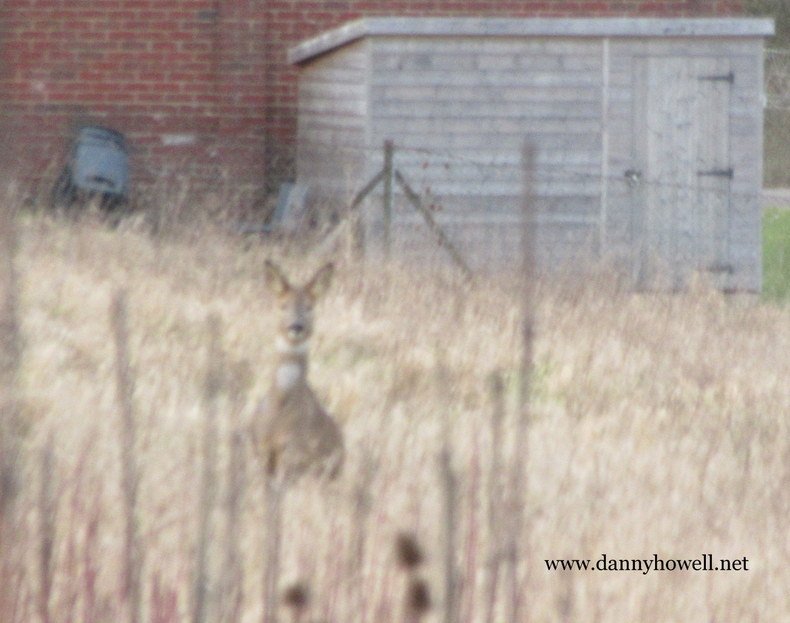
A deer in Battlesbury Barracks. Photograph by Danny Howell.
This deer is confined to Battlesbury Barracks, Warminster. It probably wandered in when the back gates to the barracks, at Battlesbury Bridge, were open for military access but they are now locked shut. The deer can’t jump over the perimeter fence of Battlesbury Barracks because the fence is high and is topped with razor wire. The deer has grass and leaves to eat and can drink from the water-jump at the army assault course in the north-east corner of the grounds, but he/she looks like a lonely figure in the fenced-in landscape and is easily spooked and doesn’t know which way to run. More than one person who has seen it has said: “I do feel sorry for it.” Would be real good if the officer in charge of the barracks could have the back gates temporarily opened and maybe gain the assistance of some soldiers to show the deer the way out to the freedom it deserves.
Projects To Remember Those Who Lost Their Lives In The First World War.
The monthly meeting of Heytesbury, Imber & Knook Parish Council took place on Tuesday 28th November 2017 and welcomed its two newest members, Councillors Louise Morris and Elizabeth Colvin.
One of the projects under discussion was the Council’s involvement in the County wide proposal to deliver a legacy to mark the end of World War One on 11th November 1918 and invite local communities to get involved in the planting of 10,000 trees. Each tree to represent the soldiers that lost their lives. A number of organisations will be supporting the project and The Woodland Trust will donate free trees to communities who will be encouraged to plant native types.
Heytesbury, Imber And Knook Parish Council members discussed the proposals and it was agreed that crab apple (Malus sylvestris) be requested with the aim to plant one in Heytesbury, Tytherington and Knook. The trees don’t grow too large and flower in spring, with the blossom pollinated by bees and other insects which develops into small yellow green apple-like fruits. Councillor Sarah Buttenshaw said “this is an excellent way to remember those who made the ultimate sacrifice and the Parish will be able to commemorate the end of World War One with something that can be appreciated by everyone”.
Heytesbury, Imber and Knook Parish Council also discussed the report submitted to them from Historic England who are assessing the Heytesbury War Memorial for listing as part of their First World War Commemoration project. The memorial is situated in the north-east corner of the churchyard of the Church of St Peter and St Paul and stands on a square stone platform. The tall octagonal Latin cross is of Cornish Granite and is inscribed with the 12 names of those who lost their lives in the First World War and the four men who died in the Second World War. The Parish Council felt this was a positive move to protect this historic and important memorial.
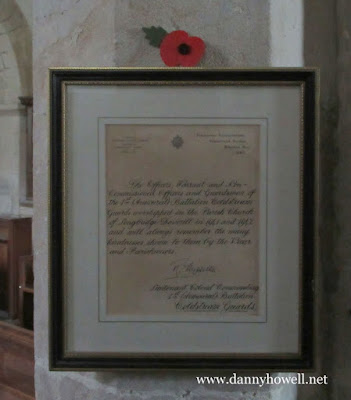
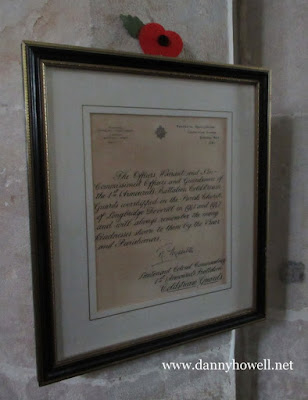
A framed letter written by Lieutenant Colonel Ririd Myddelton, on display at The Church of St. Peter and St. Paul, Longbridge Deverill.
It reads:
“Regimental Headquarters, Coldstream Guards, Birdcage Walk, SW1. The Officers, Warrant and Non-Commissioned Officers and Guardsmen of the 1st (Armoured) Battalion Coldstream Guards worshipped in the Parish Church of Longbridge Deverill in 1941 and 1942 and will always remember the many kindnesses shown to them by the Vicar and Parishioners.