From a list of items in Harold Nelson Dewey’s diaries 1919-1947 (list made by Percy Trollope):
August 1920
Lord Allenby opened the Old Comrades Institute at East Street, Warminster.
Information and pictures about the military in Warminster and district including The Tank Barracks, The School Of Infantry, The Land Warfare Centre, Boreham Barracks, Battlesbury Barracks, Knook Camp, Sutton Veny, Boyton and Corton, Codford, Longbridge Deverill, Salisbury Plain, etc.
From a list of items in Harold Nelson Dewey’s diaries 1919-1947 (list made by Percy Trollope):
August 1920
Lord Allenby opened the Old Comrades Institute at East Street, Warminster.
From a list of items in Harold Nelson Dewey’s diaries 1919-1947 (list made by Percy Trollope):
March 1920
Lord Bath unveiled the captured German gun at the entrance to The Close, Warminster.
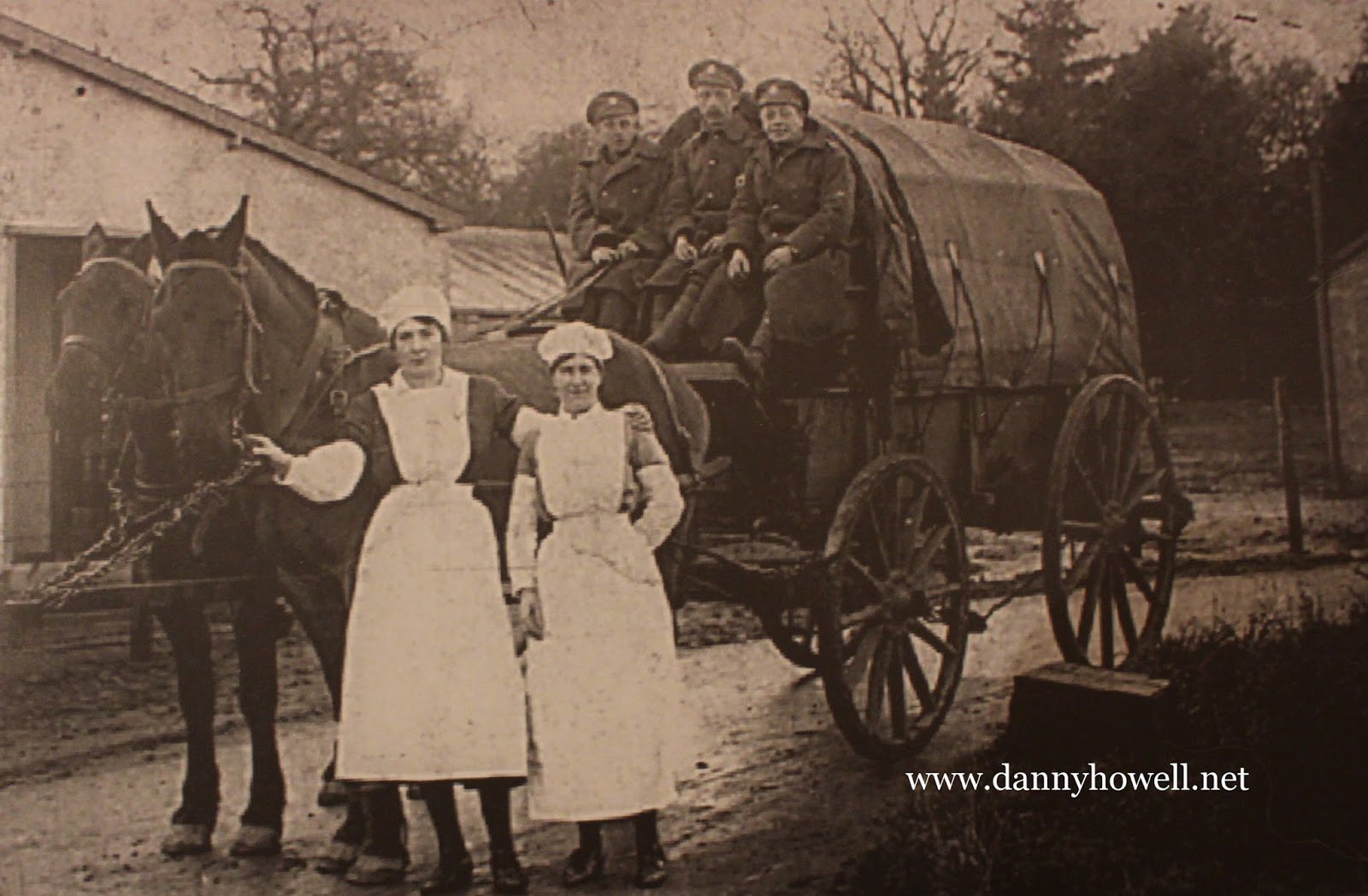
Horsedrawn wagon of the Army Service Corps delivering rations to the Military Hospital on Sutton Veny Common during the First World War.
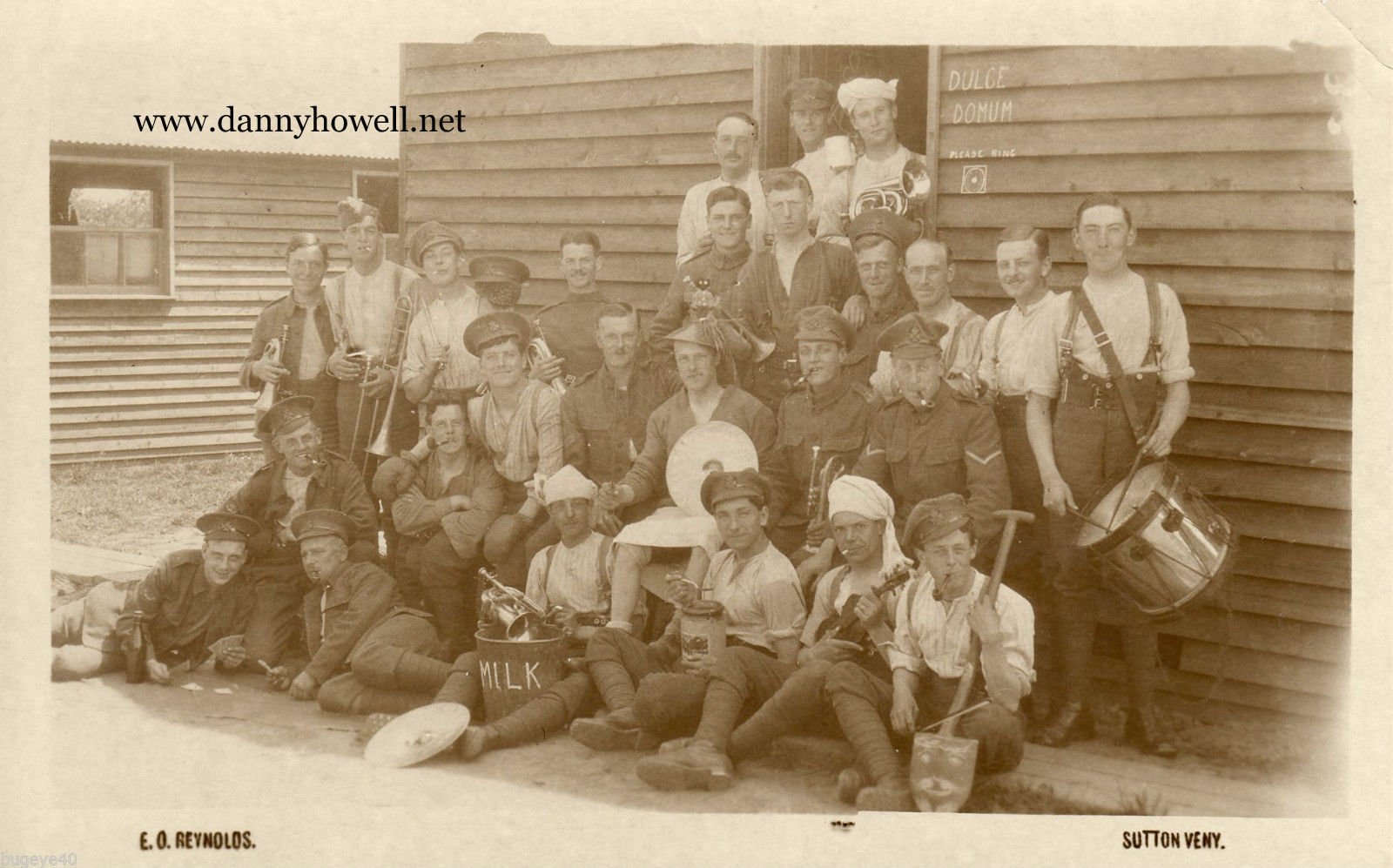
Photograph by E.O. Reynolds, taken at Sutton Veny, during the latter half of 1916. It shows some of the serving soldiers in the 2/6th London Regiment (City Of London Rifles) nicknamed the Cast Iron Sixth.
It seems these men had a great sense of humour and enjoyed some fun. The words ‘Dulce Domum’ are written to the right of the hut doorway. Dulce Domum means “Sweetly at home.” It is coincidentally the name of a song written by Robert S. Ambrose in 1876 (not to be confused with another song of the same name sung at Winchester School). Underneath ‘Dulce Domum’ someone has chalked or painted a depiction of a door bell with the words: ‘Please Ring.’
Some of the soldiers are smoking cigarettes, some of the others are smoking pipes. Some have bugles, one has a trombone, one has a drum, and there are two cymbals. Another soldier has a violin. The soldier next to him has the violin bow and is bowing it across the handle of a shovel (the shovel has a face drawn upon it).
One soldier has a bucket with the word ‘milk’ on it. Another soldier has a spoon and is eating something out of an earthenware jar. Another soldier appears to have a toy monkey on what looks like a lampshade or a funnel he is wearing as a hat on his head. He has a towel over his lap and is either wearing shorts or his trousers legs are rolled up. He is holding what looks like a swagger stick or a riding crop. Two others have wrapped towels or scarves or some type of material round their heads in the style of turbans.
The battalion was at Sutton Veny from July 1916, doing final training there before going to France and the Western Front in January 1917.
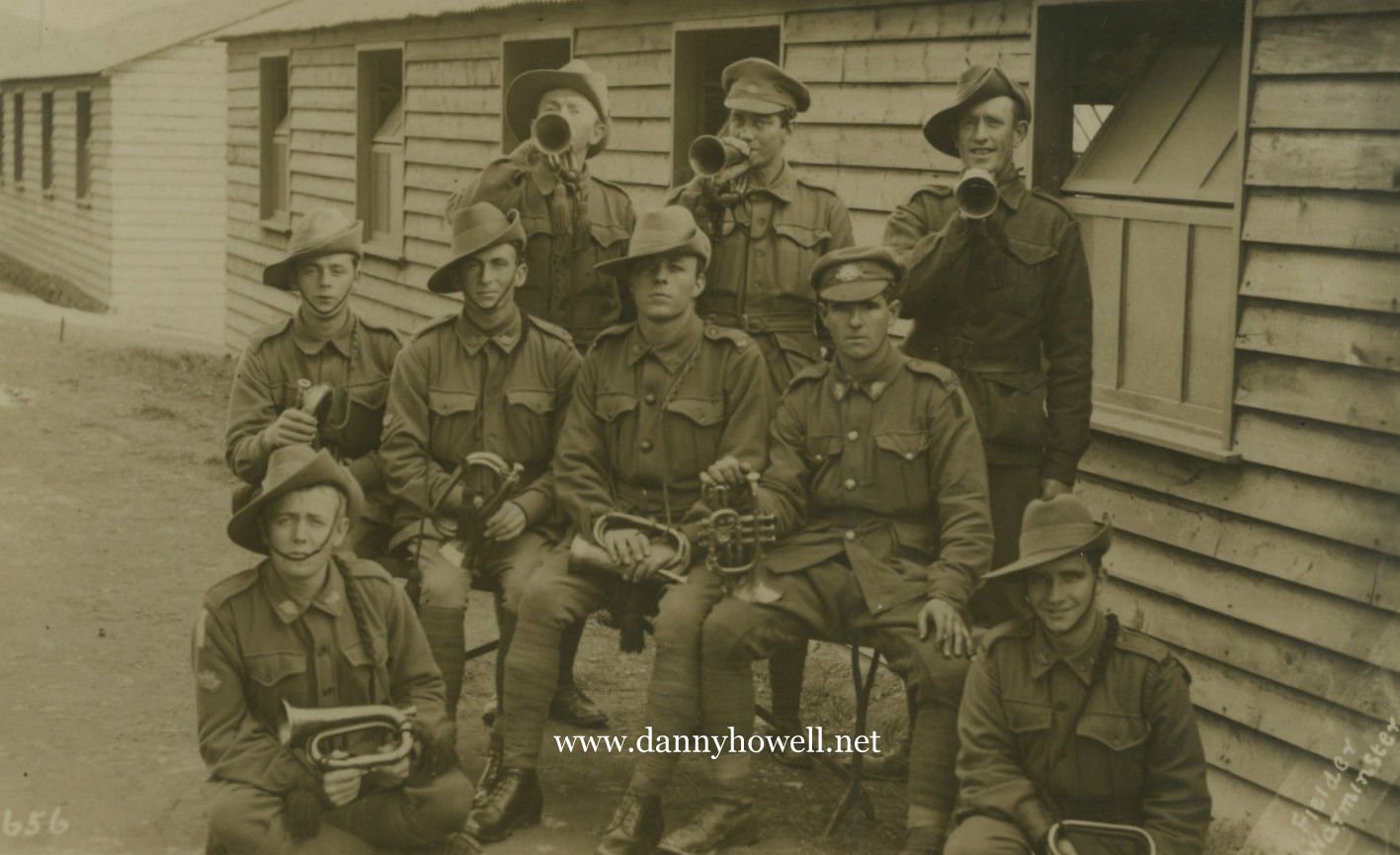
Some of the buglers of the Australian Imperial Force (AIF) at Sutton Veny Camp, circa July 1916. The photograph was taken by Fielder of Warminster.
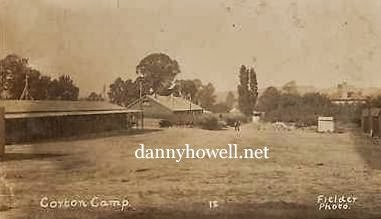
A view of the military camp at Corton,
in the Wylye Valley, circa 1916.
The picture was taken by the
Warminster photographer Mr. Fielder.
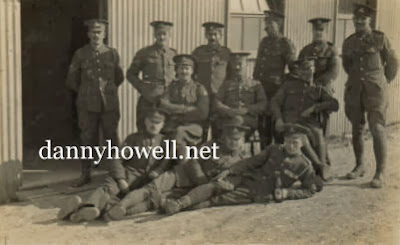
Soldiers outside a building with corrugated iron
sides, depicted on a postcard with a
Boyton Camp, 1916, postmark.

The 2/18th London Regiment (London Irish) at Sutton Veny in 1916. The photograph was taken by E.O. Reynolds. The 2/18th London Regiment arrived in Sutton Veny in January 1916. Landed at Le Havre on 23rd June 1916.
Friday 10 September 1915
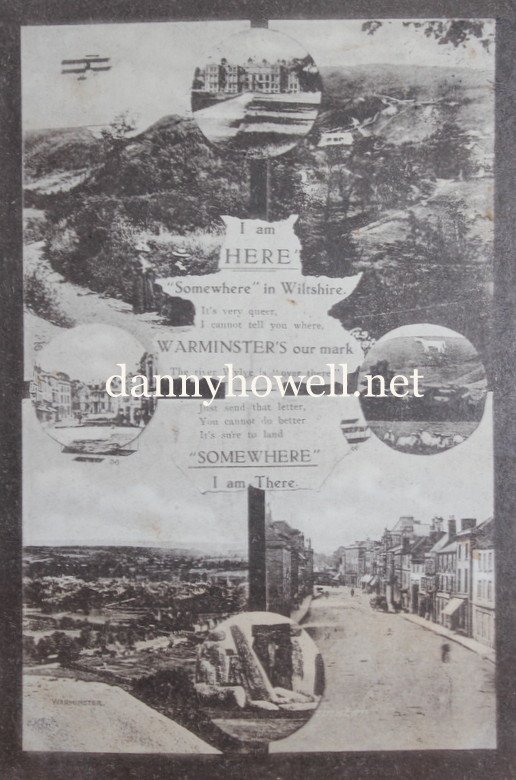
A multi-view picture postcard with illustrations of the Market Place, Warminster; the Golf Club House on Arn Hill, Warminster; view from the Downs at Warminster; Longleat House; Westbury White Horse; the downs at Codford; and Stonehenge.
In the centre of the pictures is the following rhyme:
I am here – Somewhere in Wiltshire. It’s very queer, I cannot tell you where. Warminster’s our mark, The river Wylye is over there. You send that letter, You cannot do better. It’s sure to land “Somewhere”, I am There.

The card is postmarked Warminster 8PM 10 September 1915. The card is addressed to: Mrs. A. Greenwood, 4 Hollins Street, Walsden, Nr. Todmorden, Yorkshire.
The message is also dated “Sept 10 1915” and reads:
“Dear Sister, The weather so very hot indeed but you know I cannot get fat because we have to work like convicts. Start 8 to 8 at night. My right address is Pte E. Crossley 09516, Army Ordnance Depot, Warminster, Wiltshire. (Will write a letter when I have time)
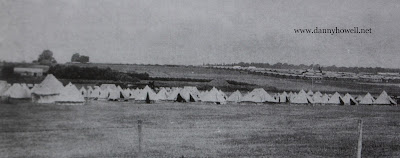
Sandhill Camp, Longbridge Deverill,
in its early phase during the First World War,
when the soldiers were under canvas
prior to the building of wooden huts.