Home Farm Community Value Survey

Monday 9th March 2026

Al Wright is conducting a survey, gathering evidence to protect Home Farm, Boreham, Warminster as a Local Green Space and Green Corridor. He will be out and about, as always, along the public footpaths, bridleways and lanes in the Home Farm area (and also on the Southern Range Road below Battlesbury) up until 21st March, with survey forms, to give everyone the opportunity to make their views known.

If you don’t know him already, you will recognise him as the tall guy with a bushy beard, with a rucksack on his back, and usually with a camera in hand, photographing the landscape and wildlife. If you’re not outdoors enjoying the Home Farm area but would still like to take part in this important survey, you can fill in the survey online by going to the EBBRAG website: https://www.ebbrag.com/home-farm-community-value-survey/

The survey results will be presented to Warminster Town Council, for the Warminster Neighbourhood Plan Consultation, with the objective of making people’s views known in regard to having Home Farm removed from housing allocation and proposing that Home Farm be added to the Local Green Spaces for Warminster.

Here is what the survey is asking:

Home Farm Community Value Survey

This survey gathers evidence to protect Home Farm as a Local Green Space and Green Corridor. Your responses will be submitted to Warminster Town Council and Wiltshire Council to oppose the WNP2 housing allocation.”

Section 1:
How You Use Home Farm

How often do you use, walk past or view the Home Farm site?

  • (Daily / Weekly / Occasionally / Rarely

How do you value this space? (Tick all that apply)

  • [ ] As a visual “break” between the town and the countryside.
  • [ ] As a Green corridor for local wildlife (birds, bats, deer etc).
  • [ ] For its historical significance to the Warminster landscape.
  • [ ] For its role in maintaining the “rural feel” of East Boreham.
  • [ ] For the sense of peace and tranquillity it provides.
  • [ ] As a place for recreation.


    Section 2:
    The “Green Corridor”

What specific wildlife and wild flowers have you observed at Home Farm?

  • ( i.e. owls, bats, deer, snakes, newts, butterflies, orchids, fungi, etc.).

How important is Home Farm in preventing “urban sprawl” (Warminster merging with Bishopstrow)?

  • On a Scale of 1 2 3 4 5: (1 = Not important, 5 = Critical for town identity).

Would the loss of this green gap impact your well-being or enjoyment of the area?

  • (Yes / No – Please explain why).

Section 3: LGS Criteria

In your opinion, is Home Farm “demonstrably special” to the local community?

(Yes / No)

If yes, which “Local Green Space” criteria does it meet? (Tick all that apply):
[ ] Beauty: Its contribution to the scenic character of the area.
[ ] History: Its connection to the farm’s heritage and the wider valley.
[ ] Tranquillity: Its value as a quiet, undeveloped space.
[ ] Wildlife: Its richness in biodiversity.
[ ] Recreation: its use as a recreation space ie, running, walking, etc.


Section 4:
About You:

Your Postcode:

How long have you lived in the area?

Which age group do you belong to? under 18, 18-34, 35-65, 66 and over, please circle appropriately.


Section 5:
Any other comments you would like to add or testimonies on why this area is valuable.

Are You A Dog Walker, Hiker, Runner, Horse Rider, Cyclist Or Just Someone Who Enjoys Warminster’s Stunning Natural Landscape And Associated Wildlife?

Thursday 19th February 2026

From the Facebook page of EBBRAG:

Are you a dog walker, hiker, runner, horse rider, cyclist or just someone who enjoys Warminster’s stunning natural landscape and associated wildlife?

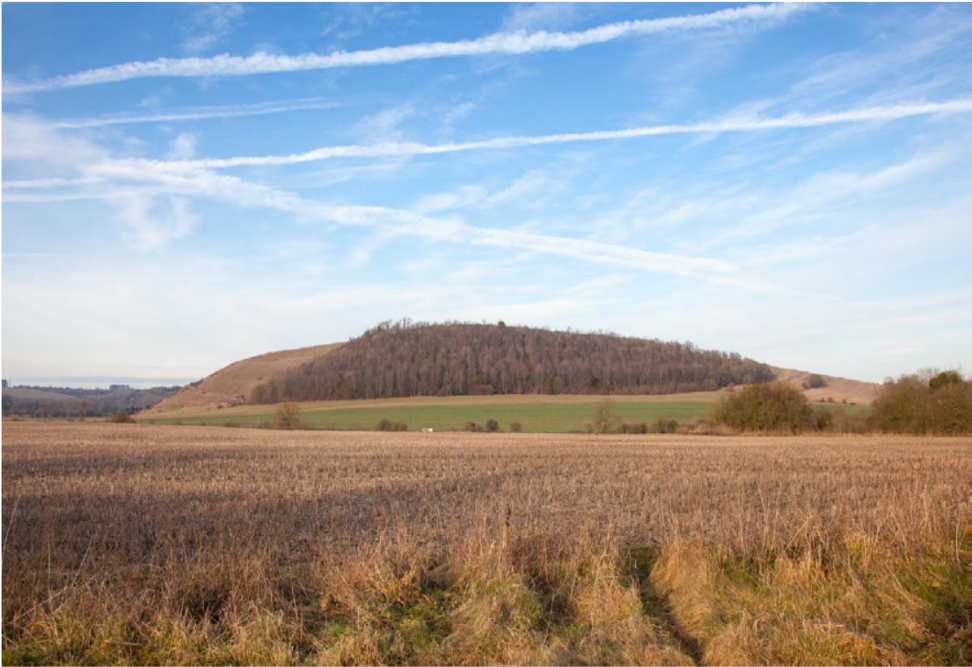
This photo was taken by the late Steve Climpson, who was passionate about protecting this landscape. It is the view from the public footpath adjacent the potential Home Farm development site. The view looks to Battlesbury Hill. The draft Neighbourhood Plan does not preserve the view from Battlesbury to Boreham and Bishopstrow, nor does it protect the Home Farm fields from development.

Developers are supposed to improve biodiversity and commit to providing community open spaces as part of their obligation to sustainable development, set out by Government legislation. In reality, they rarely do this. In effect, in their greed for money, natural landscapes are destroyed forever and many developers don’t even deliver the mitigations they agree to when planning permission is granted.

You can read more in our article on protecting the landscape: Red Kites And Rubble Stone – EBBRAG: https://www.ebbrag.com/boreham-history-the-unique-landscape-setting/

And for background on what Bellway, the potential developer of the Home Farm site, might be like: Bellway Homes for Warminster or would that be Hellway if it goes ahead? EBBRAG: https://www.ebbrag.com/bellway-homes-for-warminster-or-would-that-be-hellway-if-it-goes-ahead/

The other large scale developers sniffing around sites in Warminster are likely to be similar. We need to take out site selection from the draft Warminster Neighbourhood plan.

Warminster needs YOU to find a voice.

As a resident of Warminster, you will already be aware of the huge West Urban Extension/Jubilee Gardens where 1000 new homes are currently being built, with another 500 due by 2042. Did you also know that a further approximately 700+ houses are at the planning stage?

  • Cley Hill View, 227 homes already approved and being advertised.
  • Ashley Coombe, 77 homes; planning permission applied for.
  • Westbury Road, 205 homes; rejected once in 2025, outline planning applied for again.
  • Home Farm, 135 homes; planning application expected imminently (the Neighbourhood Plan suggests 90 but the developer Bellway Homes would like 135).
  • Grovelands, 68 homes; building already started.


Are these homes ALL really needed?

Are they being planned in a responsible and sustainable way? They are all eating up green areas, rather than using brown field sites.

What impact will these developments have on the lives of people already living in our town?

Despite what the Town Council would have us believe, a Neighbourhood Plan does not offer Warminster protection against these speculative development bids.

The whole premise of naming a potential site in the Neighbourhood Plan is to offer legal protection for the rest of Warminster for up to five years. Consider this example – Melksham Parish Council had an adopted Neighbourhood Plan, fully supported by local residents which excluded a site Snarlton Farm from designated building. On appeal, the developer has now gone to The Secretary of State for Housing, taking the decision right out of local hands.

And consider this – by the time the current draft Neighbourhood Plan is finalised, it is likely that all of the developments listed above will already have gone through the planning process and have been approved, not just the one they have named.

What can you do?

  • Register on the EBBRAG website. Our contact form is here: https://www.ebbrag.com/contact/
  • Make it known to our Town Council that you do not support any more large scale developments, in the absence of improved infrastructure and local services. You can email the council here: admin@warminster-tc.gov.uk

How?

“Political Charade” – Warminster Town Council Extraordinary Meeting

Friday 23rd January 2026

From the EBBRAG website – www.ebbrag.com – EBBRAG’s report of the Full Council Meeting of Warminster Town Council, last Monday evening, which saw the launch of the Warminster Neighbourhood Plan 2 for public consultation:

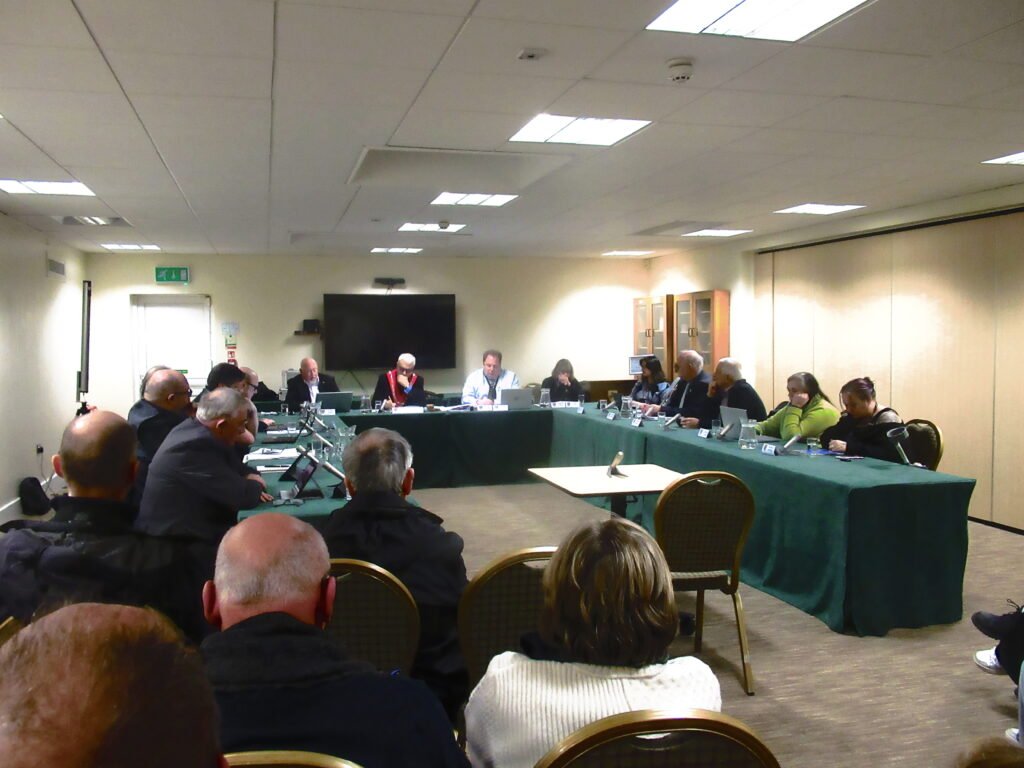
Warminster Town Council Extraordinary Meeting, Monday 19th January 2026

“Unfortunately last night’s Town Council meeting was no more than the political charade we could have expected it to be. Blind and ill-informed compliance by most of the councillors to an agenda set by an influential few, is how it came across to me.” – an angry comment from a member of the public after the meeting.

Warminster Town Council held an Extraordinary meeting on 19th January 2026, to vote on progressing the Neighbourhood Plan to Regulation 14. In plain English this means a discussion of whether the current process moves to its next phase of a formal public consultation on the draft plan document.

You may have missed the widespread publicity of this meeting, as there was none! They put the agenda on their Council agendas/minutes page one week ahead but that was all, they didn’t publicise that the meeting was taking place. So that’s why only 17 adult members of the public attended. Could it be the Town Council didn’t really want any public there?

Nick Parker, spoke as someone who has lived in Warminster for 28 years. He highlighted the exceptional level of housing development Warminster is undergoing and how the further 90 houses at Home Farm are not justified and indeed against Wiltshire Council Planning documents for Warminster. Warminster is already meeting its housing requirement and needs a coherent strategy for infrastructure to catch up. Will the inclusion of unsustainable housing development on the fields of Home Farm and elsewhere be the single issue which causes residents to reject the Plan altogether?

Tania Peacock also spoke about factual errors the Council had made regarding land in the Cannimore/Folly Lane area owned by her family, which has been classified as Local Green Space within the plan. She highlighted how the plan does not even get the name of this area correct, due democratic process has not been followed, there are spurious claims that there is public support for this land to be open space from a survey which was for a totally different purpose, the space is in fact a private fenced field and not as claimed an open space and the Council claims to have agreement from the landowner which is disputed and which the Council cannot evidence ever happened.

Alastair Wright flagged how there is a legal requirement for Wiltshire Council to produce more detailed flood risk assessments before they allocate any houses in Warminster outside of the West Urban Extension but this has not been done. There are sewage overflows currently on Woodcock Road and Boreham Road which suggest the sewage system in that area is at capacity, but this is not recognised within Warminster’s flood risk assessments. Mr Wright also highlighted problems with the classification of the open spaces and rural buffer corridors within the plan. Finally, he highlighted that the Home Farm site is outside the settlement boundary and as the maps cut off at this point, the important historic setting in that area is also excluded.

Jeremy Kelton, who has lived beside the river Wylye for 14 years, also highlighted issues around flooding and how building on Home Farm would remove its ability to act like a flood plain in winter and force the groundwater elsewhere. He reminded the council that we have had two “once in a generation” floods in a decade in 2014 and 2024.

Nick Tilt who lives near to the proposed entrance to the Home Farm site and whose family have lived in Warminster for over 60 years, outlined how the inclusion of Home Farm would be contrary to a number of national planning policies. In particular 109 which relates to road safety given the development’s need for a westbound right turn ghost lane on a road which is already too narrow at that point. The resultant damage to several mature trees, a length of unique historic wall and removing the rural character with suburban lighting. The harm to Bishopstrow Conservation Area also being contrary to 135c in the NPPF.

But the Councillors seemed not to be listening. They didn’t appear to want to listen. They were determined to proceed with Regulation 14 and put the draft out for consultation, yet they know it has flaws and contains things unnecessary and not wanted. They must know the flaws put acceptance of the Plan in jeopardy and if the Plan is rejected it will cost £1,000s in taxpayers’ money.

One EBBRAG supporter commented afterwards, “I was of a view our Councillors didn’t take on board the speeches from the public, particularly the selection of Home Farm for housing allocation, and it seemed not one of the Councillors had anything to say about the matter.

They could have called for a postponement, held a discussion, and then said they would pull things out or make amendments before putting the Plan out for consultation. They didn’t.

Even though the speakers raised many issues and in some cases calling out major flaws in the process, the Council made no comment or held no proper debate among themselves about what was said. Councillor Andrew Davis (who is not only a Warminster East Ward Councillor but also a Wiltshire Councillor) put several questions to the Mayor, Cllr Andrew Cooper who was chairing the meeting but I don’t think anyone present fully understood what Councillor Davis was trying to say. It was notable that when speeches from the public were being made, at least one Councillor seemed more occupied messing about with his phone than listening to voters.

When the Chair asked Councillors to speak, there was a deadly silence to begin with. Only a couple of Councillors commented and their comments were really questions. The speeches from the public made important points about the river Wylye and raised serious concerns with how flood risk is being dealt with in Warminster. Flooding is not being recorded at a Wiltshire level. Even though some Councillors have professed an interest in this area, they had absolutely nothing to say at this meeting.

The Council also failed to mention that one of the Neighbourhood Plan Steering Group has resigned, Could it be that this person cannot support a draft plan that allocates unsustainable housing development? Why hasn’t the public been told?

Our Councillors always say they are available to chat, but what do they actually do? the meeting was just an exercise for the Council to tick boxes and go sailing ahead despite the consequences.

We urge Warminster residents to vote against this flawed Neighbourhood Plan to show “the influential few” that Warminster has had enough of large scale over-development of our town.

Draft minutes of the meeting including text of the speeches submitted is on the Warminster Town Council Website. We include text of the speeches below. Al Wright spoke from his extensive knowledge of the issues without verbatim notes.

Nick Parker spoke as a resident of Warminster for 28 years.

While there is much that is positive in the draft Neighbourhood Plan, the site selection is a serious mistake. If left unchanged, it risks the Plan being rejected by residents, wasting public money and damaging the Council’s reputation.

Warminster is already experiencing an exceptional level of housing development including Grovelands, Cley Hill View, Ashley Coombe, Westbury Road and Jubilee Gardens. In that context, the proposed 90 houses at Home Farm and two at the Yew Tree are neither required nor justified. Their inclusion risks becoming the single issue that causes residents to reject the Plan altogether.

There are clear signs that supply has outpaced demand. Homes at Jubilee Gardens are not selling, with councils elsewhere now purchasing them for their own needs. This shows that Warminster is already meeting its housing requirement.

The scale of development is staggering, yet it is proceeding without a coherent strategy for infrastructure, roads, healthcare, schools and drainage. The Neighbourhood Plan is intended to prevent speculative development, yet it will not be adopted until the end of this year, leaving Warminster exposed in the meantime.

Wiltshire Council’s Planning for Warminster document of September 2023, on which this Plan should be based, clearly explains why housing numbers in Warminster were restricted. That reasoning remains valid.

The draft inclusion of Home Farm and the Yew Tree fails to address the reasons these sites were rejected by a Planning Inspector in 2020. Nothing material has changed since then, and housing need is being met elsewhere.

This decision rests with you. Local feeling about Home Farm has been seriously underestimated, and approving this Plan unchanged risks losing both a valued part of Warminster and public confidence in the Neighbourhood Plan itself.

We have already seen irreversible damage to the west of Warminster at Jubilee Gardens and Cley Hill View. Please do not repeat that mistake in the east, for development that is simply not needed.

Speech by Tania Peacock

Good evening. I am Tania Peacock. I am here because Warminster Town Council is at a crossroads between the law and a documented falsehood. You are now formally “on notice” that the evidence for LGS 1.1 Folly Lane is built on factual errors that cannot be carried into the 2026 Plan.

The Clerk previously stated that if errors were shown, the designation could be removed. I am presenting five fatal evidence failures:

  1. The Petition: The Council relies on 729 names as “support.” However, this petition was originally gathered to object to a separate housing development. To repurpose those signatures to tell a Government Inspector they represent real support for a Local Green Space designation is legally misleading.
  2. The Law: This site was never in the original draft plan. The Council bypassed the mandatory 6 week public consultation required to add it, meaning the public never had a legal window to object.
  3. The Consent: The previous Examiner was told the landowners agreed. Your own FOI response now admits the Council holds no records of contact with my father. You cannot claim “agreement” with a resident you never spoke to.he Description: The Council described a private, fenced field as “Rehobath open space for all by the water.” This was a factual inaccuracy regarding the land’s physical state, designed to meet criteria that the land does not fulfill.
  4. The Deeds: The Council calls this land “Rehobath.” I am handing over the Legal Title Deeds today which show the historical and legal identity of this site as Cannimore. Land Registry as “Land lying North of Cannimore”. The name “Rehobath” is a nickname for a neighbouring private house, it is not the name of this land. By simply “copying and pasting” a neighbour’s house name from the 2016 plan, the Council has failed in its duty of due diligence.

Furthermore, your 2023 survey is “Unsound.” Using data from people walking on a Public Footpath to justify a Green Space on a private field is a mapping error that no Inspector will accept.

It appears the Council has relied on the narrative of a third party that contradicts the Legal Deeds and the Official FOI record. A planning policy built on a neighbour’s house name instead of a Legal Deed is a Material Error of Fact.

Closing: No Independent Examiner will ignore these documented factual errors. If you vote to retain LGS 1.1 “Rehobath” Folly Lane tonight, you are knowingly adopting a flawed evidence base. To protect the integrity of the 2026 Plan and your own reputations, I ask that you remove LGS 1.1 tonight. I request that the minutes specifically record that the Legal Title Deeds have been handed to the Council tonight.

Speech by Jeremy Kelton

Although Home Farm is labelled Flood Zone 1, in reality it behaves like floodplain. In winter it holds water, it connects directly to the River Wylye, and it feeds groundwater into the river— which is how chalk streams flood.

Building here would force water elsewhere. Hard surfaces increase runoff and groundwater pressure, risks not shown on national flood maps but well known in Warminster.

All water from the town flows into the River Wylye. In 2024, residents saw the river completely change colour as phosphate-rich silt from the WUE entered this protected chalk stream.

We have now had two “once-in-a-generation” floods in a decade, in 2014 and 2024, and they are getting much worse due to climate change. In 2024 GEA’s factory in Watery Lane flooded, homes in Bishopstrow were inches from flooding, Park Cottages flooded, and Boreham roundabout became impassable to emergency vehicles and full of sewage coming down Woodcock Road.

Approving this without a full catchment-wide assessment would pass flood and pollution risk onto existing homes and a protected river.

Speech by Nick Tilt

This statement refers to the inclusion of Home Farm as a potential site for housing development within the Warminster neighbourhood plan.

There are significant highway safety concerns relating to the proposed location of the access road, required visibility splays and weight of traffic arising from the development of Home Farm.

This development would result in an unacceptable impact on highway safety, contrary to NPPF paragraph 109. Boreham Road is constrained rural road with blind bends and high vehicle speeds, carrying cars, buses, HGV and military traffic. There have been at least five recorded accidents in recent years within close proximity to the existing Home Farm lane.

The access depends on the creation of a westbound right-turn ghost lane on a carriageway that is already too narrow. This will necessitate carriageway widening into the conservation area, endangering the root systems of seven mature trees and a narrowing of the westbound lane at a bend further increasing risk at the most hazardous point of the road.

Achieving visibility standards would require a 30-metre splayed access cut through an existing 100-metre high stone wall, causing further harm to heritage assets which along with the road safety concerns have been key reasons for 3 previous government inspector refusals of earlier planning applications of this site.

The associated road markings and additional street lighting (the area is very dark at night reinforcing its very rural character) would result in a more suburban level of lighting which would fail to sustain or enhance the significance of the Bishopstrow Conservation Area causing clear harm to its setting and character, contrary to NPPF paragraph 135 section (c).

The above concerns relating to the development of Home Farm are not new and have been publicly available information for several years and should have been key considerations against site selection and allocation. On this basis, Home Farm should not have been included in the Warminster neighbourhood plan and any future development applications should, as they have in the past, be refused.

The scale of highway intervention required to make this access function would itself cause unacceptable highway risk and heritage harm, which is not outweighed by any public benefit.

Notes:

NPPF Paragraph 109 is the criterion used at decision-making to assess whether a proposal can be refused on transport grounds.

NPPF paragraph 135 section (c): provides the decision criteria against which proposals should be judged – including character, landscape setting, heritage, safety, and overall quality. c) be sympathetic to local character and history, including built and landscape settings.

www.ebbrag.com

Bishopstrow Residents Are Fearful Of The Impact Of Development On Home Farm

Thursday 22nd January 2026

Mike Perry, Chairman of Bishopstrow Parish Meeting, has, today, emailed the following letter to Warminster Town Council:

Good Morning,

It is with increasing concern that we, in Bishopstrow, continue to hear that there is the prospect of 135 houses being built at Home Farm. We are fearful of the impact of such development for a series of reasons, especially since the building of the 35 houses at Boreham Mead. To us, it is obvious that Boreham Mead has created problems with issues such a flooding in or near the village, including at the roundabout on Boreham Road.

An even larger development at Home Farm has the potential to exacerbate our problems through:

Coalescence and narrowing the gap between Warminster and Bishopstrow. 

Bishopstrow remains an independent village and is separate from Warminster but building at Boreham Mead and at Mill Island has narrowed the gap between the two. Building at Home Farm will continue this process. We do not wish to become part of Warminster like the former village of Boreham has.

Threat to the Bishopstrow Conservation area

The proposed development site runs adjacent to the boundary of the Bishopstrow Conservation Area. No matter what developers say, the ecology of the area will be compromised and irrespective of management plans will be harmed permanently. The management plan for Boreham Mead has not been enforced, for example the tree screening, which was a condition of approval, has not taken place. Bellway Homes has a reputation for not adhering to management plans and has faced multiple fines for illegal practice (£600,000 in 2020 alone). A conservation area is also concerned with people and places and the unique setting of Home Farm ensures that an important part of Warminster is preserved for future generations, given its proximity to the hills of Salisbury Plain and the River Wylye which forms part of the River Avon SAC. Further downstream the River Wylye carries SSSI status. 

The proposed boundary for the site is adjacent to Bishopstrow House Hotel and Spa, a major employer in the area and also a great supporter of our village. Anything that compromises this essential part of the local economy has to be questioned. Additionally, the hotel buildings and grounds are of significant historic importance to the local area and more widely.

In addition to the hotel, the Conservation Area also includes other sites of historic and archaeological importance such as burial mounds including The King Barrow, which is both listed and protected by Historic England.

Increased flood risk and further damage to the Wylye from additional phosphate pollution.

All water flows through Warminster ultimately come down to Bishopstrow and the removal of flood plains increases both the volume and speed of this flow, especially during periods of adverse weather. The frequency of these severe weather episodes has increased and will increase further as a result of climate change and the resilience of existing and planned infrastructure is and will be insufficient to avoid flooding in our village. No sequential analysis seems to have taken place that considers the impacts from multiple development sites across Warminster on locations downstream, such as here in Bishopstrow. In this sense, Bishopstrow is being placed at risk from developments in Warminster. In addition to water flows, during recent flood events, sewage has been present in flood waters that have come into our village, indicating that the infrastructure doesn’t have the capacity to deal with volumes and flows. Putting an additional 135 houses into the system can only make the situation worse.

Traffic flows into Warminster and through Bishopstrow

With traffic planned to exit the new development into Boreham Road, an increase in traffic volume into Warminster is inevitable. This, on its own, will cause problems for those going into the town but we also have serious concerns within our village. We already experience problems with the number of cars coming into the village, some to go to Sutton Veny, for example to the school but also to avoid Warminster Town Centre and so access the A350 (and then the A303) and A36. More cars from Home Farm will make this situation even worse.

Impact on our village life from an increase in visitors.

Bishopstrow is a peaceful village, with few facilities. Increased traffic will compromise this sense of rurality as will an increase of people coming to the village for leisure activities such as dog walking, viewing the church, historic buildings and sites and using the field. We are a welcoming village but do not wish for our more tranquil life to be further compromised.

Given all of these concerns, we in the village feel disappointed that no contact has been made with us as part of your wider consultation on your Neighbourhood Plan. 

 Your Sincerely.

Mike Perry,
Chair,
Bishopstrow Parish Meeting.

cc. Dr. Andrew Murrison MP,
Cllr. Christopher Newbury (Wylye Valley),
Jeremy Kelton (Clerk to Bishopstrow Parish Meeting).

An Open Letter To Warminster Town Councillors From EBBRAG

Friday 16th January 2026

An open letter written by Nick Parker, the Chairman of EBBRAG (the East Boreham Business And Residents Action Group), sent to Warminster Town Councillors on behalf of EBBRAG members:

16th January 2026

Extraordinary Town Council Meeting – Monday 19 January 2026

Good morning,

As a Town Councillor you are requested to attend an Extraordinary Town Council Meeting on Monday 19 January 2026, at which Members will be asked to approve the draft Neighbourhood Plan (NP) 2 for Regulation 14 public consultation.

We apologise for the timing of this letter; however, the issues raised are of critical importance to the ultimate acceptance of the Neighbourhood Plan by the residents of Warminster and warrant your urgent attention before any resolution is made.

East Boreham Business and Residents Action Group (EBBRAG) represents a rapidly growing body of residents opposed to development at Home Farm, East Warminster. At a public meeting held on Saturday 10 January 2026, 137 residents attended, with a further 20 apologies (including one from Cllr Davies). Dr Murrison, one East Ward councillor and two non-ward councillors were present and contributed constructively.

Since that meeting, EBBRAG’s database has expanded by 57 email contacts in a single day and continues to grow by an average of five new contacts per day. Engagement through social media has tripled in the past fortnight. The group’s membership now rivals the vote totals achieved by some councillors at the most recent Town Council election.

Opposition to development at Home Farm was unanimous. More broadly, there is overwhelming resistance to further speculative and planned development in Warminster in the absence of essential supporting infrastructure. In response, EBBRAG is now formally coordinating with other resident groups across the town who share these concerns.

While EBBRAG recognises and values the substantial work that has gone into the revised Neighbourhood Plan, the plan has been prepared in a context of limited community engagement, as reflected in the informal survey results. With 61% of respondents opposed to development at Home Farm, there is a clear and serious risk that inclusion of this site will lead to rejection of the Plan at referendum, potentially influencing wider voting behaviour.

The consequences of such an outcome would be significant both financially and reputationally for the Town Council and would undermine the considerable progress made to date.

EBBRAG firmly believes that the inclusion of Home Farm and the old Yew Tree public house is unnecessary. Warminster’s housing requirement remains relatively modest at 90 houses until 2038; the rationale for lower allocations is clearly set out in Planning for Warminster (September 2023), and housing commitments within the West Urban Extension continue to increase (for example, Cley Hill View’s 227 additional homes alongside Jubilee Gardens), with further windfall developments likely.

We therefore urge the Town Council, in the strongest but most constructive terms, to withdraw site selection from the Neighbourhood Plan review before proceeding to Regulation 14. This measured step would safeguard the integrity of the Plan and protect the extensive work already undertaken.

Removing site allocations now would also allow resident groups to focus on addressing speculative planning applications through the appropriate planning processes, rather than relying on a Neighbourhood Plan timetable that will arrive too late to prevent the applications currently emerging.

Taking this approach, consistent with the reasoning applied at Ashley Coombe, (which now faces a speculative application for 77 homes and where Westbury Road is understood to have re-emerged), would send a clear and positive message that the Town Council is listening to its residents and is prepared to act decisively in their best interests.

Thank you.
EBBRAG

Stop The Development On Home Farm ~ Public Meeting Hosted By EBBRAG

Saturday 10th January 2026

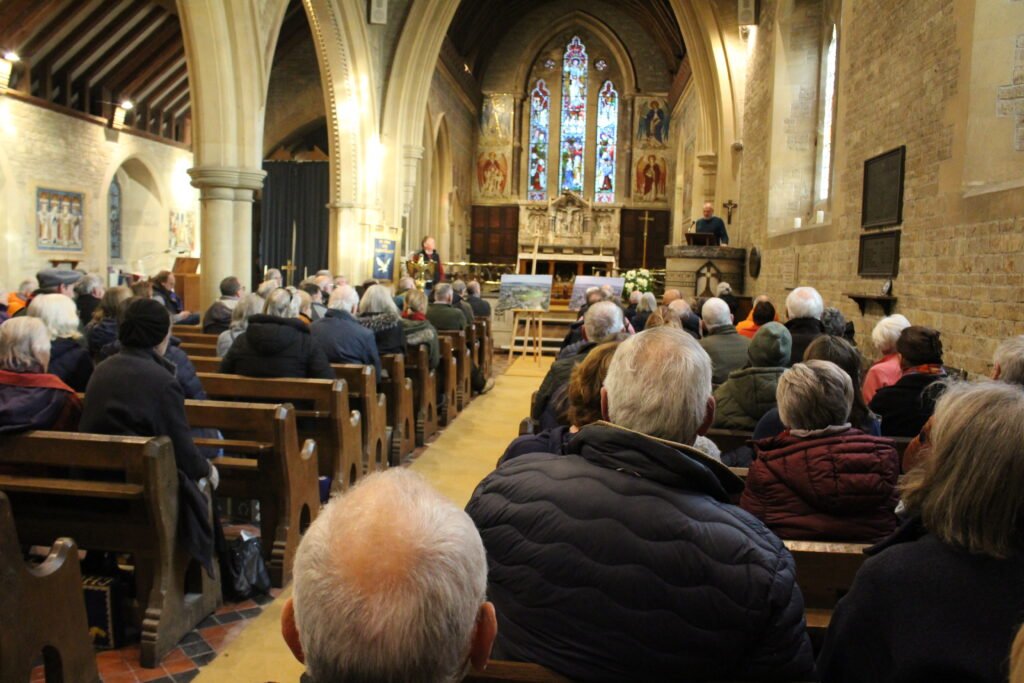
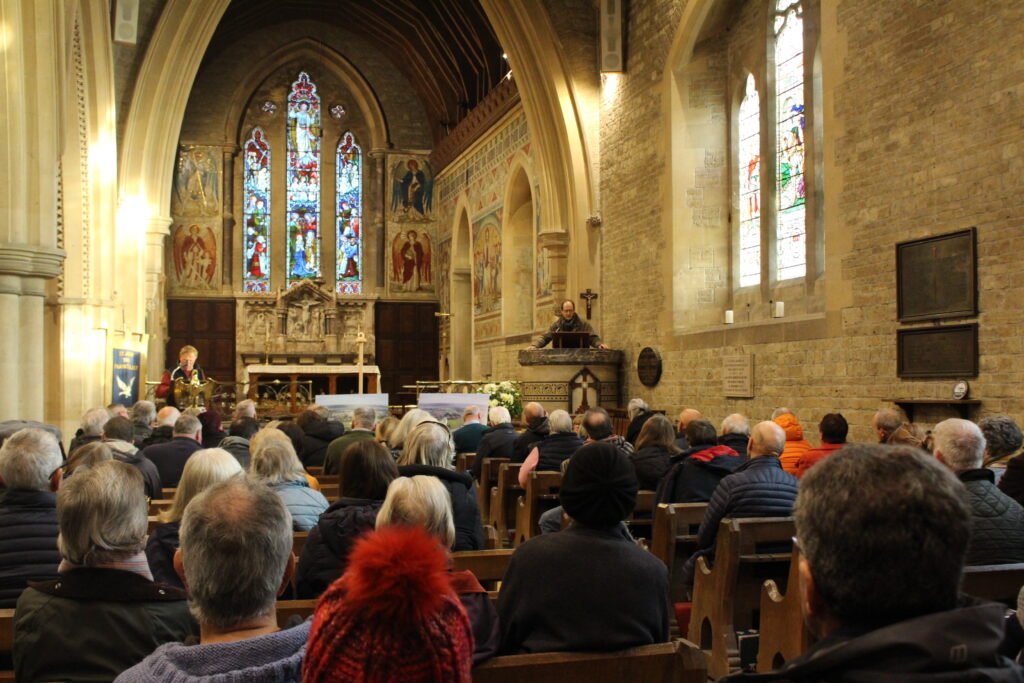
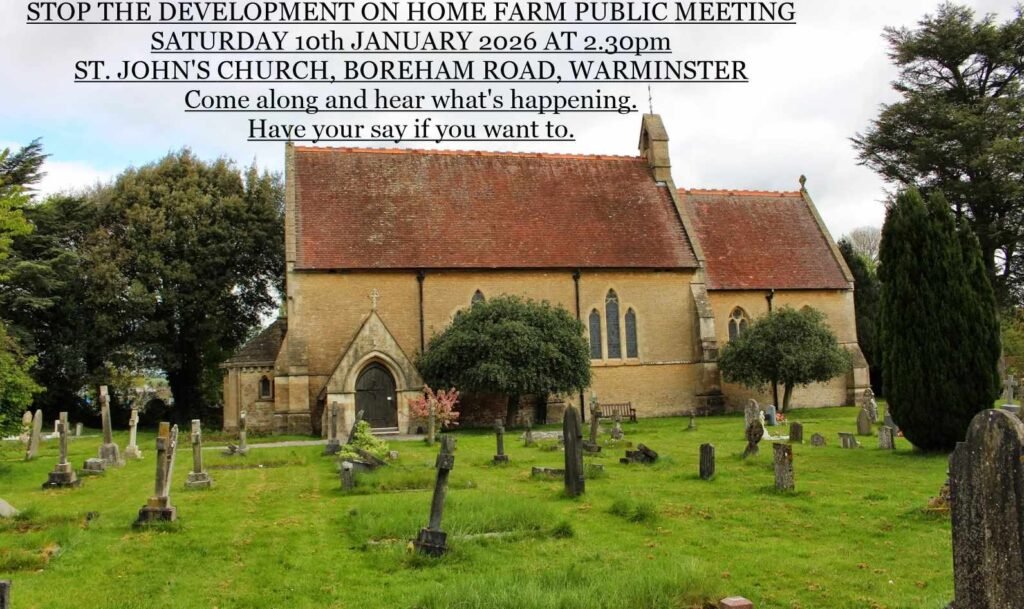
EBBRAG (the East Boreham Businesses And Residents Action Group) hosted a public meeting – Stop The Home Farm Development – at St. John’s Church, Boreham Road, Warminster, on Saturday 10th January 2026.

It was attended by 14 members of the EBBRAG Committee and 123 members of the public. There were 20 apologies.

The meeting was due to start at 2.30pm but there was a slight delay as the big number of people attending made a struggle for car-drivers to find somewhere to park. The line of cars stretched in both directions, some people having to park on the Boreham Road as far as to near the junction with Heronslade.

The meeting began with Nick Parker, the Chairman of EBBRAG, welcoming everyone before outlining the historical context of EBBRAG, what EBBRAG is trying to do, and some references to Bellway Homes, the developer who has a pre-application in processs for building houses on Home Farm.

This is what Nick Parker said:

Good afternoon.
Thank you for coming to this meeting today. My name is Nick. If my talk is not as polished as it should be please excuse me as EBBRAG received a copy of the draft Neighbourhood Plan around 1800hrs last night which has meant a rewrite of my notes into the early hours.

I would like to start by thanking the Parochial Parish Council of St. John’s for allowing EBBRAG to use the church as a community facility today – it is most kind and thank you.

I intend to give a brief time line of events, Home Farm land, what EBBRAG are trying to achieve, a bit on the developer and then after input from others and any questions, I’ll sum up with how you can help.

EBBRAG
East Boreham Residents Action Group was born in 1997 and played a prominent part to enable three Planning Inspectors to conclude Home Farm was unsuitable for development:
In 1997 when an Inspector selected Victoria Roadd rather than Home Farm.
In 2012 when Wiltshire Council and a Planning Inspector selected the Warminster West Urban Extension for development after rejecting Home Farm and confirming it was outside the town settlement boundary.
In 2016 the first Warminster Neighbourhood Plan was approved excluding this site, even after representation by a developer.
In 2020 a Planning Inspector concluded that the site should be removed from the Wiltshire Local Plan to 2038. The developer withdrew their application rather than have it refused.

The Inspectors main concerns were:

Access from Boreham Rd, including loss of ancient wall setting character for
Warminster.

Affect on Heritage designated and non-designated assets, including Bishopstrow House Hotel & Spa, Battlesbury Hill Camp, King Barrow, etc.

Surface and ground water contributing to phosphate pollution levels in the River Wylye.

Nothing has changed since that finding of three Planning Inspectors or the initial Warminster Neighbourhood Plan.

Bellway Homes started talking to Warminster Town Council about Home Farm in 2021, without the knowledge of local residents; and the Warminster Town Neighbourhood Plan rewrite started in 2022. The team to execute the rewrite comprised Town Councillors and volunteers from the community, none of whom have any qualification in planning. Because of their lack of knowledge, they rely on one planning consultant for advice (paid for by taxpayers’ money); no one qualified is checking the advice he gives. He advised that local landowners should be invited to register an interest in developing their
land. This was apparently to stop speculative development in Warminster for 5 years – ?

Fifteen sites came forward and three were selected – Home Farm, Ashley Coombe and old Yew Tree pub. I have to say the analysis of the three sites is very suspect. East Boreham Business and Residents Action Group was then resurrected to include local businesses, one being one of the largest employers in Warminster (Bishopstrow House Hotel And Spa).

Ashley Coombe was almost immediately withdrawn from the process as apparently “the developer” changed his proposal but no new site was selected to replace Ashley Coombe. A Council informal survey asked Warminster residents their views on the down selected sites. 61% of respondents stated “no”to developing Home Farm, with 18% as “may-be’s”. This provoked no reassessment of site selection and they continued in conversation to talk about Home Farm.

It is worthy to note at this stage Wiltshire Council through their own Planning for Warminster document (September 2023) only required 90 houses to be built in Warminster until 2038. Their main concern is the current inability to deal with phosphate pollution in the River Wylye. The river is a chalk stream and a designated Site of Special Scientific Interest which is the basic building block of nature conservation legislation. Close development is one of the major
sources of pollution.

Wiltshire Council also withdrew Home Farm as a possible future development site based on historical evidence.

Warminster Town Council and the Warminster Neighbourhood Plan rewrite group have not mitigated or understood either of these points – Why?

In mid-2025 Bellway Homes submitted a pre-application to Wiltshire Council to develop Home Farm with 135 houses. As yet, they have not submitted an application but at their recent Public Consultation they stated it will be soon, as they are frustrated with the time the Neighbourhood Plan process is taking. If it is submitted before the Neighbourhood Plan is ratified, which is highly
likely, it means it becomes a speculative development application.

Last night EBBRAG had first sight of the draft Neighbourhood Plan – Home Farm is included but the conditions of development and numbers of houses are very different to the Bellway Homes proposed development. EBBRAG has not had the time to analysis this draft plan fully.

Lastly, Ashley Coombe has now had a speculative development application submitted by Rubix for 77 houses. We are talking to the organisers of the Ashley Coombe development protest group to combine opposition.

This means that two speculative development applications are now possible despite the claims of the Town Council that allocating housing in the Neighbourhood Plan will prevent such things happening.


An application (Cley Hill View) near Jubilee Gardens off Victoria Road has just surfaced for a further 227 houses.

This makes a total of a further speculative 439 houses on top of the West Warminster Urban Extension of approx. 800+ houses making up to 1239+ new houses for Warminster. How many more are in the pipeline because of the invite to landowners?

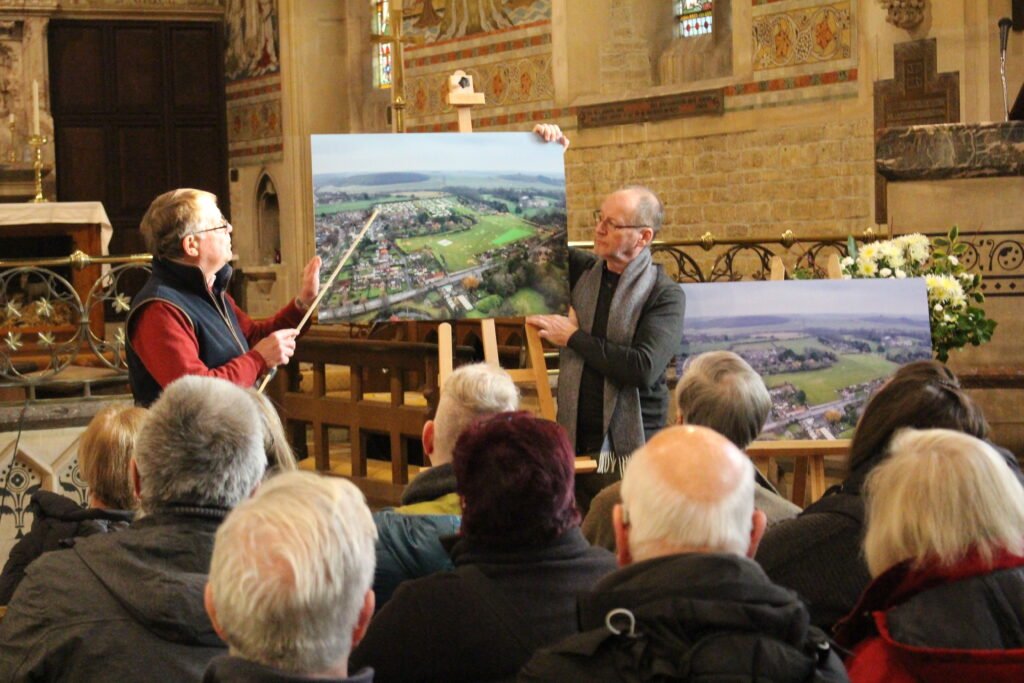
At this point, Nick Parker, with the help of Nick Tilt, stepped into the nave to explain the illustrations and diagrams of the Home Farm site, referencing boundaries, land ownership, and access to the proposed development.

Nick Parker then returned to the lectern and the microphone, to say:

What is EBBRAG is doing?

a) Stop purely residential development in a uniquely rural part of Warminster, which is outside the settlement boundary and rejected by Wiltshire Council as a development site.

b) Stop development impacting on already groaning town infrastructure including traffic, medical care, schooling, emergency services – EBBRAG has used National Statistics calculations for most support services for 1239+ houses, e.g. cars per house, a further 1500 cars in Warminster; Education another 325 primary and 169 secondary places, i.e. a further 494 school places!

c) Stop development generating surface and ground water following routes from the hills to the River Wylye through Home Farm land and causing flooding in areas which already flood on a regular basis such as Bishopstrow Roundabout and Home Farm and Grange Lane. In addition, contributing to dangerous rises in theil river level downstream for housing.

d) Stop development through strengthening our arguments with facts by employing experts, e.g.

i) A Conservationist looked at the impact on heritage designated and non-
designated assets around Home Farm and the report has been sent to Wiltshire Council.

ii) We have completed an aerial Topographical Survey to chart water flow from
Battlesbury Hill to the River Wylye. This shows areas around Boreham/Bishopstrow prone to flooding including Bellways’ proposed entrance to the site.

iii) An expert in river management to show already polluted and high levels of water in the River Wylye which will get worse through Climate Change and massive close development. We have sent an initial letter to Wiltshire Council concerning flooding in the east of Warminster and had a response.

iv) A Highways’ expert to show the current proposed entrance is dangerous and non-viable just after a blind bend on Boreham Road. The entrance was rejected in 2020 by Wiltshire Highways’ Department – why are they looking at it again?

iv) Finally Planning experts to show additional houses, on top of the proposed West Warminster Urban Extension, are not needed. It is speculative greed not need!

Bellway Homes

In the 2025 Bellway Annual Report they state they have nationwide a total of 94,944 development plots (houses) with either planning permission, awaiting planning permission or sites held under option to build! Why do they need a further 135 houses at Home Farm? Warminster does not need more houses, but the call for development sites by our Council has awoken the greedy.

There is a Facebook page called Bellway Homes Unhappy Customers (Hellway Homes) with over 3000 members who are complaining about the quality of their new Bellway homes – leaking roofs, mould growing in the attics, failure of items such as stairs, loos, leaks, etc. We are talking to the organisers of the Facebook page. What are councils doing about poor-quality building? The Town Council /Wiltshire Council will claim it is not their problem after approval is given.

The UK is currently one of the world’s most biodiverse-depleted countries. Urbanisation is a known driver of the nature crisis. This means that the planning system, which regulates development in the UK, plays a crucial role in protecting nature from harm.

However, in the summer of 2024, 42 new developments across five local planning authorities were audited in England to see whether developers were complying with these ecological conditions on the ground. Only 53% of the ecological features that should have been there were actually present. When street trees were removed, this fell to only 34% of what a developer said they would do!

I raise this as Bellway Homes has faced significant fines recently due to various
infractions, including: £600,000 for destroying a bat breeding site in Greenwich, which was the largest fine ever issued by an English court in relation to a wildlife crime and a further total of £100,115 for illegal water connections at two development sites and for dumping contaminated
soil on a site in Northumberland.

The point is these fines are very unusual as Councils do not normally follow up on what developers promise and then do not deliver or check the quality of the finished article! Look at Boreham Mead! I leave you to make your own minds up about who our Council has been in communication with without our knowledge!

Nick Parker then invited Gwynfor Evans to give a short history of the Warminster Neighbourhood Plan Process as experienced by EBBRAG:

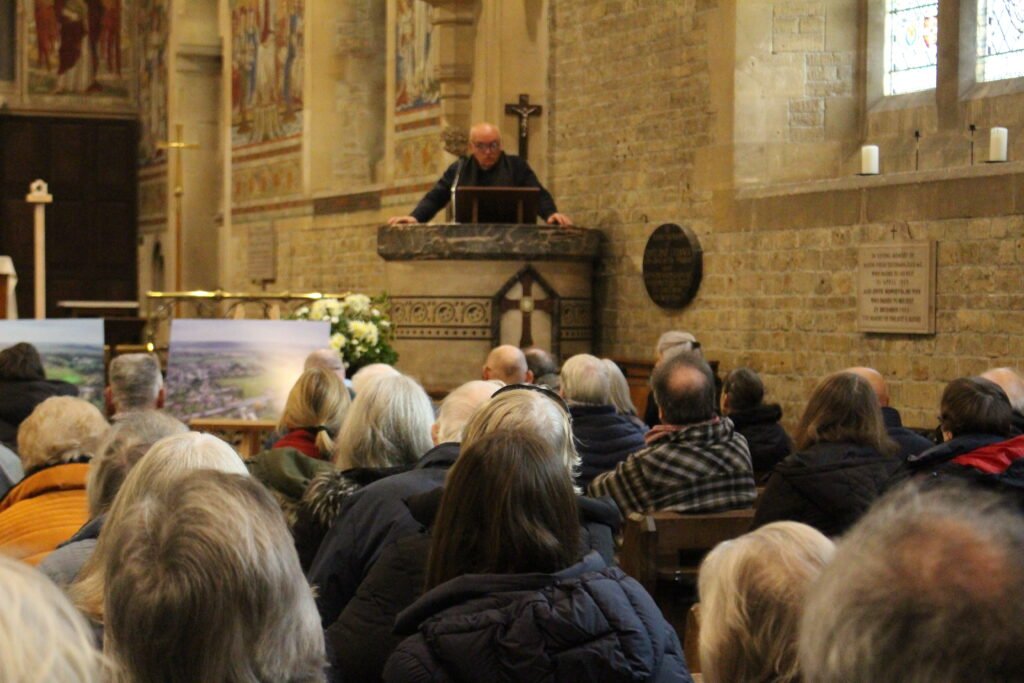
After climbing up the steps to the pulpit, Gwyn said:

The Neighbourhood Plan as we have experienced it

Good afternoon,
My name is Gwyn Evans, my wife Anne, and I live on Home Farm Lane. The character of our town is a product of its people, the built environment and the sheer beauty of its surrounding landscape and historic setting. Any changes to those key elements should be done in a carefully considered manner with the
avoidance of harm wherever possible. A neighbourhood plan ought to be an ideal vehicle to manage sustainable growth our town. We live in an age where we are frequently encouraged to express an opinion even if we have no
relevant experience or knowledge. I shall attempt to avoid that trap and share with you in an honest way, our experiences of our first encounter with a neighbourhood Plan.

Communication and consultation
My story begins with me seeing a post by a local resident expressing concern that a Warminster Neighbourhood Plan Consultation was live, with only two weeks remaining for residents to respond. Very quickly, my wife and I spoke to neighbours, the people running Bishopstrow Hotel and residents along Boreham Road, including Nick Parker, who we knew had been past Chair of EBBRAG. It was quickly evident that no-one we spoke to knew anything about this survey.

In a matter of days EBBRAG had reformed, designed a leaflet and distributed hundreds to residents living close to Home Farm. At this point, it genuinely felt like we were playing catch up! The Town Council had already had detailed discussions with land promoters and developers, and employed consultants who had assisted them in shortlisting sites for potential housing development. We were the last to know!

At this point an original FIFTEEN SITES FOR CONSIDERATION HAD ALREADY BEEN REDUCED TO THREE, HOME FARM being one of them.

Many good practice guides state that effective community engagement should be in place before public money is spent on the services of private consultants. Opportunity missed!

EBBRAG members have designed, paid for and distributed over 2,000 leaflets to our local community in Warminster, we have a website and a strong social media presence. Was a leaflet drop like Bellway’s not something the Town Council could have done?

Concerns over site selection
There are 14 members of the Neighbourhood Plan Steering group , comprising five Councillors and nine volunteers. To date, the Town Council has not been forthcoming about its framework and selection process for securing volunteers for such a pivotal role. My view would be that as far as possible, this group should be as representative as possible of a broad cross section of Warminster residents.

Site selection should be fairly straightforward in terms of a process:
Technical assessment criteria – a bit like buying a car. You apply the same criteria to each car you are considering, so that you can make a comparative
assessment to decide which model has the most to offer. This does not appear to have been done effectively during the site assessment process. The
same criteria were not applied to all of the sites under consideration, for example some sites were considered under one criteria which is not even referred to for another site, even though equally applicable.

It is also evident that some of the consultant’s advice was ignored for some sites, e.g. flooding issues were cited by the consultants in relation to Home Farm yet there is NO mention of it in the notes produced by the Steering Group!

Shortcomings in the democratic process/duplicity
EBBRAG were invited to a meeting in August 2025 to discuss the outcome of the informal survey of the three sites selected and to give us the opportunity to raise our concerns.

We were assured that the community would be consulted “at every stage” of the Neighbourhood Plan process.

We were told that building on Home Farm land WOULD happen and our only option to effect positive change was “to get behind the Neighbourhood Plan”.

WAS this a democratic process? OR A FOREGONE CONCLUSION?
The outcome appeared to have already been decided before a range of democratic processes which are normally part of the overall process had been completed, i.e. public consultation once the draft plan is ready – pretty much where we are now

oversight by Wiltshire County Council

public referendum

This is the crux of our issues.

Question put to the Town Council:

“If the developer elected to play the system by submitting a ‘speculative application,’ would they then be outside the Neighbourhood Plan process?”

Response “I can’t really speculate on the scenario you have put forward.”

The Minutes of a Warminster Town Council meeting on 8th July, obtained through a Freedom of Information request, revealed that the Town
Council already knew Bellway were ready to submit a formal pre- application bid with Wiltshire Council. Yet they elected not to share that with us. It is obvious that the Town Council had knowledge of what Bellway were doing. At their “drop-in consultation event” Bellway were quite open about their involvement with the Town Council.

Nick Parker then invited Jonathan Walker, of Bishopstrow House Hotel & Spa, to speak about the implications of Home Farm development for Bishopstrow Hotel & Spa.

Jonathan said:

Good afternoon.
My name is Jonathan Walker, Managing Director of Bishopstrow Hotel & Spa, thank you for the opportunity to speak to you, I appreciate it. We have owned Bishopstrow Hotel for the past four and a half years, and today, as part of
EBBRAG, I am speaking on behalf of a local business that is directly affected by this proposal.

For those who may not know, Bishopstrow Hotel sits immediately adjacent to the proposed housing development site. Over the last four years, we have invested very heavily in Bishopstrow. We have refurbished the guest rooms, public areas and spa, and carried out extensive work across the grounds,
including the river garden. This has not been cosmetic investment — it has been a long-term commitment to the area.

When we purchased Bishopstrow, we employed 35 people. Today, we employ over 100 full-time and part-time staff, making us the third-largest employer in the town. The majority of our team live locally in Warminster and nearby towns such as Westbury and Frome. Bishopstrow is not just a hotel; it is a significant local employer and contributor to the local economy.

What we offer our guests is peace, tranquillity, and a true Wiltshire experience. Guests come to enjoy the historic Georgian house, the beautiful grounds, and the surrounding countryside. They come to walk the local landscape, to enjoy the views towards the hills and historic settlements, and to explore nearby attractions such as Longleat, Stourhead and Stonehenge. Many of our guests bring their dogs specifically to enjoy these walks and open spaces. This
sense of calm and connection with nature is central to why people choose Bishopstrow.

The spa is absolutely critical to our future. All of our spa members live locally. They use the gym, sauna, steam room and indoor pool — but what they value most is the outdoor spa experience: the external pool, the grounds, and the sense of privacy and quiet.

We are currently investing a significant sum to further develop these outdoor spa areas. This includes refurbishing the external pool, adding a hydrotherapy pool and an outdoor sauna.

Going forward, Bishopstrow will be even more strongly positioned as a place to reconnect with nature. On land directly next to the proposed development site, we plan to extend our art installations for guests and local residents to enjoy.
Importantly, our grounds are open to the local community. We actively encourage local people to walk through the river garden and explore the estate. Bishopstrow is part of this community – not separate from it.

Economically, our contribution goes far beyond direct employment. We bring visitors into the area who spend money in local shops, restaurants and attractions. We also make a deliberate effort to use local suppliers and contractors wherever possible.

Our concerns about this development are therefore very real and very specific.

First, our spa grounds sit next to the proposed construction access road. Construction traffic, noise, fumes, lighting and disruption would severely damage the guest and member experience – the very thing people come to us for.

Second, once built, the development would permanently affect noise levels, light pollution, traffic volumes and, critically, the views from the hotel and spa. These views are not incidental – they are part of the product we sell.

Third, Bishopstrow is a Grade II listed Georgian building set within historic grounds. The estate includes multiple Grade II listed structures, historic walls, and three protected scheduled monuments, including King Barrow. This is a heritage landscape of county importance.

It is also important to note that in the past, Bishopstrow Hotel and Spa was explicitly cited as a key reason why housing development at Home Farm should not proceed. We are a recognised heritage asset. We have not moved. We are still here. And we still object.

Let me be clear: I am not opposed to housing development in principle. I fully understand the national need for more housing. But I do believe in responsible housing, and I do not believe this proposal is responsible. The scale, location and impact of this development would cause lasting harm to a unique
rural and historic setting. We need our council to work harder to identify sites that do not undermine one of the most beautiful parts of our county.

Like others have said today, I also question the sheer number of houses being forced onto this area.

So, I oppose this development as a business owner, but also as a neighbour and a custodian of this landscape. Bishopstrow is a special place – one that I believe is being undervalued by local decision-makers. Once places like this are damaged, they cannot be restored. Once historic landscapes are lost,
they are lost forever. We have a responsibility to stand against irresponsible development – not just for ourselves, but for future generations.

Thank you.

As Jonathan returned to his seat the audience applauded. It seems there was a lot of love in the room for Bishopstrow Hotel & Spa.

Nick Parker then invited Nick Tilt, who lives adjacent the B3414 road at Boreham, in the long inhabited family home, to speak about highway concerns and traffic on Boreham Road, something he knows about very well.

Nick said:

There are significant highway safety concerns relating to the proposed access road, visibility splays,required for development on Home Farm, and prevailing vehicle speeds on Boreham Road, which is subject to blind bends and carries a high volume and wide mix of traffic including cars, buses, HGVs, articulated lorries, and military vehicles.

Although the speed limit at the proposed access point is 30/40 mph, observed vehicle speeds frequently exceed these limits in both directions. While a 2017 traffic survey concluded that accident patterns would not be affected by the proposed development, there have been at least five recorded traffic incidents in recent years in close proximity to the proposed access, including collisions involving military vehicles, parked vehicles, and vulnerable road users. These incidents raise serious concerns regarding the suitability of this location for a new vehicular access.

The proposed access would be formed at the existing Home Farm entrance and would require the introduction of a right-turn centre ghost lane to protect westbound traffic turning right into the development. This would materially alter the character of Boreham Road at this point through extensive road markings that would result in harm to the setting and character of Bishopstrow Conservation Area.

In accordance with UK highways ghost lane junction design guidelines, each traffic lane, including the ghost lane, must be a minimum of 3.0 metres wide, requiring a total carriageway width of 9.0 metres. The existing carriageway at this location is too narrow and would need to be widened southwards into the conservation area. This would likely result in unacceptable harm to the root protection areas of the seven magnificent mature trees along the southern boundary. It would also cause a severe narrowing of the westbound lane at the point it approaches the driveway and 100 year old beech hedge of 202 Boreham Road and the bend near Boreham ManorH ouse, further exacerbating highway safety concerns.

Compliance with visibility requirements would also necessitate the formation of a splayed access through the existing heritage stone wall. Based on Wiltshire highways previously accepted drawings, approximately 30 metres of this historic wall would need to be demolished and rebuilt to achieve the required visibility splays. The associated ghost lane would extend approximately 55 metres west and 85 metres east of Home Farm Lane, almost to the entrance of Bishopstrow House Hotel and would likely require additional street lighting along its full length, resulting in a significant level of urbanising of this sensitive rural and conservation area setting.

Finally, 2021 Census data indicates an average car ownership of 1.23 vehicles per
household, equating to approximately 170 additional vehicles accessing Boreham Road from the development. This would place additional strain on an already congested western approach to Warminster, particularly during peak periods, and does not account for additional traffic movements resulting from deliveries, visitors, taxis, or other service vehicles.

For these reasons, the proposal raises substantial concerns in relation to highway safety, conservation impact, and the suitability of the access arrangement, and is therefore considered unacceptable. And it’s not just us who share these concerns!

In 2020, expert witness statements from Wiltshire Council (South) Conservation Officer and the Government appointed Planning Inspectorate concluded the following against the then proposed development of the Home Farm site and nothing has changed since their reports:

The wall has a “strong” street presence. A splayed opening (and associated highways works, including the creation of a ghost island and right turning lane) would create a much more suburban character and erode the attractive linear qualities of the wall as well as involve the loss of historic fabric. The current rural character is further reinforced by the modest number of street lights. The area is very dark at night, reinforcing the very rural character of the area. – Jocelyn Sage MSc, BSc(Hons), PG Dip TP, IHBC, Conservation Officer, Wiltshire Council (South).

“To provide access to the developable part of the site would require a new access off Boreham Road. This would include the loss of a significant stretch of an existing high wall that is important to the character of the street and setting of the conservation area. The access road would also need to run through the southern part of the site, potentially having a detrimental impact on the setting of heritage assets. Even if similar measures to those described for sites
H2.4 and H2.6 were considered, I am not convinced that the inevitable change in character would not result in unacceptable harm.” – Steven Lee BA(Hons) MA MRPTI, an Inspector appointed by the Secretary of State.

Nick Parker then invited the final speaker Jeremy Kelton, whose home is on a bank of the River Wylye, to speak about the River Wylye and flooding issues.

Jeremy said:

The stretch of the Wylye below Boreham Mill is where all the water flows from Warminster now end up. That stretch therefore picks up FULL effects of all the new building because of:

1. the loss of the floodplain
2. all the new hard standing which leads to fast run-off
3. domestic water brought into the catchment from elsewhere.

We believe that this BUILDING had a significant effect on flooding in Jan 2024 [river colour].

Also CLIMATE CHANGE is creating flooding:
The Govt can now measure the effects of climate change- critically, storms carry 15-20% more water.

The Government now says the number of properties at high risk of flooding could rise by 73% by mid century.

In January 2024 we witnessed floods:
1. The farm chemical factory in Watery Lane – flooded into their offices
A number of houses on river in Bishopstrow were inches from flooding.

2. Park Cottages by Boreham Mead flooded- we believe Boreham Mead was built up more, sending the water elsewhere.

3. Flooding on Boreham roundabout made it impassable to emergency vehicles.
The water was full of sewage coming down from overflows in the houses on Woodcock Road.

Also, the lack of capacity of pumping station on Boreham Road was a major factor.

HOME FARM WILL CONNECT TO THE SAME PUMPING STATION MAKING THE SITUATION WORSE.

THE REAL PROBLEM- Authorities still look at ISOLATED planning applications NOT THE CUMULATIVE EFFECTS OF ALL THE BUILDING.

WE BELIEVE THAT Wiltshire Council needs to commission a detailed study of the water movement and flood potential in Warminster BEFORE they make any planning decisions. The Environment Agency said this was necessary for any new build after the West Warminster Urban Extension, but it hasn’t happened.

Nick Parker then opened the meeting up to the floor, to allow anyone present to have their say or raise their concerns about the planning process, the Neighbourhood Plan and development on Home Farm.

Questions and comments could be summarised as:

If we need only 90 homes, why are there so many building
developments with hundreds more houses being proposed?

The developers at Jubilee Gardens are struggling to sell their
properties. Other councils are buying up properties to fill the
shortfall in housing stock in their areas.

By the time the Neighbourhood Plan is completed and
ratified, the five years’ protection against speculative building
will have almost elapsed.

Am I right in thinking we, the public, should have been consulted about the Neighbourhood Plan before the draft was written?

Westbury Road development is back on the table as it has
gone to appeal.

There are housing units on army land which could be included
in the figures for required housing allocation; increasing
military accommodation could well offset the need for more
housing (Dr Andrew Murrison, M.P.)

Does anyone know what the Labour Government’s future plans are for housing?

The Town Council does try to engage the public about local issues,
including the Neighbourhood Plan, with often disappointing
response. The Council only has a limited budget – £200,000 for the Neighbourhood Plan. I urge people to look at the Town Council and Neighbourhood Plan websites and to be “proactive”. I am against development at Home Farm (applause). When you object, you need to use “planning” reasons to underpin objections. (East Ward Town Councillor Chris Robbins).

People are not bothered until a development directly affects them.

61 homes+ have already been built in the East of Warminster, – why do we
need more?

Government policy is to blame – relaxation of the planning process. Harder to block development.

There is a huge tip in the ground underneath part of the proposed site which is full of cars and all sorts of nasty things – the land could be contaminated.

I live at The Dene and I’ve noticed lots of bats in our area.

There has been consultation about the Neighbourhood Plan. I stood with Nick Parker in the Three Horseshoes Walk, canvassing people about the Plan (Town Councillor Stacie Allensby).

Nick Tilt then stood up and made an impassioned plea: Warminster is a great place to live and bring up your children. If you are concerned about what we have raised and feel passionate about it, then you need to vote against the
Neighbourhood plan and get 10 friends/contacts who live in the are to do the same.

With the time now approaching 4.30 p.m. Nick Parker summed up the proceedings:

Nick said:

At present we need to play a waiting game as:

The draft Neighbourhood Plan process is slow and painful – at some stage we the residents of Warminster need to vote for a plan to be approved? A lot of good work has gone into the rewrite, but to stop Home Farm inclusion I will vote against its acceptance at the appropriate time – will you?

The Bellway Homes application – We need to wait for submission of application to Wiltshire Council and then react – some 13 weeks to react. EBBRAG will organise responses, including draft format of letters from residents and if necessary legal argument against the application.

We are still looking for experts with hydrology, planning, legal expertise to help save expense – if you know of anyone please get in touch.

And we will continue to update via the EBBRAG website, Facebook, and Instagram pages, and will email provided you have registered your address via the contact form on our website or through social media.

Funding
EBBRAG has now spent some £3,000.

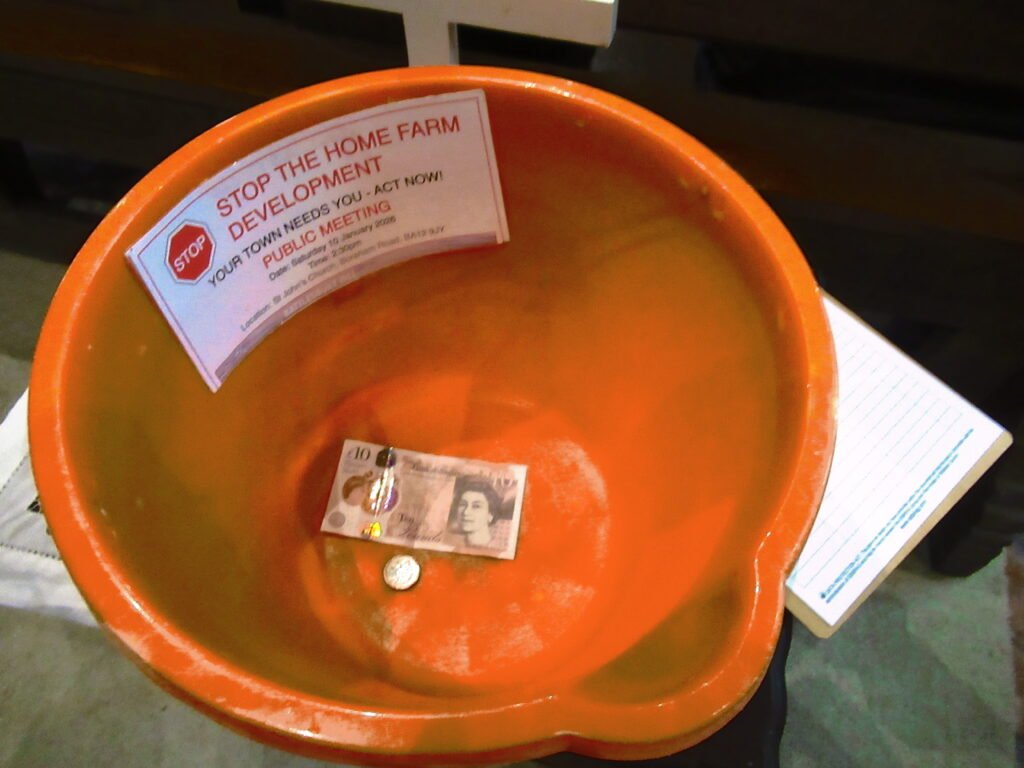
Many of you have been very generous already and I appreciate that this time of year with the current cost of living crises mean every penny must be watched, but EBBRAG needs your financial help to employ the experts we need. There are 2 buckets at the entrance as you leave so any amount of cash however small is gratefully received.

You can also donate via the EBBRAG website: www.ebbrag.com

The EBBRAG Lloyds Business account is audited by an independent financial expert every 6 months.

Conclusion
It is worrying the Neighbourhhood Plan has not been community led, as you have heard, nor stopped speculative development in Warminster for houses not needed. Jubilee Gardens is slowing their house building, because they cannot sell houses. Why is our Town Council therefor looking at Home Farm and other sites for a further 439 houses when Jubilee Gardens can produce the perceived requirement? The Town Council said they want to stop speculative development for 5 years – this is a joke as they have encouraged it and are now powerless to stop it!

The Town Council enthusiastically applauded in spring 2025 a Planning Inspectors refusal of Barrett homes application to build on Westbury Road with the then Mayor stating “The proposed development is not in keeping with the stylistic context or scale of the local area” and “Residents had raised concerns over sewage management, public safety, and the character of the town potentially being distorted.”

What is different about these three new sites and why is this Council pursuing these plans in isolation without the supporting infrastructure in place beforehand?

Please register and monitor the EBBRAG media sites, local news, talk to neighbours and friends, write/talk to local councillors who should be representing your views, complain if you don’t get the response you think you deserve and react when EBBRAG sends out critical information.

Thank you for listening today I hope you are as fired up as we are.

As people left the church they made donations to EBBRAG.
£211.93 in buckets; and £50 via Sum Up electronic donation.

Further donations to fighting development on Home Farm can be made via the EBBRAG website: www.ebbrag.com/donate/

Press Release From EBBRAG

Wednesday 7th January 2026

Press Release from EBBRAG (the East Boreham Businesses And Residents Action Group):

Previous press coverage from EBBRAG (the East Boreham Businesses And Residents Action Group) about the consequences of residential development on Home Farm, has awakened the community.

As yet, however, most people are unaware that with the proposed Ashley Coombe (77 houses), Cley Hill View (227 houses) and Home Farm (135 houses) developments this makes a total of a further 439 houses on top of the WWUE (1200 houses?) without any change or increase to the supporting infrastructure. This make 1639 houses in Warminster when all are completed.

We understand houses are not selling as expected on Jubilee Gardens and the developer has slowed the build.

The Town Council were delighted when the application on Westbury Road was turned down in March 2025. They, and Wiltshire Council, have singularly failed, however, to plan, compensate or provide increased infrastructure support for this new increase in housing.

As an example of the storm that is coming when all 1639 houses are completed, based on Government National Averages in 2022:

Education: a further 409 Primary School Children and 213 Secondary Children. Schools are near capacity now.

Traffic: 1639 houses brings an increase of 738 cars (one car/van per household) and 171 cars (for 2 cars/van per household) in Warminster, making a total of 909 cars/vans when the houses are complete. The  town is grid locked at peak times in the morning and afternoon already.

Finally, developers are failing to meet the conditions imposed on applications when granted i.e. where is the new school and surgery for Jubilee Gardens? Where is the environmental planting for Boreham Mead and Mill Island?

Warminster Community Radio, Will Feature An Interview With EBBRAG Members About The Campaign To Stop Development On Home Farm.

Tuesday 6th January 2026

From the Facebook page of EBBRAG (the East Boreham Business and Residents Action Group):

Community Chest, hosted by Andrew Robinson, on Warminster Community Radio, will be featuring an interview with EBBRAG members about the campaign to stop development on Home Farm.

The programme is on Saturday 10th January 2025, commencing at 9.00 a.m. Andrew tells us the interview will be at approx 9.30 a.m.

EBBRAG has several serious concerns about a pre-planning application submitted by Bellway Homes to Wiltshire Council to develop Home Farm land:

The Town Council (TC) appear to have been in communication with Bellway Homes since 2021 without consulting/informing the residents of Warminster.

The current TC Neighbourhood Plan rewrite team have not followed the defined and democratic process for selecting possible development sites. In particularly, seeking the approval of Warminster residents before selecting those sites. During the first informal survey 61% of residents who responded stated they did not want Home Farm land developed. The TC continues to pursue the site selection.

The TC has not made the effort to understand the criticism and comments of a Government appointed Planning Inspector when he so strongly rejected the site in 2020, in order to mitigate his findings.

The proposed development site is alongside the third largest employer in Warminster, who has invested heavily into the site due to its tranquil, unspoilt location in the countryside and outside the Warminster settlement boundary. The economic outcome for Warminster is therefore seriously in jeopardy if this development is approved.

To find out more about EBBRAG and their campaign

email: info@ebbrag.com

website: www.ebbrag.com

Instagram: www.instagram.com/ebbrag_warminster/

Latest Update From EBBRAG

Sunday 4th January 2025

Latest Update From EBBRAG (the East Boreham Business And Residents Action Group) – Fighting to stop development on Home Farm.

Due to recent legislative changes by the Government, there appears to be something of a national house building frenzy by developers. Whilst we all recognise the need for building homes for our future, it should not be at the expense of vital services and infrastructure nor should it result in a permanent loss of amenity space or the loss of landscape that defines the very character of Warminster.

EBBRAG would therefore like to invite you to a public meeting at St. John’s Church, Boreham Road, on Saturday 10th January 2026, starting at 2.30pm. The date and time has been selected to allow the maximum number to attend in daylight and for most on a non-working day.

EBBRAG thanks the St. John’s Parochial Church Council (PCC) for allowing the meeting to be held in the church.

The intention is to:

Give a brief outline of the history of EBBRAG and what is currently being undertaken by EBBRAG to stop the possibility of development of Home Farm land.

The consequences of a development on Home Farm land for Warminster and the surrounding businesses and residents.

How you can help to stop it.

Give you the opportunity to ask questions, voice your thoughts or allow you to suggest ways to stop the development.

As an example of recent EBBRAG activity, we have commissioned a Conservation Impact Report which has been sent to the relative authority, completed an authoritative topographical survey, raised serious concerns (based on fact), with Wiltshire Council over the prospect of development increasing the flood risk in East Warminster and continue to lobby/question the Town Council (TC) and Neighbourhood Plan (NP) rewrite team over their undemocratic process for selecting Home Farm Land.

61% of Warminster respondents to the NP recent informal survey stated they did not want development on Home Farm, which the TC/NP team then ignored. The TC are now claiming that the respondents were a small fraction of the total Warminster residents. They have not explained unfortunately why their survey only attracted a small percentage of Warminster residents. Even so, 61% of respondents said no.

As you will appreciate, hiring experts to assist EBBRAG is expensive and some £3,000 of donations has been spent so far. While the current financial situation is hard for the majority of us, anything you can spare will help EBBRAG hire the best experts available. You can make a bank transfer, give cash at the public meeting or make a pledge on this means in case your funds are needed in the future. Details are on the EBBRAG website. Any funds not needed will be refunded on a pro-rata basis.

Following the public meeting, EBBRAG will consider the next steps, including possible legal action, if a planning application is submitted.

Lastly you should be aware all four East Ward Town Councillors and the local MP, Dr Murrison, have been invited to the meeting. If they wish to address the meeting about a possible development on Home Farm they are more than welcome.

If you can’t attend the meeting but want to be involved, or you require further info, please email: info@ebbrag.com

Donations welcome (even small amounts help). To make a donation to the EBBRAG funds to fight development on Home Farm, go to: https://www.ebbrag.com/donate/

Website: www.ebbrag.com

Facebook: https://www.facebook.com/groups/389576351110879

Instagram: https://www.instagram.com/ebbrag_warminster/

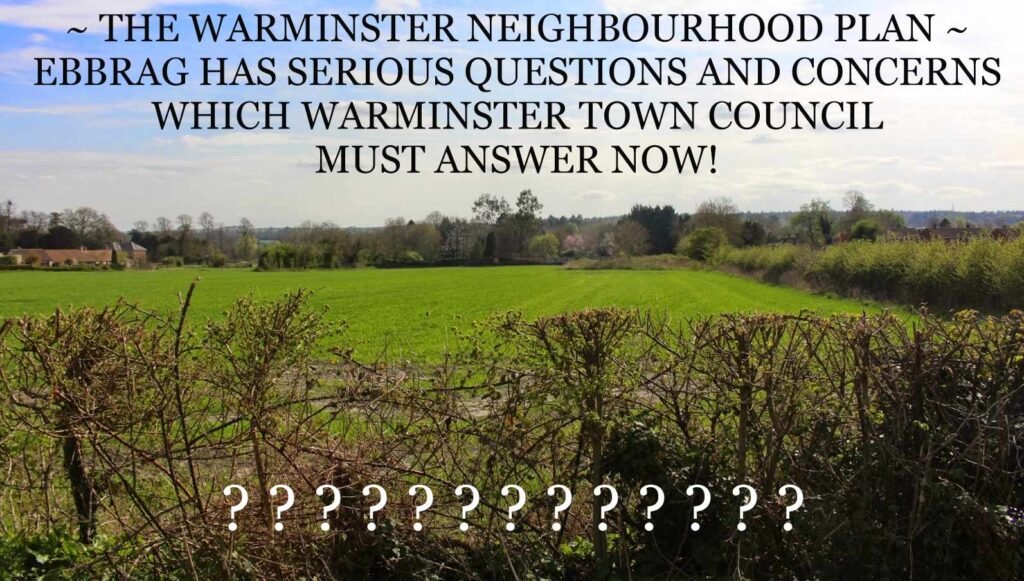
The Warminster Neighbourhood Plan ~ EBBRAG Has Serious Questions And Concerns Which Warminster Town Council Must Answer Now!

Friday 2nd January 2026

From the Facebook page of EBBRAG (the East Boreham Business And Residents Action Group):

THE WARMINSTER NEIGHBOURHOOD PLAN – EBBRAG HAS SERIOUS QUESTIONS AND CONCERNS WHICH WARMINSTER TOWN COUNCIL MUST ANSWER NOW!

(Written by an EBBRAG supporter, but more importantly, a resident of Warminster town)

Key PRINCIPLES of a Neighbourhood Plan

A Neighbourhood Plan should be a “community led’ process at every stage.

An approved Neighbourhood Plan, which identifies sites for development approved by a 50% local “yes” vote, offers a town some protection from “speculative” planning applications for a period of five years.

.A review of existing evidence should be undertaken including

Conservation area appraisals and statutory lists (listed buildings, historic, environmental record and scheduled ancient monuments)

Asking consultants to produce options before consulting the community is poor practice.

(taken from guidance on good practice in relation to developing a neighbourhood plan ‘Quick Guide to Neighbourhood Plans’) Ref : Dave Chetwyn MA., MRTPI, IHBC, Finest.M- Managing Director of Urban Vision Enterprise CIC and a Design Council CABE Built Environment expert. Other roles (present and former) ; Planning Chair with Civic Voice, Vice Chair of the National Planning Forum, Vice Chair of the Historic Towns Forum, Planning Adviser to Locality and Heritage Specialist on Crossrail , Head Planning Aid England, UK Chair of the Institute of Historic Building Conservation. He has advised and participated in various Government groups, reviews and Parliamentary select committees on planning, heritage, urban design, economic development, state aid and community engagement. Chartered member of the Royal Town Planning Institute, full member of the Institute of Historic Building Conservation and a fellow of the Institute of Leadership and Management.

Our fundamental issues:

– We feel decisions, well intentioned though they may have been, have largely been made behind closed doors and without meaningful reference to the community of Warminster.

– Bellway Homes are poised to submit a “speculative” planning application.

– In putting forward Home Farm as a potential site for development, historic barriers to building there for environmental, heritage and practical reasons have not been given sufficiently thorough consideration. The site has been turned down several times previously for very sound reasons.

– If allowed to go ahead, development of Home Farm land will forever change an area much loved and used by residents from across the town and wider afield by ramblers and hikers, dog walkers, horse riders, cyclists, historians, nature lovers and people who just enjoy the sensational views from Battlesbury, Middle and Scratchbury Hills.

On their website, the Town Council describe the Neighbourhood Plan process as “a community -led project by Warminster Town Council and local volunteers to shape the future development in Warminster.”

“The neighbourhood Plan gives you, the community who live here and who know Warminster best, a real voice.”

The legal point “Community engagement is a requirement of planning legislation, including for Neighbourhood Plans. It is essential in developing consensus and creating community support. Failure to engage communities at an early stage is one of the main causes of conflict later in the planning process.” Ref : Dave Chetwyn

TIMELINE

The current plan – which is still legally valid was made in 2016 and is now being reviewed. Work on this review began as far back as 2022. This week, whilst actively “researching” the neighbourhood plan, I came across an old Facebook feed @JohnBakeNewsW1:

The revised plan will need to look ahead, as far as 2036, and address important local issues.

During 2022, members of the Warminster community volunteered to support the town council, and other professionals, in beginning to update the Neighbourhood Plan.

As we move into 2023, we still need the local community to be fully involved and help ensure the Neighbourhood Plan reflects your views.

Interestingly, there were 0 comments in response to this post!

Summer 2025

As someone who is not a regular Facebook user, I did not become aware of anything to do with the Neighbourhood Plan until this summer, when my husband stumbled across a reference to an “informal consultation” about sites being proposed for housing development. By this time an original FIFTEEN sites had already been reduced to just THREE, for residents to comment on : Home Farm/Land East of Dene, Yew Tree public house and Ashley Combe.

This was about a week before the deadline for people to submit their thoughts online. We have lived in Warminster for 10 years, go into town regularly, use the library and yet were completely unaware of any Neighbourhood Plan. This gives rise to the questions:

How serious were the Town Council about the Neighbourhood plan being “community led”?

How proactive and effective have they really been at publicising and engaging the local community?

They may have been well intentioned but the reality is, many people didn’t know about it.

We set about informing as many people as we could about this informal consultation, as quickly as we could, including residents and local businesses. It was clear that this all came as a bolt out of the blue for most of the people we contacted – including the Manager / Director of Bishopstrow Hotel – a significant employer and local business adjacent to the proposed site.

The results ultimately revealed that 61% of respondents did not want building at Home Farm.

August 2025

Following the results of this informal consultation, members of EBBRAG were invited to a meeting hosted by the Town Council, ostensibly to raise concerns and ask questions.

Despite being told by representatives of the Town Council and their team of consultants (incidentally paid for with public money), that their aim was to be open and transparent, we came away with many questions unanswered and a distinct feeling that the decision to promote Home Farm as a site for development had pretty much been made already (albeit, not “officially”).

We also discovered at the meeting that the Ashley Coombe site had been removed from the Neighbourhood Plan process and with Yew Tree public house only offering the possibility of a build of 2 or 3 homes, the Home Farm site was left as the only remaining site.

This does give rise to another question:

Why were other sites not brought back in for consideration at this stage?

November 2025

Bellway Homes launched an online public consultation, with a daytime “drop in” session for residents of Warminster to comment on their proposal for development of land at Home Farm, following a broad leaflet drop to households across the town.

Their outline plan is pretty much the same as the plan we were shown at the meeting in August by the Town council, just with added detail relating to the specific type and layout of the dwellings.

At the “drop in”, Bellway Homes were quite open about the fact that they had already engaged in a pre- planning exercise and were intending to enter a full “speculative” application in early 2026, effectively putting them outside the Neighbourhood plan process.

Incidentally, the developer – Rubix- interested in the Ashley Coombe site also initiated a consultation about their proposed development at about the same time.

This gives rise to the questions:

What protection does the Neighbourhood Plan process really give against “speculative” applications by developers? Does it unintentionally encourage them?

Going forward to 2026

1. It is highly likely that Bellway Homes will submit a formal planning application for the Home Farm site early to mid 2026.

It is perhaps worth mentioning they do not have a great reputation as a builder, both in terms of the quality of the houses they build, nor in their delivery of agreed mitigations for reducing identified potentially negative “impacts” of their developments.

IT IS VITAL TO FORMALLY OBJECT TO THIS DEVELOPMENT IF YOU ARE AGAINST IT, EITHER INDIVIDUALLY OR BY PUTTING YOUR NAME BEHIND EBBRAG OBJECTIONS.

2. The official public referendum for/against the Neighbourhood Plan is likely to be early 2026.

IT IS VITAL TO MAKE YOUR VOICE HEARD BY EXERCISING YOUR RIGHT TO VOTE.

PLEASE NOTE, EBBRAG IS NOT a small group of residents who just object to a development “in their back yards”. IT IS a group of people who care passionately about the potential scarring of, and impact forever on, one of Warminster town’s most beautiful landscapes and historically sensitive areas, currently enjoyed by many residents from across the town and visitors alike.

EBBRAG would love to hear from you, contact EBBRAG:

email: info@ebbrag.com

website: www.ebbrag.com