Friday 20th February 2015
Judy Dunkley (nee Witchell) writes ~
“Hi Danny,
I’ve just come across your website when trying to find information about Boreham Farm. It’s really interesting!
My ancestor g g grandfather- William WITCHELL and family lived in Smallbrook Lane in 1871; you have a list of their names on there.
They also lived at 48 Temple Row in 1881, the census shows it was quite near to Boreham Farm, Boreham Villa and Heronslade. He was an ag lab probably very poor, was in the workhouse twice.
I’ve looked at old maps at the Records office in Chippenham but Temple Row isn’t named.
We decided the houses/cottages as they probably would have been may have been named by Mr Temple.
I wonder if you know where these houses may have been? And which school the children may have attended in 1880’s?
Thank you.”
Danny Howell replies ~
Hello Judy Dunkley,
Thank you for your email. Pleased to hear from you!
The row of cottages at Boreham, Warminster, known as Temple Row, were named after the Temple family, Lords of the Manor.
The name Temple Row is now almost forgotten, and the cottages were renumbered 153, 155 and 157 Boreham Road, Warminster.
In recent years, number 155 was made into two homes, now numbered 155a and 155b, with the cottage names Riverview and Well Cottage respectively. (155b has a well in its back garden which can still be seen – restored as a feature – today).
Nos. 153 and 157 just remain as numbered homes with no cottage names.
You can see photos of how the row of cottages (formerly known as Temple Row) now look by clicking on these links to my website:
http://www.dannyhowell.net/2015/01/nos-153-155a-155b-157-boreham-road.html
http://www.dannyhowell.net/2014/08/nos153-155a-and-155b-boreham-road.html
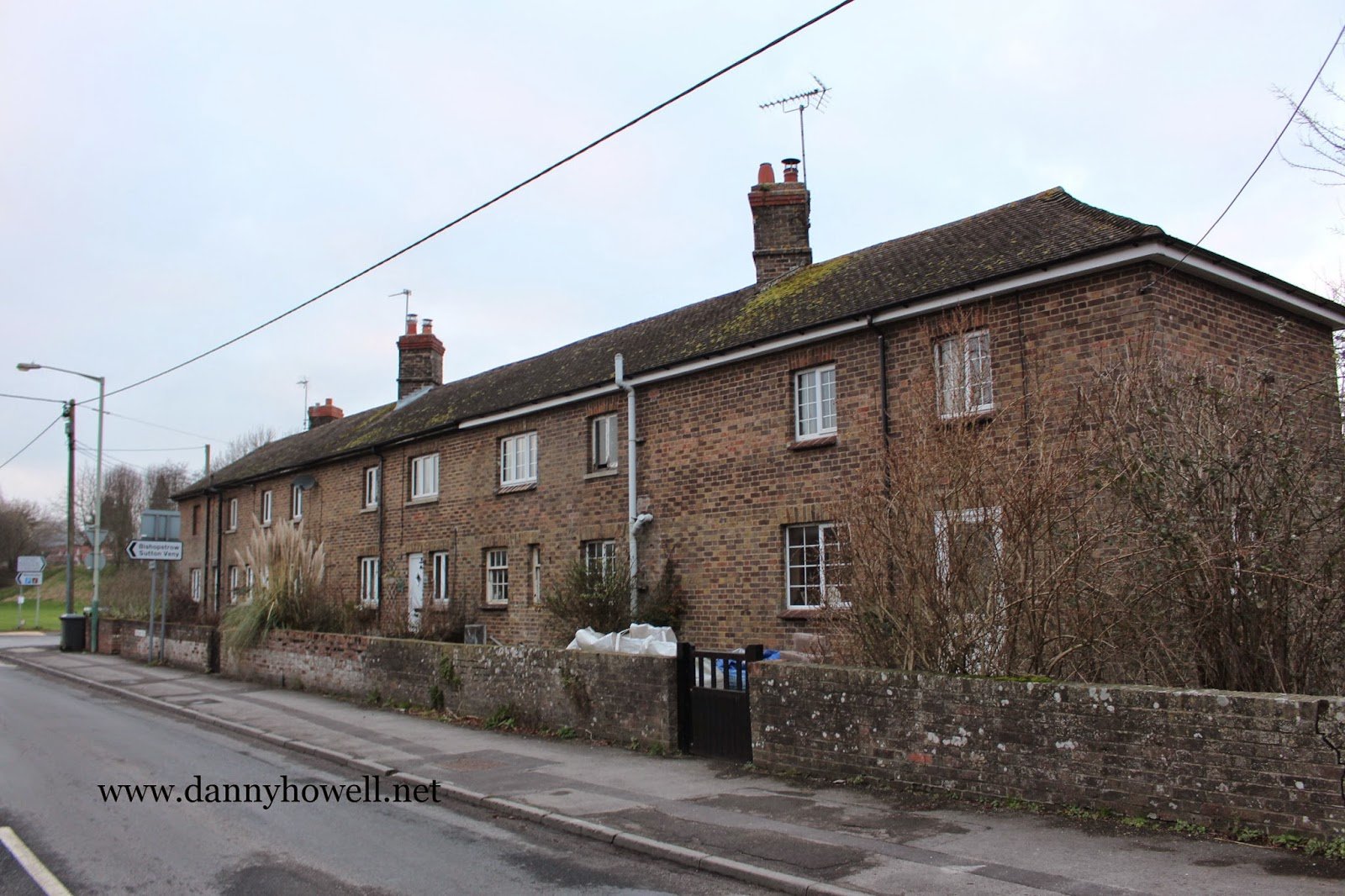
These cottages were indeed where some of the staff of the neighbouring Boreham Farm lived.
No.153 was where the dairyman for Boreham Farm lived. There is a door in the garden wall to the rear of this cottage which gave access to a small building known as The Dairy. The dairy building has since been demolished. No doubt it was where the dairyman brought milk from the farm to be processed in some way.
Boreham Farm, I guess you know, stood on what is now St. George’s Playing Field on the opposite side of Woodcock Road, just round the corner from Temple Row. The farmhouse and the farm buildings and yard were demolished c.1968. There is an aerial view of Boreham Farm on my website, click on:
http://www.dannyhowell.net/1970/08/boreham-farm-warminster-in-mid-1960s.html
Temple Row is not on the aerial photo but just off the lower right corner of the photo.
I think I’m right in saying that although the row of cottages have had tiled roofs for many years, in your g g grandfather’s day they were thatched.
I think I’m right in saying too that Boreham Farm was farmed by the Beaven family in the 1870s. In 2012, Barbara Mulligan (in New Zealand) and David Cuthbert produced a book called Lives Well Lived, which concentrates on Arthur Ward Beaven who emigrated to New Zealand, having become an engineer. The book features a chapter about Boreham Farm and how it was farmed. It is/was available in the UK. The ISBN for the book is 9780473222390.
With regard your question about schools, there were two, both about the same distance from Temple Row, in existence in the 1880s. There was a school in Bishopstrow, the adjacent village to the south. Bishopstrow School is no longer a school but the building survives as Bishopstrow Village Hall. And to the west along Boreham Road, next to St. John’s Church, was St. John’s School, Boreham. St. John’s School is still operating today. The original school building still stands but recently new classrooms were built in the grounds to the rear,
There is a photo of St.John’s School, Boreham Road, Warminster, on my website, click on:
http://www.dannyhowell.net/2012/10/st-johns-school.html
I hope this information answers your questions.”