Wilson & Kennard, Warminster

Extract from The Changing Face Of Warminster by Wilfred Middlebrook, published in 1971:

Older still is the large brown stone establishment of Wilson and Kennard, a little further along; [the Market Place] a family grocery business founded in 1796. Still with coffee beans and a coffee grinder in the window, and the pleasing aroma of real coffee, this remains the only shop in the Market Place that can boast of personal service by counter hands – a reminder of the leisurely shopping methods of a bygone age. Other grocers have been compelled by the supermarkets to convert their shops into self-service emporiums but Wilson And Kennard still dispenses individual service, with a coffee lounge in the rear where customers can further relax.
Few Trees Remain At The Avenue, Warminster

In The Changing Face of Warminster, (1971), Wilfred Middlebrook says:

“The Avenue links Common Close with Station Road. Like Ash Walk this thoroughfare is still barred to wheeled traffic by stout posts, though there may well be an exit from the Central Car Park at some future date, land still being cleared across from the Avenue School. Few trees remain to give any meaning to its title, and the Avenue has seen several changes in the last forty years.”

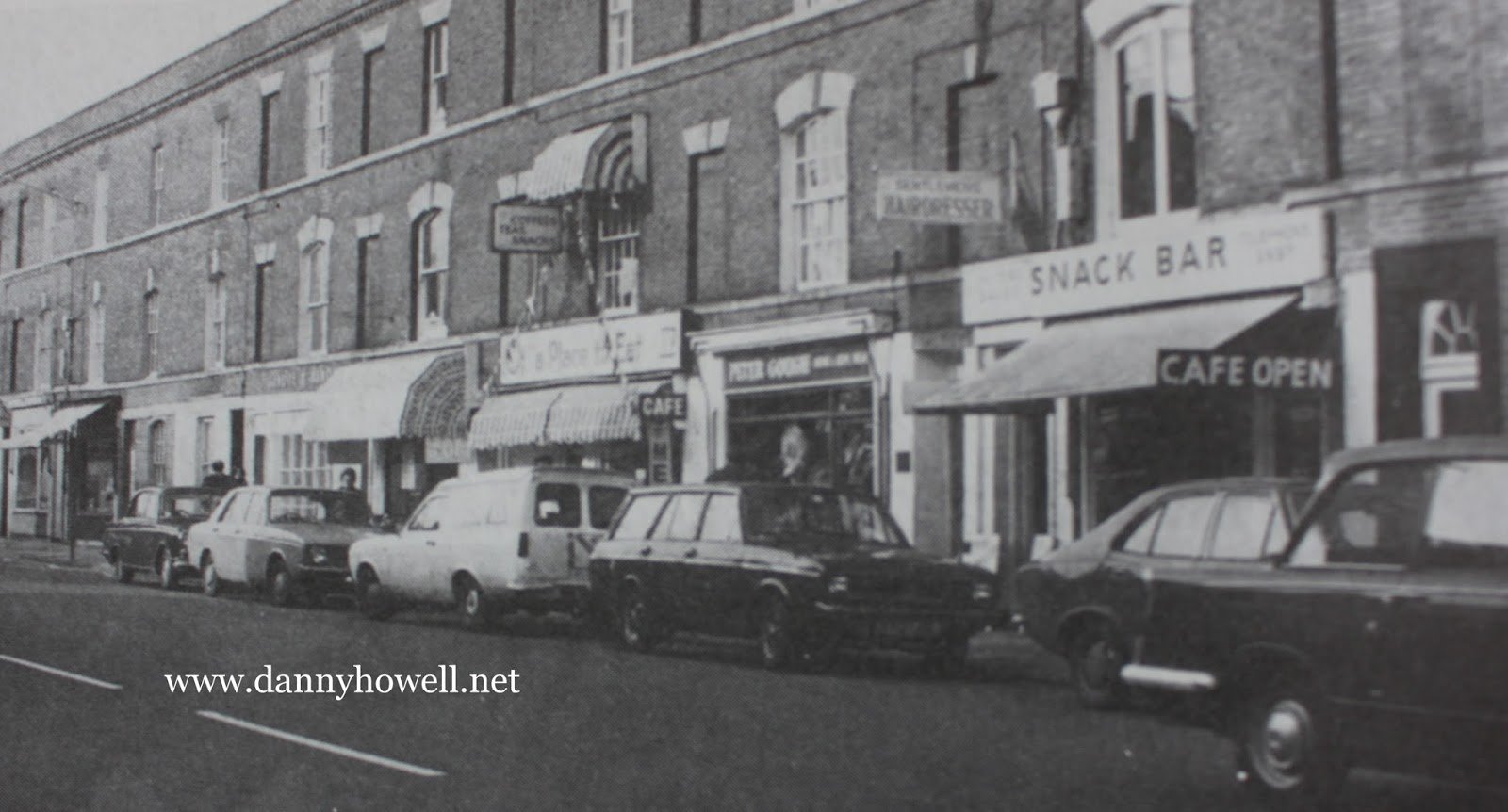
The North Side Of George Street, Warminster, Circa 1970

The north side of George Street,
Warminster, circa 1970.

The shops and businesses here at that time
included Sandoe & Sandoe (estate agents);
A Place To Eat (restaurant/cafe);
Peter Gough (mens and boys wear);
and the Two Daves Snack Bar
(run by David Deacon and David Sims).

Peter Gough transferred his menswear
business to the opposite side of
George Street in January 1976.

Norton Bavant And Sutton Veny Flower Show Committee

Saturday 1st August 1970

Norton Bavant And Sutton Veny Flower Show Committee
1st August 1970

Chairman: D. Bunyan, Esq.

Vice Chairman: J.L. Bowden, Esq.

Secretary: S.C. McCracken, Esq.

Treasurer: W.L. Barrett, Esq.

Show Organiser: A. Heavens, Esq.

Exhibition Officer: D. Eyres, Esq.

Entertainments Officer: E.G. Jukes, Esq.

Catering Officer: Mrs. C.E. Bailey.

Liaison Officer: Major J.R. Cousens.

Upton Scudamore Burials, 1965-1969

Burials at Upton Scudamore, 1965 – 1969

Arranged alphabetically by surname:

MARY JANE DENNES, of this parish, aged 81 years, 31 August 1965.

ALLEN LEONARD KNIGHT, of Trowbridge, aged 33 years, 2 November 1968.

FREDERICK GEORGE LOCKYER, of this parish, aged 76 years, 9 June 1966.

FRANK WILLIAM LUDLOW, of this parish, aged 77 years, 15 November 1967.

VICTOR JOHN MORTIMER, of Warminster, aged 69 years, 22 June 1968.

HERBERT SIDNEY GEORGE NOAKES, of Westbury, aged 67 years, 29 December 1965.

ERNEST THOMAS PURNELL, of Trowbridge, aged 68 years, 1 October 1968.

ANN MARIA SQUIBB, of this parish, aged 94 years, 18 November 1965.

Norton Bavant Manor And Stables For Sir John Jardine Paterson And Lady Nicholson

The Wiltshire And Swindon History Centre, at Cocklebury Road, Chippenham, Wiltshire, SN15 3QN, holds the following document(s):

Norton Bavant Manor and stables for Sir John Jardine Paterson and Lady Nicholson. 1967-1969. Imrie, Porter and Wakefield, architects. Reference: 2499/350/68

An Election Flyer From John Wall, 1969

An election flyer from John Wall. 1969.

Warminster Urban District Council Election.
Saturday next, 10th May 1969.

To The Electors of Warminster
Ladies and Gentlemen,
I am a candidate for the Urban Election being held on Saturday next and before asking for your vote I feel I should give some information on myself.

I am aged 44, and run the Garage in East Street which was founded by my father in 1921, and except for War Service I have lived in Warminster all my life. I have served on the Council for 18 years as an Independent, was Chairman in 1957 and have been Chairman of various Committees of the Council. Although, naturally, I support a political party in my private life, I feel strongly that our level of Local Government all decisions should be made with local considerations foremost and one should not be biased by preconceived views.

It is not really possible to sum up one’s outlook and aims in a few words but in my years on the Council I have always tried to view things with the well being and prosperity of the Town and people of Warminster uppermost in my mind and to judge all problems with that as a yardstick. As the subject of a By-Pass is so much in our minds I have endeavoured to set forth my views on the back of this sheet.

I very much hope that you will use your vote next Saturday and that you will feel able to give me your support.

John Wall.

The By-Pass
It is not easy to condense the subject of this By-Pass, but Mr. Beaven and I composed and moved at the special Council Meeting on April 21st, the following amendment:-

“That the Outline Proposal for the provision of an Inner By-Pass be disapproved but the County Council be informed that this Council would support the construction of an Outer By-Pass . . . . to a more modest standard than hitherto envisaged, on the clear understanding that every effort will be made to include it in the next preparation pool of the M. of T. Furthermore, this Council calls upon the County Council and the M. of T. to prepare comprehensive plans without delay to enable traffic flow to be maintained in the interim period, and, if necessary, this Council will be prepared to employ professional Traffic Management Consultants to advise how these two objectives may best be achieved.”

I feel strongly that this would have been a much better basis for negotiation than that which was eventually adopted, and that all our energies should be directed to bringing forward the Outer By-Pass. I am convinced, as I have been since the start, that in spite of the very negative attitude of the County Council, the changing circumstances together with strong pressure from the Town could make the Outer By-Pass a reality in the reasonably near future. This is the only proper answer to our difficulties.

(Flyer) published by J. Wall.

Residents At Church Street, Warminster, 1968

Residents at Church Street, Warminster, 1968:

Wallis B. Hardy, 2 Church Street.
Jennetta Carroll Airth Richardson, 3 Church Street.
Philip W. Boughton, 4 Church Street.
Anthony Trevor Johnson, 5 Church Street.
Hilda Margaret Fitch, 11 Church Street.
Edward John Townroe, 12 Church Street.

Howard Holden Marsden, 13 / 14 Church Street.
Alan Patrick G. Charise, 13 / 14 Church Street.
Roger Philip Robins, 16 Church Street.
Christopher Boxley, 16 Church Street.
David Christopher Self, 16 Church Street.
Stanley George Frank Edwards, 22 Church Street.

George Ernest Knock, 23 Church Street.
Michael R.D. Ross-Gower, 23 Church Street.
Olive Lydia Johnson, 24 Church Street.
Roderick McAdams, 28 Church Street.
Edna Webb, 28 Church Street.

C. Koughill, 28 Church Street.
Mary Helena Knuckley, 28 Church Street.
Eric Philip, 29 Church Street.
Peter James Lester Binns, 30 Church Street.
James Francis Clifford Brown, 40 Church Street.
David Charles Brew, 40 Church Street.

William James Goulding, 40a Church Street.
Ethne Agnes Pritchard, 43 Church Street.
Marjory Melita Carr, 43 Church Street.
Michael William Blood, Top Flat, 45 Church Street.
Alice Elizabeth Scott, Bottom Flat, 45 Church Street.
Wilfred Arthur Cornelius, 46 Church Street.

The Biggest Toad I Ever Saw

1968

Danny Howell writes:

As a child, growing up at The Dene, Warminster, there were lots of places around my home in which to play and explore. One of them was the old chalk quarry, known simply to us as ‘The Quarry’ which was situated between the southern end of Woodcock Road and Grange Lane, where some of the houses of St. George’s Close now stand. St. George’s Close was built between 1971 and 1972 and what I am going to write about now dates back to about 1968 when the quarry was already long disused and overgrown in places.

One of my great childhood friends was Simon Peck. He lived at No.69 The Dene and I lived at No.57. We spent a lot of our play time in the evenings, weekends and school holidays together and the Quarry was one of the places we often frequented. In the north-east part of the quarry was a large dip where chalk had long ago been extracted. Part of the steep slopes either side of the dip had well worn paths you could go up or down. One day, Simon and I were wandering about in the quarry and rather than go up one of the steep slopes using the pathway we started clambering up the slope, not where the path was, but to the side of it where there was some undergrowth and the terrain was rather rough under foot. It was all part of the fun of what boys did.

As we got near the top of the slope we suddenly saw a tiny cave-like opening among the brambles and nettles. It wasn’t really a cave, not one you could walk into, not even one you could crawl into. It was more a hole about two feet square, going into the bank of the slope, with the back of it in semi-darkness. It was all very earthy. To our absolute amazement we saw a very large toad sat in the middle of the hollow. It was the biggest toad I have ever seen. It would be an exaggeration to say it was the size of a football but it was very big, far bigger than any other toads I had seen in my childhood. I would say, if memory serves me right, it was about six inches from its mouth to its rump. One got the idea that it was probably very old but there’s no way of knowing. I think I’m right in saying that toads can live up to 12 years in the wild. A toad could have survived undisturbed many years in the quarry because the quarry had been left out of use a long time and was for the most part a forgotten wilderness.

Simon and I were so in awe of this toad because of its size we immediately decided we would capture it, so that we could study it more closely and show it to others. The question was how would we take it. A large box or a cage was needed. I knew that in my father’s garden shed at home, in which my family kept all sorts of discarded things, was an old birdcage. It had once housed my parents’ pet budgerigar. Simon and I sped off to my father’s garden shed and pulled out the birdcage. It was obvious that the toad was so large we wouldn’t be able to place it through the door of the cage. An alteration was needed. We decided that we would need to take the base off the cage and put the base back on once we had the wire cage over the toad. We hastily, using some of father’s tools, removed the base and rushed off back to the quarry, Simon carrying the base and myself carrying the wire cage part.

When we got back to the spot, which was no more than 400 yards from my home, the hollow was empty and there was no sign of the toad. We looked everywhere in the vicinity but it had gone, never to be seen by us again. Simon and I were very disappointed. This particular piece of fun was over for us but there was nothing we could do. It had been very exciting when we first spied it. It was probably just as well we had failed to capture the toad. It would have been unfair to it and who knows what the consequences might have been. Our encounter with the big toad was just a brief observation, but it was so awesome to see, even fleetingly, that it has remained a vivid memory in my mind ever since.

error: Content is protected !!