The Birches, 84a East Street, Warminster, BA12 9BQ, was built circa 1973.
Category: Warminster: Default posts
A Minniapolis Moline Z Tractor With A Stourton Owner
Friday 22nd September 1972
A Minniapolis Moline Z tractor, No. Z.T.V. 570972, owned by G.R.A. Pickford of Stourton, near Warminster, is one of the exhibits in the Vintage Tractors section of the Fourth Great Working of Steam Engines at Stourpaine Bushes, near Blandford Forum, which takes place on Friday 22nd, Saturday 23rd and Sunday 24th September 1972.
Built in 1942, the tractor was purchased by its present owner’s father, Allan Pickford, in August 1942 from S. Braddick & Son, Gillingham, Dorset. Supplied on steel wheels, it was converted to rubber tyres in 1948. It has been in regular use. For the last two years it has been used mainly for belt work. The tractor came to this country from the U.S.A. under “lease-lend” and was allocated by the then Dorset W.A.E.C. for use at Hardings Farm, Buckhorn Weston.
Obituary: Edward Charles Hine
From the programme of The Fourth Great Working Of Steam Engines, Stourpaine Bushes, September 1972:
Edward Charles Hine (1895-1972)
Born in the Wiltshire village of Steeple Ashton, near Trowbridge, Ted Hine from his early school days was connected with steam engines, his father being in the road making business.
After leaving school he was apprenticed to the Eddison Steam Rolling and Ploughing Company at Dorchester. During the 1914-18 War he served with the Dorset Regiment in France and during this time he had ambitions of becoming a haulage contractor in a large way when he returned to England.
With his brothers he founded the haulage business of Hine Bros., Gillingham, Dorset, using Burrell and Tasker traction engines, later going over to a fleet of 4 and 6-wheeled Sentinels. Around this time the Company went into the sand and gravel and stone quarry business with pits in Dorset, Hants and the Mendip area. At the time of his retirement in 1964 he was the head of a company that had over 100 vehicles.
It was during the middle fifties that Ted Hine purchased his famous Burrell Showman’s Scenic No.3938 “Quo Vadis” in a very poor condition and started to rebuild her to her former glory. During this time he acquired a collection of six engines and had built a museum for his six fairground organs which became very well-known throughout the country. His tackle was always immaculately turned out and his showman’s engines were rated by many as the finest in preservation.
He was a founder member of the Dorset Steam and Historic Vehicle Club, an association which during his retirement gave him very much pleasure and was its Vice-President.
His pet charity was raising money for Cancer Research, and his fair organs always carried the collecting boxes for this organisation for which he collected hundreds of pounds.
He was a great steam enthusiast and his advice to younger people will be appreciated by many in the steam world. His pet phrase of “I say” will be remembered by many for a long time, especially members of the Dorset Club of which he was so well respected and liked.
The Name Of Warminster
Extract from The Changing Face Of Warminster by Wilfred Middlebrook, published in 1971:
It must surely be a fact that more printers’ ink has been squandered on futile discussions concerning the origin of the name of Warminster than on any other place-name in the country.
The only certainties are the varied spellings since the first mention of Worgemynster in the Anglo-Saxon Charter around A.D. 900. In Domesday the Normans changed it to Guerminstre, then through the Plantagenet period, by an easy transition of Guer into Wer (as Guilou into Wily) we find ever-varying forms of the name ranging from Werminster in 1115, and Warmestre in 1496, to our present-day Warminster.
Many writers, including the historians Hoare and Wansey, have quickly disposed of the matter by presuming that a minster or monastery once stood on the banks of a river or stream called the Were. Daniell declares that “if any brook bears the name of Were, it seems to that which is now called the Biss, which rises in Upton Scudamore and runs through Trowbridge.”
Failing the “Minster on the Were” theory, there have been some fantastic flights of fancy in an effort to solve the puzzle. Working on the names Guerminstre and Worgemynster, one writer finally translated the result into “the place of waters where the blue sky-god was worshipped in a green place, and at which a Dragon protected the Spirit of a Chief in his Grave.”
More down to earth, Daniell suggests that Worgemyn or Guermin is the name of an ancient Wiltshire Chief, so that Warminster means “the headquarters of Worgemyn.”
The Ship And Punch Bowl
Extract from The Changing Face Of Warminster by Wilfred Middlebrook, published in 1971:
Across from the blind house stands the Ship And Punchbowl inn, at the beginning of Silver Street. The original inn was thatched, but was burnt down in 1880 and rebuilt. An old press cutting reports of the Ship And Punch Bowl: “There is no house in Warminster with such centuries of vileness justly attributed to it – horrible scenes of debauchery nightly occurred there – the discord of fiddle and tambourine and boisterous singing, followed by the indecency of drunken men and women reeling homewards, shouting curses and threats.”
Another queer press cutting, dated 15th March 1779, reads as follows: “To Gentlemen Ringers, Warminster Wilts; Notice is hereby given that six Hats, value 12/- each, with Silver Buttons and lappets, the gift of Mr. William Cutler of the Ship and Punch Bowl Inn of Warminster aforesaid will be rung for on Tuesday in Easter-week. Each set is to ring for half an hour, allowing five minutes to rise and four to fall, and to ring a full peal without intermission. The Hats to be given to that set which makes the least faults. The Umpires to be sworn if required. Whose dinners are to be paid for by that set who wins. N.B. – A good dinner will be on the table at 8.”
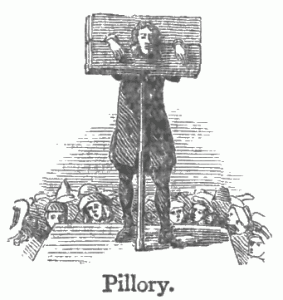
The Ducking Stool And The Pillory In Warminster
Exract from The Changing Face Of Warminster, by Wilfred Middlebrook, published in 1971:
There are several references to the Sloper family in the 17th century Quarter Sessions records.
For example, in July 1607, it was recorded that a “cooking stoole!’ was needed in the town of Warminster, to be made and maintained by Simon Sloper.
Thirty years later, in 1637, the Jury at Warminster present “that they have neither a cucking stool (ducking stool) nor pillory in Warminster, and that William Sloper must maintain and put them up.”
It seems as though the present century has no monopoly in procrastination, for in 1647 comes: “We present that we have noe stocks in the towne of Warminster in default of William Sloper” (ordered to be provided before August under penalty of 40/-).
In 1650 the presentment to the Jury states “that their church is mightily in decay insomuch that the pishoners (parishioners) are afraid to assemble there,” and in 1669 we find “Simon Sloper Junior presented for not setting up a Pillory and Cookinge Stoole in Warminster.” They must have been a kind-hearted lot, these Slopers of Ash Walk.
The Lock Up In The Avenue, Warminster
Extract from The Changing Face Of Warminster by Wilfred Middlebrook, published in 1971:
There is a curious roundhouse in front of the Avenue School, a tree-shaded building of weathered brick with small apertures closed by rusting iron plates. According to Mr. Samuel Smart, who owns the nearby scrap metal business, this is an old lock-up, where drunks were incarcerated in olden days .
Dorothy Walk, Warminster
Extract from The Changing Face Of Warminster by Wilfred Middlebrook, published in 1971:
Coming back to the Minster Church from Coldharbour, one is impressed by the generous widening of the road across from the church. In recent years the road has been cut well back to improve visibility as the motorist enters the town by Church Street. Turning left around the churchyard, passing the entrance to Ash Walk, we find Dorothy Walk leading the way through Church Fields to the Westbury Road, Nun’s Path and Arn Hill.
Some years ago, this pleasant path, lined only by a few modern bungalows facing the churchyard, was given the fanciful name of Dorothean Walk. Until recent years, the path went in a direct line to Arn Hill, though you were lucky if you got through Church Fields without wet feet in rainy weather. When the railway cutting was made, back in 1851, the railway company acknowledged the rights of pedestrians by building a footbridge over the lines.
Charities Associated With The King’s Arms Inn, Warminster
Extract from The Changing Face Of Warminster by Wilfred Middlebrook, published in 1971:
The Co-operative buildings end this side [north side] of the Market Place at North Row or Meeting House Lane. This was once the site of the King’s Arms (not to be confused with another inn, with the same name, in Weymouth Street). The old King’s Arms, on the corner of Meeting House Lane, was used as a source of Warminster charities. King’s Charity, named after a London silk merchant called William King, first decreed that the rents of all his lands in Warminster should be divided among four deserving persons, who should not receive any other alms. These lands produced forty shillings a year in 1772. William King died in 1769.
After the Enclosure Awards of 1783, allotments in Chedlanger Field, near Brick Hill, were awarded to the Churchwardens and Overseers in lieu of the former lands and let at six pounds a year. For many years this sum was divided among fifteen men at eight shillings each, altered in 1833 to ten shillings each for twelve persons and paid on St. Stephen’s Day. This charity was not actually paid out at the King’s Arms, but the original source of King’s Charity was derived “from tenements or houses thereunto belonging known by the name of the King’s Arms Warminster.”
Slade’s Charity was payable out of the King’s Arms inn, when “twenty poor housekeepers of the Parish, who received nothing of the collection for the Poor,” received twenty half-crowns around 15th January every year. William Slade died in 1723, and a rent-charge of fifty shillings “on a freehold property situate at the entrance of Meeting House Lane” was distributed as Slade’s Charity at Christmas.
Cromwell Gardens, Warminster, Once Called Ludlow Court
Wilfred Middlebrook, in his newspaper serialisation The Changing Face Of Warminster, written in 1970 and published in 1971, noted:
Cromwell Gardens, once called Ludlow Court. . . . It was supposedly renamed after Oliver Cromwell spent a night with the Hallidays at Yard House, directly opposite.