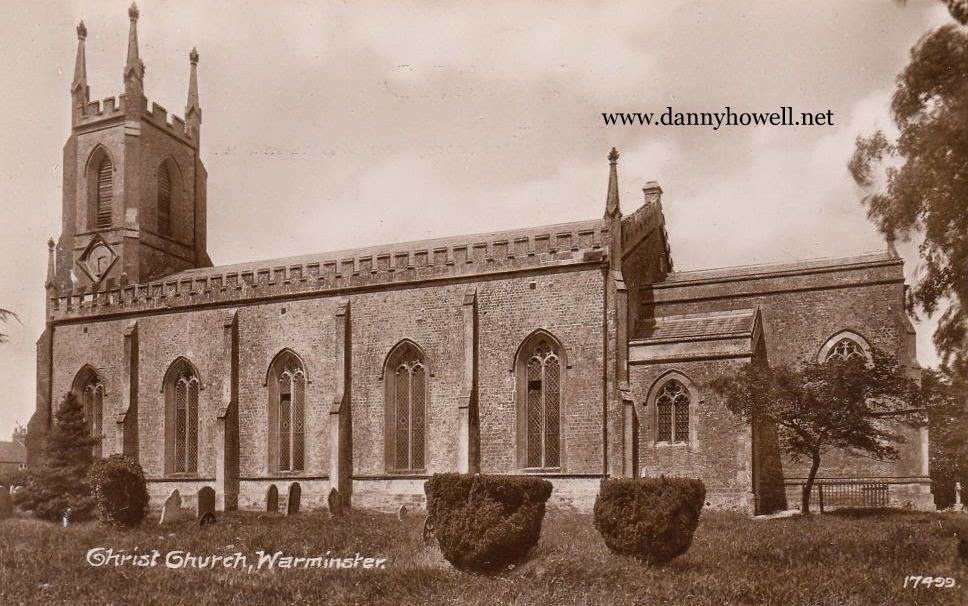
Christ Church, Warminster

The Warminster Town Centre Conservation Area Assessment (Informative Document), published in March 2007, noted: 

One of the most prominent landmarks within the town is Christ Church, which is located to the south of the main centre and outside of the conservation area. Its location, high above the town on Sambourne Hill, and its pinnacle tower make it a visible feature from a number of vantage points, bothwithin and outside the settlement boundaries.

The Nave Altar At Christ Church, Warminster

In Christ Church, Warminster, The First 150 Years, a booklet published in October 1980, to celebrate the 150th birthday of Christ Church, the Rev. John C. Day (Vicar) wrote:

The Nave Altar

Mention should be made of this new feature which was finally brought to a completion in its present form in 1978. The fully portable altar, platform and rails enable the church to celebrate the eucharist in the body of the church and among the assembled congregation. Also the whole area can be quickly transformed into an open space and the church brought back almost to what it was originally intended to look like. There is too the added advantage of being able to have a spacious area at the front of the church for drama, choirs, orchestra, etc.

The carpentry work was executed by an old parishioner, Eric Payne, and the iron work by the Motcombe blacksmiths, Wing & Staples. The total cost was met from private gifts and donations, and the altar dedicated by the Bishop of Salisbury in October 1978.

Warminster Common

In Christ Church, Warminster, The First 150 Years, a booklet published in October 1980, to celebrate the 150th birthday of Christ Church, the Rev. John C. Day (Vicar) wrote:

Why was Christ Church built way back in 1831?

To answer that question we must begin with a long look back into the earlier history of our district.

At the beginning of the 19th century the whole area around where the church now stands would have been open country; no school, no hospital, very few homesteads and until 1830 Weymouth Street as we know it did not exist as a road. Before that date the main road through the parish was the old turnpike road running up what is now Sambourne Road, being part of the important London to Barnstaple highway.

In those days Warminster town had not begun to climb the hill and spread southwards from the present town centre. But south of the town a large separate village had grown up known by the locals as “The Common” or “Newtown”.

Warminster Common

The history of Christ Church is much bound up with the story of Warminster Common so it will be interesting to recall a little of the background of this part of the parish.

In the old days this large area of waste land south of the town and described as Warminster Heath on the old maps, was not owned privately or required by anybody. Thus anyone could build on and enclose pieces of ground for their own use without reference to authority, and by the end of the 18th century the Common had a population of well over a thousand, huddled along the stream which runs west to east along the Brook Street, Fore Street and Wylye Road valley. Alas, with road widening and new housing, the stream, which for centuries must have been both water supply, laundry and playground for the children, is now culverted underground.

In 1779, the free and easy life of the commoners took a turn for the worse. That year saw the beginning of attempts to force enclosure acts on the people; acts which were to mean the loss of any ancient rights and privileges. Among local landowners desiring to enclose land in this part of Warminster was the Viscount Weymouth of Longleat.

By an award made in 1783 the inhabitants of the Common lost all their old rights of pasturage, fuel gathering, etc. Previously in 1777 an attempt had been made to make them bow their knee to the Lord of the Manor by the voluntary payment of one penny for a dinner at the Bell inn (now known as the Bell And Crown) in the village. But being suspicious of the move, no villager rose to the bait so at least among their many misfortunes they were able to retain the freehold of the homes they lived in.

From accounts by W. Daniell and J. Daniell, the Common in the 19th century must have been a miserable place to have to live in. A description of it obtained from an eyewitness account of 1780 describes the hovels as consisting for the most part of “one ground floor and one bedroom under the thatch, walls unplastered and the floor just as nature made it. Both animals and family lived in the ground floor and the bedroom reached by a ladder doubled as hayloft.” There was no place of worship, no schooling for the children, so it followed that the populace grew up illiterate and godless.

The eyewitness goes on to say that “scarce anyone went near a church and that Sundays were spent in all sorts of games such as bull and badger baiting, cock fighting, boxing, wrestling and drunkenness, oaths and fights.”

Thus the historians give us a picture of a thoroughly squalid, miserable place that few of the residents of Warminster wished to know about. How things have changed. Now the Common has become a desirable place to live in and many of the remaining old cottages renovated and made very attractive. The whole area now has a quaint village-like flavour about it.

But to return to our tale, there can be little doubt that earlier in the last century as Daniell relates in his history of the town that “The inhabitants of the Common were at the lowest level of moral and social life, and, as a natural consequence of their deep poverty, hard drinking and unhealthy homes, typhoid fever made dreadful ravages among them; twenty eight or thirty adults died in a month and when smallpox and measles attacked them also, the mortality was frightful.”

It was this state of affairs that finally awakened the conscience of Warminster.

Towards the end of the 18th century, a blind man, Jeremiah Payne, and a John Pearce began attempting to conduct regular acts of worship on the Common, probably on their home and in the home of a James Gunning.

Mention will be made later of the original Workhouse on the Common. Suffice to say here that it was in that place that we begin to see the real beginning of what later became Christ Church. In the early part of the last century it was here that a curate of St. Denys (in whose parish the Common then was) came to conduct Church of England services and in 1826 the Rev. William Dalby, the new Vicar, conducted a regular afternoon service at a room in the Workhouse. It appears that the authorities did not go out of their way to make things comfortable for the worshippers, a situation which convinced the good Vicar that the only real answer was to set about building a new church in this part of the town.

The Choir At Christ Church, Warminster

In Christ Church, Warminster, The First 150 Years, a booklet published in October 1980, to celebrate the 150th birthday of Christ Church, the Rev. John C. Day (Vicar) wrote:

The Choir
The stalls now occupied by the choir were also made locally by two craftsmen, Albert Randall and Charles Turner working with the firm of Butcher’s.

The choir has recently raised almost all the money to replace their robes in readiness for the 150th Anniversary of the consecration. It is interesting to read in the report of the re-opening of the church after its 1881 restoration, that ‘the choir was dressed in surplices for the first time.’

Also worthy of note is the mosaic representation of the Last Supper from the original painting of Leonardo da Vinci. This occupies a prominent position above the high altar reminding us of our Lord’s presence with his followers when they meet with him in the sacrament of Holy Communion. It was placed there in 1885 replacing the old boards on which were inscribed the Ten Commandments, the Lord’s Prayer and the Creed. These boards now are fixed high on the west wall of the church.

Christ Church, Warminster, By J.C. Day

In Christ Church, Warminster, The First 150 Years, a booklet published in October 1980, to celebrate the 150th birthday of Christ Church, the Rev. John C. Day (Vicar) wrote:

Christ Church

Although, as we have heard, several attempts had been made to establish Church of England services on the Common, none were very successful owing to cramped conditions and the fact that the rooms could not function as a church and neither could they be used for such things as baptisms, weddings and funerals. Daniell’s chapel was opened in 1828 and before that there had been a half-hearted attempt at a Methodist place of worship in Bread Street.

But under the Rev. W. Dalby, it was felt that the time had come to build a church on the Common. From 1827 meetings were held and soon division came as to the positioning of the new church. Some wanted it actually on the Common, others in the hamlet of Sambourne. In the end, Sambourne won and the foundation stone was laid on the ground at the top of the hill midway between the old town of Warminster and the Common.

On Thursday, April 15th, 1830, the foundation stone was laid by the Rev. W. Dalby. First of all a service was held at St. Denys, the old parish church, then a great procession of clergy, magistrates, gentry, tradespeople and school-children, wound their way up the hill to Sambourne. The following inscription was placed on a brass plate let into the foundation stone:

The first stone of Christ Church
Warminster
was laid on the fifteenth day of April
in the year of our Lord 1830
Glory to God in the Highest and on earth
Peace, Goodwill to all men.

Incidentally, the foundation stone of what was our Town Hall was laid on the same day.

The original church was built to the design of John Leachman (also the architect of St. Margaret’s, Corsley, which is a smaller edition of what Christ Church originally looked like). The first church was an open hall type building consisting only of tower and nave. This was finished in 1831 and was consecrated amid great pomp and ceremony by the then Bishop of Salisbury on May 13th, 1831.

The total cost was in the region of £4,800. £2,400 came from the Parliamentary Commissioners. £77 from the profits of lectures by William Dalby, £60 for land taken by the Turnpike Trust and the balance from donations and subscriptions.

Our present church bears little resemblance to the building opened in 1831. It was then a bare rectangular hall-like room with a flat plastered ceiling, plain windows and a large unsightly gallery at the west end. Outwardly, only the tower would have told the casual onlooker what it was. Simply, it was a large room built to hold a congregation of some 800 people for the traditional matins and evening prayer type service, with sermon, that was popular in those days.

However, as the years went by, successive vicars were to leave their mark not only on the parish but on the building as well.

In its early years, Christ Church stood in relation as a chancel of ease to St. Denys and the first priest in charge, the Rev. J.H.A. Walsh, lived in Church Street as there was then no vicarage in the new parish.

Soon, however, the new district became a parish in its own right and a vicarage was built in Weymouth Street in about 1863. The Rev. Walsh remained incumbent until 1859 when he left to become Vicar of nearby Bishopstrow. He was succeeded by the Rev. R.R. Hutton who stayed until 1866 when he left on becoming Vicar of Barnet.

It is now that the first great turning point in the transformation of Christ Church begins. In 1867 the new Vicar, the Rev. William Hickman, was inducted into the parish, where he was to serve for 32 years of his life and was destined to do great things for his parish and church.

William Hickman first set himself to place in the church a decent font, which since 1867 has witnessed the reception of many hundreds of young people into the family of Christ’s Church.

The font, made of Caen stone and Derbyshire fossil marble, is based on a known early Norman design and was made by Messrs. Strong, the local monumental masons.

The new vicar then turned his attention to the building itself and began the arduous task of transforming it into the appearance of a traditional church. First came the chancel, vestry and organ loft erected in 1871. The architect for this work was T.H. Wyatt and the work was carried out under the supervision of two local contractors, William Dutch and Benjamin Parsons. The cost of this extension was in the region of £1,200, and included in the price was the church’s first pipe organ.

Again, there was great ceremony for the opening of the new chancel by the Bishop and this was followed by a lunch party for distinguished guests in Sambourne Schoolroom.

Not content with his new chancel, Mr. Hickman then turned his attention to the nave itself. The present stained glass windows were fitted and with the help of an anonymous donation of £1,000 he set about giving the body of the church its present appearance.

In 1881 the flat plaster ceiling was removed to expose the lovely timber roof beams, the church was re-seated with its present pews, and pavements of encaustic tiles were laid. At the same time the old unsightly gallery was taken down and the way made clear for the crowning glory, the adding of the present arches and pillars. The new arcade of five bays on each side, divides the church neatly into nave and side aisles. These pillars are made of Bath stone and the arches of locally quarried Frome stone.

This second major restoration was supervised by a London architect, G. Vialls, and the general contractor for the work was a Mr. Joseph Gaisford.

The grand re-opening of the transformed building took place on Thursday, November 17th, 1881.

William Hickman’s final work in the transformation was the erection of the pulpit in 1887. This grand perch made of stone and alabaster cost £80, and was to commemorate the Jubilee of Queen Victoria.

After a long and distinguished ministry, Mr. Hickman resigned as Vicar of Christ Church in 1889, retiring to Maidenhead. On his death in 1920 he was brought back to Warminster to lie in the churchyard of the church he loved so well. In his will he left a large sum of money invested to contribute towards the salary of his successors. Christ Church owes a great deal of gratitude to the long ministry of this faithful priest.

In the same year came another new vicar who was destined to become the longest serving vicar in the history of the church. The Rev. James Senior Stuart, known affectionately as “Jimmy Stuart” stayed for just short of 40 years and if William Hickman is remembered for his work in transforming the church building, James Stuart will be remembered for his love and care in the parish. In his day the parish was of course much smaller than it is now and there was then usually an assistant curate to help with the routine work. The Vicar presided himself in knowing all his parishioners, taking the trouble to visit them regularly in their own homes. Canon Stuart was vicar all through the 1st World War and during that time he devoted much time and trouble to the troops stationed in and around the town. For the whole course of the war he served as Chaplain to the Forces at Sandhill Camp and Sutton Veny, and after the War was a founder member of the local branch of the British Legion, retaining his interest in force welfare throughout his ministry. A keen sportsman he also for many years was president of the Town Football Club.

Canon Stuart also left his mark in the church. It was he who was instrumental in procuring the majestic brass eagle lectern. This noble bird once graced no less a place than the Royal Hospital Chapel at Greenwich. It came to Christ Church in 1937. The chapel at Greenwich was designed by Sir Christopher Wren and included in his design was a wooden lectern for the Bible. Sometime this was lost and the Victorians produced this brass eagle to take its place. By chance the original was re-discovered earlier in this century and so the Victorian newcomer was no longer required. Through the good offices of Canon Stuart it came to Christ Church and cost a mere £70, a sum incidentally raised by the young people of the parish.

It was during Canon Stuart’s ministry that the church celebrated its 100th birthday and great festivity, in May 1931.

In 1942, having spent the whole of his active working ministry in Warminster, Canon Stuart retired to Westbury-sub-Mendip, where he died, full of years, in 1950. Even after a decade his parishioners did not forget his devotion to them and there was in 1951 erected the memorial cross to him outside the west door of the tower.

The next vicar of the parish was Herbert Lloyd Jones. Sadly, his ministry was to be a short one, lasting only half as many months as his predecessor’s had been years. He died unexpectedly after a minor operation early on in what promised to be a great ministry.

Taking over at this point in the darkest days of the war and following the tragic loss of Mr. Lloyd Jones, was the Rev. (later Canon) Harry Green, who was also destined to endear himself to his parishioners during a long period of service spanning 21 years. During his time here Canon Green also had the added task of acting as Rector of Bishopstrow.

1965 saw another new vicar, in the Rev. Andrew Ford who came to Warminster after serving as full time Chaplain to the Forces. It was during Andrew Ford’s time that the old parish room and other property on what is now the Sambourne Roundabout, was pulled down and the new church hall in the Vicarage garden built. Also the old Glebe Field, which the Victorian clergy had actually farmed, was sold for housing. Andrew Ford left in 1971 to become Vicar of Abbotsham in Devon.

Now into the seventies, the parish welcomed another new vicar, the Rev. Barry Abbott who had been previously Curate at Wilton. He remained for some four years. The present holder of the office arrived in 1977 which brings us up to date. In its 150 years history Christ Church has had but nine vicars, one serving for 42 years, another 32, another 29, and yet another 21 years.
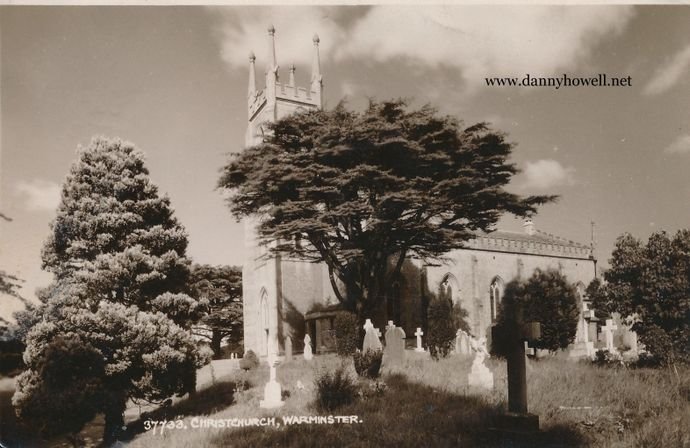
Memorials At Christ Church, Warminster

In Christ Church, Warminster, The First 150 Years, a booklet published in October 1980, to celebrate the 150th birthday of Christ Church, the Rev. John C. Day (Vicar) wrote:

Memorials

There are numerous memorials in the church, both in the form of glass windows, plaques on the walls and useful items.

The large east window in the chancel portraying the crucifixion was originally where now the nave arch exists. It was placed there in memory of William Cockrell who died in 1863, and moved to its present position in 1871 when the extension was added.

Of two other smaller windows in the chancel, rarely seen because of their positions in the south and west corners, one was given by the Rev. Hickman in memory of his mother and depicts the raising of Tabitha recorded in Acts, Chapter 9. The other, given by a Mr. Chapman, shows our Lord’s Ascension into heaven.

The only other piece of real stained picture glass in the church is in the west tower window. This part of the church was altered early on in the century. Earlier pictures show us a tall ugly wooden west door with no glass. The present west window was given in memory of a John Lewis Foreman who died in 1919.

Those early years of Christ Church were years when Great Britain commanded a large empire. Many of her sons went overseas to govern and order that Empire and some Warminster people no doubt found themselves far from home. Sadly many an Englishman’s bones lie far from the land that sired him and we are reminded of that in Christ Church as we look at some of its Victorian memorials. There is Major Sydenham George Clarke Reynoud who died of battle injuries at Cawnpore, India, in 1857.

Then there are the sad and poignant lists of those who gave their lives for King and Country in war. Like nearly every church in the realm, this one gives pride of place to the list of men who died in the Great War. And on the south wall is also a plaque recording the sad story of Frank Hubert Butler who died in the hour of victory, of dysentery, at Alexandria, 10th November, 1918, aged 35.

Other memorials in the church tell of the ministry of the first incumbent, Mr. walsh, of the long and great ministry of William Hickman; a small plaque records the memory of the wife of Brigadier General Harding-Newman who died in 1943. The Harding-Newmans lived at Portway House and were for many years great friends of Christ Church. The Brigadier served for a long period as Churchwarden.

Lastly, we should perhaps not forget to mention two recent memorials in Christ Church. Close to the north-west door is a plaque listing the names of the nine incumbents of Christ Church who have served during the first 150 years of its history. It was placed in the church on the 150th anniversary of the laying of the foundation stone of Christ Church and given in memory of Thomas Frederick Augustus Bullen. This gentleman died way back in 1851, His family, now living in Bristol, on visiting the church and finding he had no memorial asked if they might provide this.

In 1980, a new vestment chest was given to the church on which a brass plate is affixed recording the service of Frederick Knight, a well-loved solicitor in the town, who gave many years of his life to the service of Christ Church.

These are but a few of the many memorials and thank offerings given by grateful parishioners over the years, which enhance and beautify the house of God.

The Church Tower At Christ Church, Warminster

In Christ Church, Warminster, The First 150 Years, a booklet published in October 1980, to celebrate the 150th birthday of Christ Church, the Rev. John C. Day (Vicar) wrote:

The Church Tower has within it a peal of 8 tubular bells, it not being robust enough to take the real thing. These were made by a firm called Hannington of Coventry, and installed in the tower in 1888. The tubes varying in length from 5 to 8 feet hang in a frame in the tower roof, with wires passing down to the ringing chamber and fitted in a frame so that one ringer can operate all 8 bell tubes.

Rev. John Day To Be New Vicar At Christ Church, Warminster

Friday 4th February 1977

After months without an active vicar, Christ Church, Warminster, is to get one – the Rev. John Day, who plans to try to heal the wounds in a parish which has seen a great deal of bitterness recently. At present he has three small parishes in Petersfield (Hants).

There has been a long period of discussion between different factions which reached its peak in the rare event of a consistory court in the church itself which decreed that the experimental nave altar should become permanent.

In September the Vicar (Rev. Barry Abbott) resigned through ill health, caused by stress and overwork.

Mr. Day (40) was born at Chippenham and has been vicar of the parishes of Froxfield, Froxfield Green and Privett for five years. Before that he was curate of Bedhampton, near Portsmouth, for four years after training at Salisbury Theological College, where he knew Mr. Abbott.

Previously he spent nine years in the Church Army after graduating from the Church Army Training College at Marylebone, London. His postings were to Preston, Reading, where his duties included chaplain of Reading Jail, which was then a Borstal, and Pamber Heath, near Basingstoke. He finished his service as a captain.

His Lancashire born wife, Margaret, was a chemist’s assistant before marriage. They have two sons – Stephen, 11, and Paul, eight.

In Froxfield, Mr. Day edits and writes for the village magazine. He is also village correspondent for a weekly paper published in Portsmouth.

Mr. and Mrs. Day are interested in antiques, local history and walking.

Mr. Day will be inducted at Christ Church on 26th April, possibly by the Bishop of Ramsbury (Rt. Rev. John Neale).