
Monday 27th January 2014
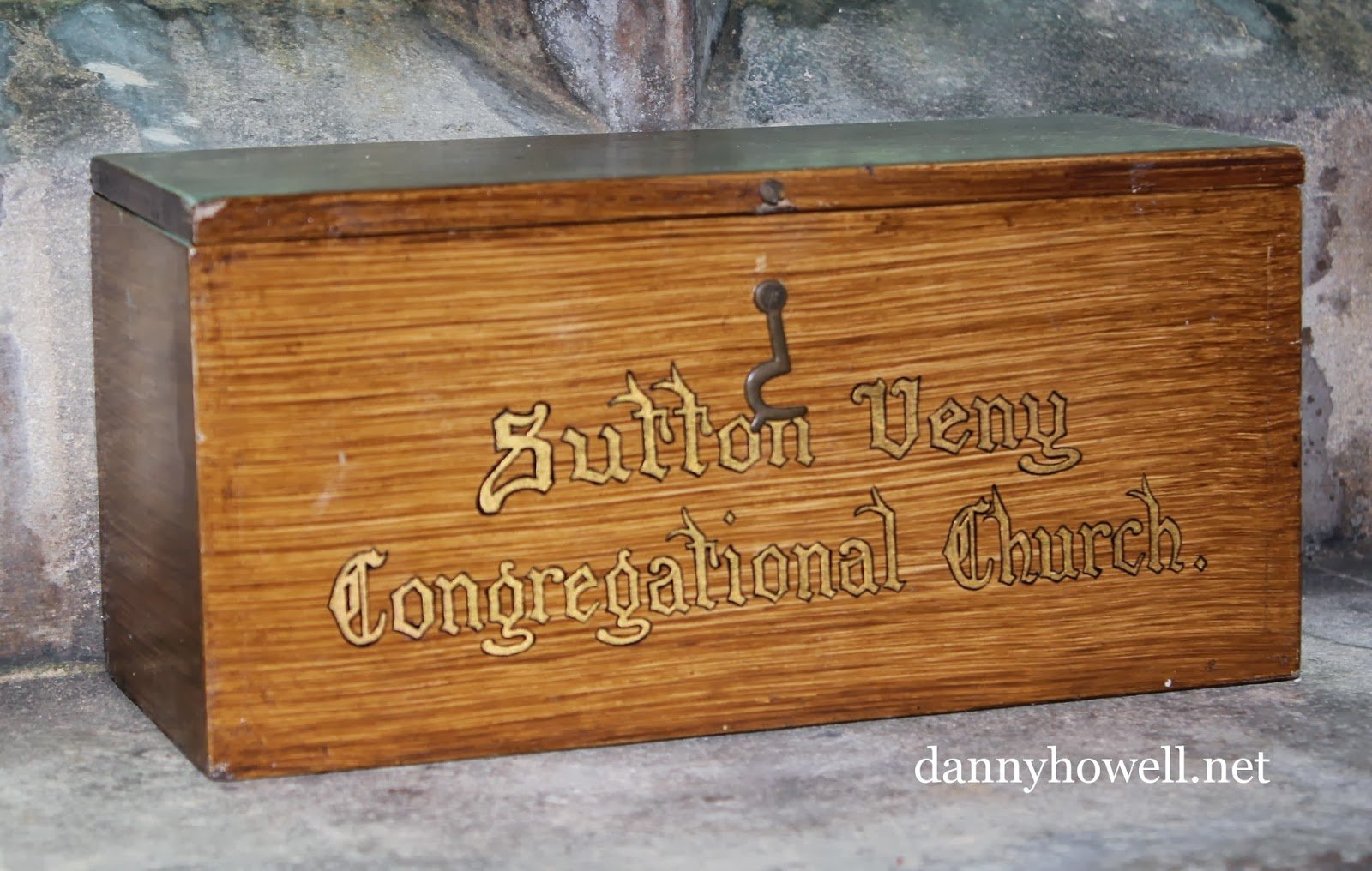
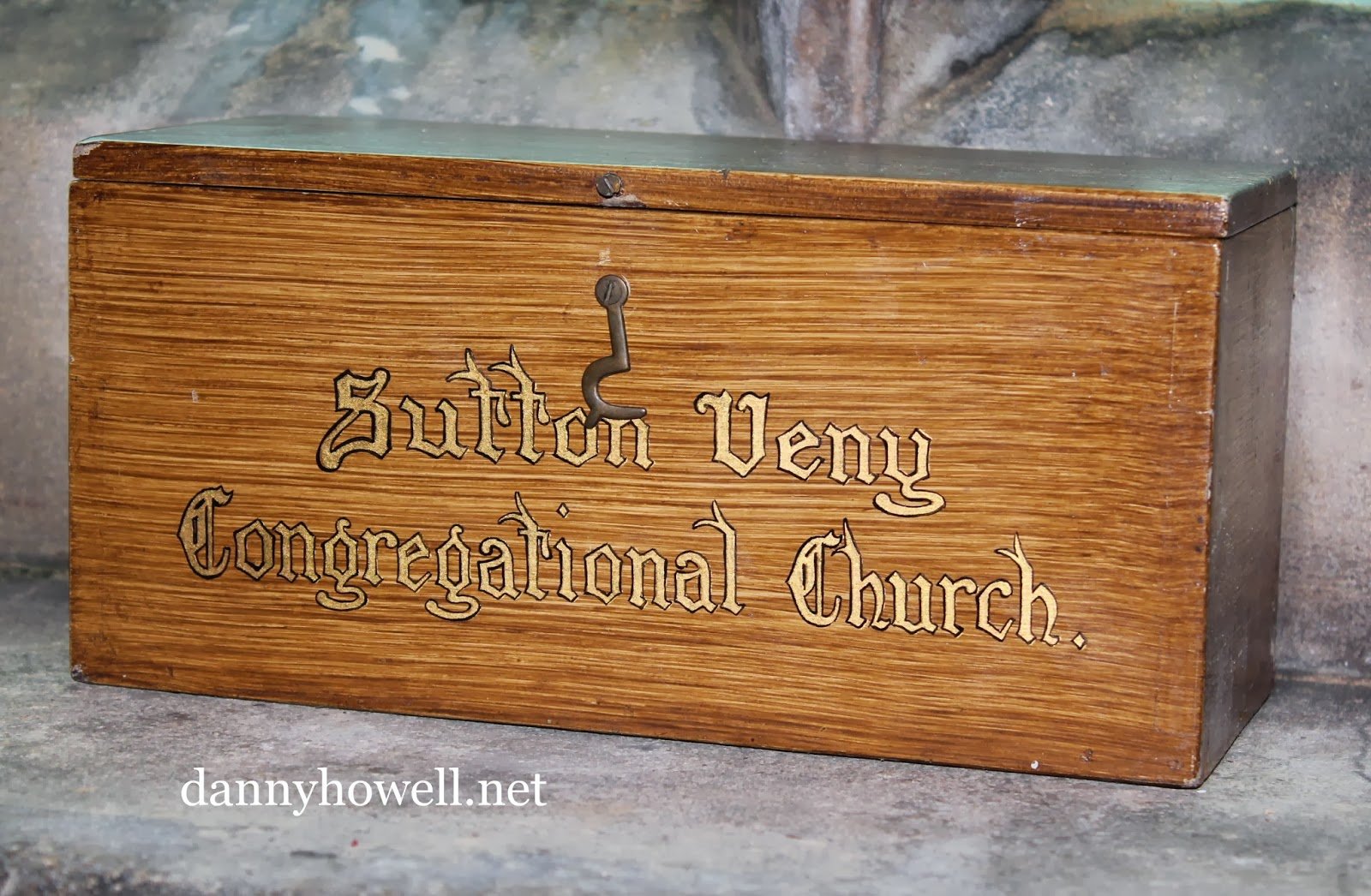
A box on a window sill inside the Chapel of St. Lawrence, High Street, Warminster. It features the wording: ‘Sutton Veny Congregational Chapel’
Photographs taken by Danny Howell on Monday 27th January 2014.
Information and pictures for the Chapel of St. Lawrence, Warminster.
Monday 27th January 2014
A box on a window sill inside the Chapel of St. Lawrence, High Street, Warminster. It features the wording: ‘Sutton Veny Congregational Chapel’
Photographs taken by Danny Howell on Monday 27th January 2014.
Friday 13th September 2013
The Warminster Area Board, at their recent meeting held in Maiden Bradley, awarded a Community Area Grant of £4,852.50p to the Friends of St. Lawrence’s Chapel. The money will be spent improving the community facilities at the Chapel in the High Street, Warminster.
Wednesday 16th March 2005
The Chapel of St. Laurence in the High Street, Warminster, is peculiar by name and peculiar by nature. However, it is in good company.
A peculiar church is one that operates outside of the Church of England control. St. Laurence’s in Warminster is one such church, as is Westminster Abbey, London, and St. George’s Chapel, Windsor.
St. Laurence’s Chapel in Warminster dates back to the 13th century and in 1575 was bought by the people of Warminster for £38 6s. 8d.
An indenture was drawn up in 1592, appointing 12 trustees, who were called feoffees, to look after the chapel. This system has been kept up until the present day, and the current feoffees now meet three or four times a year.
Geoffrey Tout, who is 81, and lives at Heronslade, Boreham Road, Warminster, has been a feoffee for 35 years. He has compiled a history of the chapel. He said: “St. Laurence is the only church in Warminster that is open every day. It is a refuge space for the town.”
Anyone, of any denomination, can enter and pray in the chapel, and a Sunday service is held once a month. The chapel has pew space for between 60 and 70 people.
The fact that it is still a focal point for the citizens of Warminster was highlighted when people placed many wreaths outside the chapel to mark the death of Diana, Princess of Wales.
Mr. Tout said: “St. Laurence’s Chapel is part of the history of Warminster. You only have to look at the visitors’ book. It is our responsibility as feoffees to make sure that the chapel keeps up with the times.”
The clock in the tower of the chapel will soon be updated. Feoffee David Pollard has masterminded a plan to do this, funded by Warminster Town Council and the Five Towns Initiative.
Mr. Pollard has already restored all of the public clocks in Warminster, and has written a book on the subject which highlights the greatest Warminster clockmaker of them all, Edward Cockey.
The clock at St. Laurence’s Chapel will be attended to in the next month and the cost will be £6,000.
Chairman of the feoffees, Mr. Philip Howard, of Highbury Park, Warminster, says: “It is our principle that St. Laurence’s Chapel will always be open for people to come in and pray.”
The Chapel Of St. Laurence ~ Some Notes Of Interest, written by Geoffrey Tout, July 2003:
The Chapel of Saint Laurence, Warminster, is known as a “Peculiar’, existing outside of the Church of England control. It is in distinguished company among other churches. Westminster Abbey and St. George’s Chapel. Windsor, being two Royal “Peculiars’.
The Chapel of Saint Laurence, is an independent foundation, held in trust since 1575 by twelve feoffees for use by all the townspeople of Warminster with no particular denominational basis. It is within the C. of E. parish of St. Denys and on the appointment of a new Vicar (of Warminster, for the Minster Church) the feoffees invite that person to take the services and he has assistance from the C. of E. clergy from the Cley Hill Team Ministry which covers that part of the town and some of the adjacent villages. He also, from time to time, invites other Anglican priests, the Roman Catholic priest, the Garrison (Army) Padre from St. Giles (Anglican) Church, the Baptist Minister, the United Church Minister and other retired ministers. Many live in the area, having been trained at one time in Warminster as part of Kings College. That is no longer so and the Kings College property at Church Street, Warminster, is now occupied by Warminster School – an independent school of some 500 pupils from all over the world. We are very grateful to the clergy for their voluntary work in taking the services – we are indeed fortunate.
There is Holy Communion on Wednesdays at 10.00 and Evensong on the 3rd Sunday in each month at 3.30. All are most welcome.
Requests for baptisms, weddings and funerals occur from time to time but there needs be a clear link to the chapel – it is an exceptional place and the feoffees do not encourage such occasions if the intention is to be “fashionable’ or “different’! In any case for a wedding to take place, apart from local considerations, there is a need to obtain an Archbishop (Of Canterbury) Special Licence (fee at present £125). Funerals do take place from time to time, but the undertakers have great difficulty in manoeuvring the coffin inside the chapel!
It is also used for ecumenical services, e.g. CTW (Churches together in Warminster), Amnesty International and also by other denominations when there has been a problem with the use of their premises, e.g. fire/extensive repairs, etc. This has resulted in the Chapel being used for several months by the Roman Catholic Church and, on another occasions, by the Methodist Church (no longer as such). There are also four Anglican Churches, a Baptist Chapel, a United Church and a Christian Scientist Hall in the town. During the War St. Laurence’s Chapel was used for services to save the cost of blacking out all the other churches’ windows!
It was purely voluntary on the part of the townspeople without any suggestion by or agreement of the feoffees. At the time of Princess Diana’s death we found that the public of all denominations were laying wreaths on the front lawn and in no time it was covered. This provided a perfect setting for a moving memorial service on 6th September 1997. Again, for the duration of the on-going Iraq conflict, CTW arranged for a meeting at 12 noon each day (except Sundays) for Prayers of Peace and Justice. That gives some idea of the very nature of the Chapel in the life of the town, sandwiched as it is in the main street with neighbours being the Town Hall (now in private ownership), Woolworth’s. Bristol & West Building Society, Halifax Building Society, Oxfam, a dry cleaner and a solicitor. The Chapel is open every day from approx. 9 a.m. to 5 p.m., and the visitors’ book is very interesting – from all over the world. Most years we have a flower festival around the Patronal Service in August, and in recent years we have had a Christmas floral festival – donations amount to around £300 each Christmas and a charity is given the proceeds – Cancer UK, MacMillan Nurses, Multiple Sclerosis, the local hospice, etc.
Whenever I go into St. Laurence’s Chapel, and it’s sometimes three or four times a week, there is nearly always someone or a couple sitting quietly in contemplation. It is an oasis in the midst of the traffic and commerce of the town. Most of the feoffees are on a security rota. Luckily there’s very little trouble – and we have CCTV covering our doorstep. We locked up one night and left someone asleep on one of the pews. He broke a stained-glass window to get out and then apologised next morning and paid for the damage (£800) in cash!
The organ is on the side of the chapel and the organist sits out in the congregation facing the altar with them. When the organ was completely overhauled in 1974, the chapel was closed for a few weeks so that all the parts could be laid out on the pews for cleaning, repair or restoration.
There is a clock in the tower but it does not have a face. It has a 36-hour movement and in consequence needs winding at least every 24 hours and this entails some 24 winding steps to the clock room and the same down, unless you miss your footing – the feoffees are on rota. The clock chimes the quarter and dongs the hour. In 1985 an attempt to put a face on the tower was not permitted by the District Council.
At the west end of the Chapel there are name boards showing many of the feoffees since 1575. Again, when we came to having it updated, we only had to pay for the gold leaf – the lettering was done by the Technical College as a project.
We have a cottage behind the Chapel, not seen from the road, which used to be used by the Sexton who had to ring the rising (4 a.m.) bell and the curfew (8 p.m.) bell each day. The cottage is now available for office purposes and brings in much needed income. We have to be self-sufficient otherwise we, as feoffees have to raise the necessaries. That’s how I became a feoffee and also the Treasurer – they thought in 1969 to raise £5,000 it would be easier, in my capacity as the then Urban District Council Treasurer (having to deal with all the ratepayers, tenants and businesses in the town) to suggest that they might like to add a bit to their rent or rates and I could put it to one side for the Chapel. That was not on!
At that time we needed to replace the front parapet – some £1,500 in intricate stonework – we had an anonymous donor – the work was done and then the stones had to remain in the Chapel for six months until we raised the £1,000 to position them, etc. We had to take in the stones as VAT was due to come in the next week and that would have increased the costs. When they were in situ they looked brand new compared with the rest of the building so they gave it several treatments of cow dung and it soon looked as mellow as the rest that had been there some 200 years. As they were about 18 feet up we couldn’t smell the parapet.
To give some idea, we have just had to renegotiate the insurance policy for the Chapel, with a professional valuation for fully rebuilding in its present form – although that would not be possible – to the tune of £1,400,000. We have therefore adopted the normal practice of insuring for 75% of value. This would enable us, if there was a complete rebuild, to replace with more modern materials etc. We are now looking to improve the external floodlighting which is on all year. With the Town Council and the District Council we might get most of it in grants – we will see.
A perusal of the minutes for the last 175 years provided some interesting notes:
1824 Cottage built.
1828-30 There was only one feoffee.
1832 New Deed of Feoffment covering 12 new members.
1854 Chapel insured for fire loss. Cover £400.
1856 Nave rebuilt. Six old houses standing in front of the chapel were demolished.
1879 Cover increased to £1,000.
1883 Improvements including new altar.
1887 Railings to be painted – but couldn’t be done in time for Queen Victoria’s Jubilee celebrations.
1888 New heating stove. £19. 1s. 0d. Water to cottage.
1889 Fire cover increased to £2,000.
1890 Harraway & Scott to maintain gardens and stock with flowers £5. Some feoffees thought it was too high.
1897 Spire and cottage struck by lightning – claim settled for £393. 11s. 11d. – but organ damage £7, not paid.
1898 Spire restored to original design for £294. 5s. 7d. Lightning conductor installed for £10. Minute Book – changed St. Laurence to St. Lawrence.
1903 Bible repaired for £1. 7s. 6d.
1907 New altar cloths worked by the Ladies of St. Denys. Cost of materials not to exceed £5.
1909-1916 No minutes prepared.
1921 H.A. Wakeman appointed Steward, £8. 8s. per annum. New Prayer Book provided at cost of £3. £2. 10s. paid for new surplice and cassock for Priest.
1922 Several old properties sold, realising £654. 9s. 8d.
1926 Inside of chapel completely renovated £21. 10s. New carpet for main aisle £4 1s. Minster font transferred to the Chapel.
1926-1937 No minutes found.
1937 Mrs Joseph Penn appointed Sexton. Wages £16 per annum (included cleaning) plus use of the cottage.
1939 Only one church to be used for worship during the War. St. Lawrence was chosen. Windows blacked out.
1947 Steward’s honorarium £12. 12s. per annum.
1948 Mr. A.J. Grace to repair clock (£10) and wind daily for £5 per annum. He continued until 1985.
1949 New St. George’s flag purchased. New pole given by Mr. Hedley Curtis.
1950 Stripping and retiling north roof and gutterwork. £300.
1952 Collections falling off. Only £10 this year. Clock-winding now £7. 10s. per annum.
1953 New electrically heated boiler in place of coal.
1954 Electricity very expensive. Switched off.
1955 Maintenance of front garden by Urban District Council not accepted.
1960 Front railings removed and sold for scrap.
1961 Request for use by Free Church Council for United Day of Prayer and Universal Week of Prayer, not approved as “since the reformation all services were according to the rites of the Church of England”.
1967 Gardeners’ Society no longer able to maintain grounds.
1968 Sexton, Mrs Amy Penn, retired (thus ending 59 years of continuous service by the Penn family).
1969 Eight new feoffees appointed. Appeal target of £5,000 agreed – to carry out extensive works in time for the 400th Anniversary of the chapel being bought by the townspeople (1975).
1971 New heaters installed by Mr. Des Bishop.
1972 Cottage leased to Warminster History Society.
1973 Old deeds passed to the County Archivist.
1974 Organ repairs – £650 plus VAT – paid by anonymous benefactor.
1975 Appeal target reached and 400th Anniversary celebrated. Lectern drape – embroidered by Dr. and Mrs. Graham-Campbell presented to the Chapel (“1575-1975”).
1976 Appeal closed. Total £5,858.
1977 Used by the Methodist Church during their repair project.
1982 Cottage leased by the Citizens Advice Bureau.
1984 Extensive clock repairs carried out by David Pollard and his helpers.
1985 Generous legacy received from the late Eustace Middleton.
1988 Used by St. George’s Roman Catholic Church during their major refurbishment.
1991 Aninymous gift of specially designed “St. Lawrence chair”.
1994 Generous legacy received from the late Elizabeth Ryall.
1995 Leadwork to the tower carried out. £4,000 plus VAT.
1997 Feoffees’ Name Boards removed, renovated and relettered.
1999 Wash-hand basin installed.
2003 Water ingross. Extensive renovation works, £4,000.
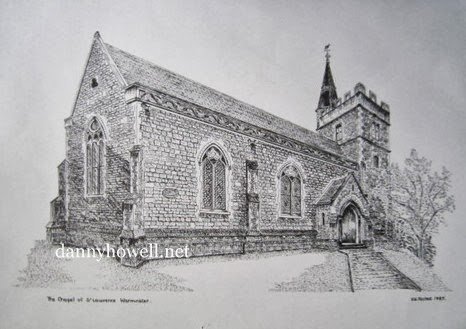
An illustration of St. Lawrence Chapel, at High Street, Warminster, by V. E. Tucker, 1987.
Extract from The Changing Face Of Warminster by Wilfred Middlebrook, published in 1971:
Like the Parish Church Of St. Denys, this Chapel Of St. Laurence has been practically re-built from its foundations and restored out of all recognition during its long and chequered existence. The dedication of this ancient Chapel of Ease is to St. Laurence or Lawrence, Archdeacon to Sixtus, Bishop Of Rome, when the latter was martyred in A.D. 258. Three days later St. Laurence himself was put to death on a red-hot gridiron, and his festival in the English calendar is 10th August.
The Chapel was built by the Mauduits, Lords of the Manor of Warminster, in Plantagenet times, and Henry The Third granted to William Mauduit a fair, to be held on the vigil, the festival and the morrow of St. Laurence. St. Laurence’s Fair was held throughout the centuries but in 1783 there was a double hanging on Sutton Common; Matthew Gardner and John Wheeler being publicly executed for the murder of Benjamin Rebbeck on 11th August. Thousands of people flocked to see this free spectacle, before coming into Warminster for the Fair, which then became known as the Hanging Fair. This three-day fair has been allowed to lapse, the present Warminster fairs being held in April and October.
The Chantry of St. Laurence, endowed with twenty nine acres of land, was built in St. Laurence Mead in 1290, and a house provided for a chaplain in Curt or Court Street. Later, the endowments proved insufficient and the inhabitants of Warminster supplemented the chaplain’s stipend, ensuring regular services until the time of the Reformation.
It seems rather strange these days, with good clean roads and footpaths, and a few short cuts to the Parish Church from the centre of the town, but in those days it was felt that the Parish Church was too far away. An account of 1565 reads: “The said Chapel was – and yet is a very fayre howse with a fayre tower and steeple, but the East Window obstructed by a little howse belonging to it, being situate in the very harte of the Market Place, and the Church being a large quarter of a mile from it, and no howse within a good bow shot of the Church.”
This commentary was written after the Reformation, when the old Chapel was gradually falling into ruin. Edward The Sixth granted the Chapel Of St. Laurence to Richard Robertes of London in 1549 – all except the bells and the lead. Thus for some forty years the Chapel was doomed to being spoiled, the retention by the Crown of the lead alone saving the fabric from utter ruin. The graveyard was let for building sites, and some half dozen lofty houses were built along the High Street in front of the Chapel which could only be reached by a long and narrow alley, completely hiding it from view.
By 1575 Thomas Wardoure owned the property and the leading inhabitants of Warminster banded together and purchased the ruined chapel for £36, restoring it in a rough fashion and once more enjoying regular services, no longer by a resident chaplain but under the ministration of the Vicar Of Warminster.
In 1592 the three survivors of the original six members of the Committee of Purchase drew up indentures conveying the property to twelve trustees or feoffees in perpetuity, and there are eight feoffees responsible for the maintenance of the Chapel to this day. In January 1950 an appeal was launched by the feoffees for the sum of one thousand pounds for the restoration of the Chapel; the names of the feoffees being as follows: Mr. H. H. Barber, Mr. A. H. Coates, the Revd. Canon Colson, M.A., Mr. Hedley P. Curtis, Dr. R. W. Graham-Campbell, F.R.C.S. (Edin.), M.R.C.S., L.R.C.P., Mr. H. F. Knight, Mr. W. R. Marshall, M.A., Mr. W. H. Wickham, with Mr. H. Pallister Clarke as the Steward.
A description of the early restoration in 1575, written by the Vicar Of Warminster in 1855, makes depressing reading. “The Chapel existed from that time,” wrote the Rev. A Fane, “Hidden from without, hideously repaired within, with four roundheaded windows utterly defying the taste and beauty of the tower; the inside a gathering of lofty and unsightly pews; the tower enclosed for fire buckets, coke, coal, and filth; the clock and bell turret in a sad state of decay; the outside, as it may now be seen, partly stuccoed, partly black, partly white; the East Window wholly closed; no altar rails, no organ – in a word, the little Chapel of St. Laurence might rejoice that the outside encroachments prevented the passerby from inspecting the interior defacements; such as the state of this ancient building, devoted now for nearly five centuries to God.”
From 1631 the curfew was sounded at eight o’clock each evening by the “Towne Bell’ in St. Laurence’s steeple, a custom that continued without a break until 1940, when the fear of enemy invasion caused all church bells to be muted, to be used only as an invasion alarm. At the end of the nineteenth century Mrs. House rang the bell by a rope that descended from the belfry directly into the sexton’s house. Since the beginning of the present century, up to 1940, Mrs. Amy Penn and Mrs. Annie Penn have rung the Town Bell for curfew, for services and, occasionally, for fire alarms.
The son of Mrs. House awoke on an early morning in December 1897 to find a huge slab of masonry across the foot of his bed; the upper stages of the tower had been completely destroyed by lightning! Mr. House, who still lives in the shadow of St. Laurence steeple, but not on the premises, was well over 90 years of age when I found him splitting logs in his woodshed. He still recalls many an occasion when he had to run downstairs in his nightshirt to ring the fire bell.
In 1657 a new Town Bell was cast by John Lott in Common Close, the rich throwing half-crowns into the molten metal and the poor throwing in their precious sixpences, “which makes of it such a soft, silvery sound.” This bell lasted over a hundred years, being melted up in 1783, new cast and re-hung at a cost of £24. The nave was rebuilt from the foundations in 1725, with four roundheaded windows “in barbarous fashion of George The Third.” The steeple had been repaired in 1642.
The Clock
A clock was put in the tower in 1765, made by Thomas Rudd and bought by public subscription for £30; still in use, this clock has no face but chimes the quarters on three bells, the chimes being added in 1786.
The St. Laurence Chapel Of Today
In 1855-1856 the Chapel was restored to the condition in which we see it today, through the efforts of the Rev. A. Fane, Vicar Of Warminster at that time. The houses hiding the Chapel from the High Street were pulled down, a new roof with a parapet was raised on the nave, and battlements added to the oblong tower. New windows were inserted and a north porch added; the west window was dedicated to David Kinnier, who left a hundred pounds to the Chapel. The east window depicts Our Lord In Glory with St. Stephen and St. Laurence, while the north and south windows represent Faith and Prayer, with the Good Shepherd and Elijah in one, Our Lord and Moses in the other. The newly-restored Chapel was re-opened on 22nd January 1857, by the Bishop Of Salisbury.
It is a simple chapel equipped with plain pews bordering a central aisle, a timber and plaster roof, plain cream walls and a curtained reredos beneath an east window that can never admit the sunlight because of other buildings that crowd upon it. The darkened east wall is brightened by a beautiful altar cloth of brilliant mauve and purple enriched with silver motifs. On the south wall is a framed panel of prints from frescoes by Fra Angelica in the Vatican at Rome, depicting the life of St. Laurence in five scenes, from his ordination to his martyrdom. It is interesting to note that the spelling of his name is given in both forms on these prints, Laurence and Lawrence.
The Organ
Facing the north door is a small pipe organ, an ancient but lovely instrument that was built, according to the Rev. A. Fane, by a deaf-mute of Warminster called Nelson Hall. In 1954 the well-known church organ builders of London, Messrs. N. P. Mander Ltd., made a report on the St. Laurence organ. One of the few Scudamore organs which had been left unaltered, they said, and a pity if it were dismantled. Worth not more than about £25, it would cost at least £90 for complete restoration, plus £65 for a Discus electric blower; rather prohibitive for a chapel that is so little used.
The maker of this little organ, Nelson Hall, started his unique business in the neighbouring village of Upton Scudamore; and in quite a number of churches in the district there are still “Scudamore” organs to be found. Nelson Hall the organ builder eventually moved from Upton Scudamore to Emwell Street, Warminster, where he carried on his business for a considerable time.
The Tower
The arch of the west door of the tower dates from the time of Henry The Seventh, but the greater part of the tower has been renewed several times; the upper stages were completely destroyed by lightning on 15th December 1897. The tower arch is huge by comparison with the size of the little chapel; an arch that covers a modern font and is curtained off from the nave. Beneath the tower is an old font that was discovered in the tower, with an 18th century bowl and base.
Octavius Bertram Chambers
The name of O. B. Chambers is well-known to older residents of Warminster, his memory being perpetuated for many years by the four-foot clock that once adorned the premises he occupied in the Market Place. This clock was reputedly brought from the Great Exhibition at the Crystal Palace in 1851. .
Octavius Bertram Chambers had the duty of keeping the Town Clock in St. Laurence’s Chapel in perfect time. One evening he climbed the tower stairway as usual to wind the old, faceless clock of St. Laurence. Being a long time gone, Mr. Chambers was sought, and there in the clock room they found him dead. After winding the clock to set time on its forward march he himself had relinquished time and entered eternity.
Recent Events
The removal of the houses that once concealed St. Laurence has left a pleasant open space where one can sit awhile and watch the ever-increasing road traffic of a modern Warminster. High railings were removed in recent years, and two seats have been provided at this vantage spot. These seats were presented to the town as the result of a successful “Beat Your Neighbour” television contest in 1963. For a long time the Warminster Gardening Society helped to keep this little plot a thing of beauty, a task now carried out by the Town Council.
It is interesting to record that the first St. Laurence wedding in living memory was held on the 16th of March 1970, when Miss Sarah Grace Butcher of Warminster became the wife of Signor Giovanni Cazzaniga of Italy. As St. Laurence is one of the few churches in England owned by a town and not by church authorities, a special licence had to be granted by the Archbishop Of Canterbury. The reason for this unusual choice was the fact that the Chapel Of St. Laurence is non-denominational, the groom a Catholic and the bride Church Of England. The Scudamore organ was played by Mr. K. Atkins of Warminster Congregational Church. Another most unusual feature of this unique wedding was the guard of honour that formed outside the church. Employees of R. Butcher And Son, wearing white protective clothing and yellow safety helmets, formed an archway of long strips of glass and glazier’s tools, in honour of the bridegroom, who is a master glazier in his native Sovico.
Some notes by the Reverend Henry Robert Whytehead in the booklet The Minster And Church Life In Warminster, published in 1911:
St. Laurence
The small Chapel of St. Laurence, situated in the very centre of the town, has a more prominent position than the Minster. The eminent archaeologist, Canon Jackson, says it was originally built and endowed by the family of Hewitt, temp. Edward III of England. The people of the town had always added to the endowments sufficient money to support a Chaplain, and regular services were held at St. Laurence till the time of Edward VI. The reason of this being that, even in those early days, the Parish Church was standing some half mile away from the bulk of the inhabitants. A small burial yard was attached to the Chapel, and human remains have been found as lately as the last century.
The endowment lands were confiscated in the evil times of the mis-government of England, by the Council of the boy King Edward VI. They passed through sundry hands, and were finally recovered, and transferred to Feoffees in the reign of Queen Elizabeth. At the time of the confiscation the Commissioners reported that Warminster “was well peopled, and especially with youth. A place very meet to have a Free Schole: towards the erection of which, if it might please the King’s Highness to gyve the said lands, the inhabitants would buy so much more, as should make it up to Ten Pounds per annum: which if it might take effect, will do much good in all that country.” However the Council turned a deaf ear to this appeal. The people themselves had prayed that the Council would spare St. Laurence, as “the saide towne of Warminster was a very good market town (Daniell’s History of Warminster, p. 208), and a great parish, wherein be 800 people which receive the blessed communion.” But nothing came of this petition either. The tower was kept for public convenience, simply because it had the bell, which was found useful, and on which the curfew was rung. The Chapel was left in a ruined state, and the little graveyard was gradually covered with buildings. Since the Feoffees have had possession of St. Laurence, the endowments have been used for maintaining the building, and for the sufficient repair of the chapel, tower, bell, and clock; and for the ringing of the curfew at 8 o’clock. The arch of the W. door of the tower dates from Henry VII; the greater part of this tower has however been renewed again and again, the last date being in 1898, after the upper stages had been totally destroyed by lightning about midnight, on December 15th, 1897.
It had been left to the Reverend Arthur Fane to effect the latest general restoration of St. Laurence, in 1855. The houses, crowded together over the graveyard were then removed, and the Chapel opened out to the street; the roof and battlements were raised, and windows added, and St. Laurence was re-opened on January 22nd, 1857, by the Bishop, with a celebration of the Holy Sacrament. The total cost of this work was £1,000.
The present silver altar plate is the personal property of the Vicar of Warminster for the time being. Since 1855 St. Laurence has been regularly used for daily services, and Celebrations on Saints’ days and Holy days. With regard to the above mentioned petition of the inhabitants (temp. Edward VI), it is interesting to know that nearly 1,000 people in Warminster received the Blessed Sacrament on Easter Day, in the year 1911.
From The Minster And Church Life In Warminster by the Reverend Henry Robert Whytehead, published in 1911:
The small Chapel of St. Laurence, situated in the very centre of the town, has a more prominent position than the Minster. The eminent archaeologist, Canon Jackson, says it was originally built and endowed by the family of Hewitt, temp. Edward III of England. The people of the town had always added to the endowments sufficient money to support a Chaplain, and regular services were held at St. Laurence till the time of Edward VI. The reason of this being that, even in those early days, the Parish Church was standing some half mile away from the bulk of the inhabitants. A small burial yard was attached to the Chapel, and human remains have been found as lately as the last century.
The endowment lands were confiscated in the evil times of the mis-government of England, by the Council of the boy King Edward VI. They passed through sundry hands, and were finally recovered, and transferred to Feoffees in the reign of Queen Elizabeth. At the time of the confiscation the Commissioners reported that Warminster “was well peopled, and especially with youth. A place very meet to have a Free Schole: towards the erection of which, if it might please the King’s Highness to gyve the said lands, the inhabitants would buy so much more, as should make it up to Ten Pounds per annum: which if it might take effect, will do much good in all that country.” However the Council turned a deaf ear to this appeal. The people themselves had prayed that the Council would spare St. Laurence, as “the saide towne of Warminster was a very good market town (Daniell’s History of Warminster, p. 208), and a great parish, wherein be 800 people which receive the blessed communion.” But nothing came of this petition either. The tower was kept for public convenience, simply because it had the bell, which was found useful, and on which the curfew was rung. The Chapel was left in a ruined state, and the little graveyard was gradually covered with buildings.
Since the Feoffees have had possession of St. Laurence, the endowments have been used for maintaining the building, and for the sufficient repair of the chapel, tower, bell, and clock; and for the ringing of the curfew at 8 o’clock. The arch of the W. door of the tower dates from Henry VII; the greater part of this tower has however been renewed again and again, the last date being in 1898, after the upper stages had been totally destroyed by lightning about midnight, on December 15th, 1897.
It had been left to the Reverend Arthur Fane to effect the latest general restoration of St. Laurence, in 1855. The houses, crowded together over the graveyard were then removed, and the Chapel opened out to the street; the roof and battlements were raised, and windows added, and St. Laurence was re-opened on January 22nd, 1857, by the Bishop, with a celebration of the Holy Sacrament. The total cost of this work was £1,000.
The present silver altar plate is the personal property of the Vicar of Warminster for the time being. Since 1855 St. Laurence has been regularly used for daily services, and Celebrations on Saints’ days and Holy days. With regard to the above mentioned petition of the inhabitants (temp. Edward VI), it is interesting to know that nearly 1,000 people in Warminster received the Blessed Sacrament on Easter Day, in the year 1911.
Extract from The Deed Of Feoffment Of The Chapel Of St. Lawrence At Warminster And Other Property Belonging To The Chapel Feoffees, From Old To New Feoffees, 21st July 1876:
. . . . All That Allotment piece or parcel of Meadow Land situate lying and being in Spurt Mead in the parish of Warminster aforesaid, containing 1r. 10p., and marked R D in the said 5th Plan annexed to the said Award, now in the occupation of Mr. Bradfield as yearly Tenant at a rent of £1, and numbered 267a on the said Survey.
Extract from The Deed Of Feoffment Of The Chapel Of St. Lawrence At Warminster And Other Property Belonging To The Chapel Feoffees, From Old To New Feoffees, 21st July 1876:
. . . . And Also one rood of Meadow lying in Bourton otherwise Boreham aforesaid commonly called “the Ham,” then or late in the occupation of Francis Gooderich or his assigns, adjoining to the Common called “the Ilonds,” on the East part, to the Watercourse on the South part, to the lands late of John Gifford on the West part, and to a certain River on the North part.