Being Human ~ At Warminster Library ~ A Free Talk About Hanging And Gibbeting In The West Country, Plus Poetry And Art Recreating The Public Hanging On Arn Hill, Warminster, In 1813, Of The Murderers George Ruddock And George Carpenter

Romancing the Gibbet

Public punishment and local memory in the Georgian West Country

A free event presented by the University Of The West Of England, taking place at Warminster Library, Three Horseshoes Walk, Warminster, BA12 9BT, on Saturday 22nd November 2013, 11.00 a.m. to 1.30 p.m.

The occasional, and extraordinary, 18th-century practice of hanging and/or gibbeting some felons (exhibiting their bodies to public view in iron cages) at the scene of their crime, was intended to leave an indelible and exemplary impression on disorderly peripheral villages and small towns. They were often staged in remote locations before very large crowds and were spectacular, processional events. In 1813, one such execution was carried out upon two convicted murderers, George Ruddock and George Carpenter, on the brow of Arn Hill, overlooking Warminster. For this Being Human event, historian Steve Poole will give an illustrated talk on this and other west country crime scene hangings, explaining their rationale and placing the Arn Hill events into a broader historical context. Then, poet Ralph Hoyte and artist Michael Fairfax will create a public performance related to the events of 1813, involving poetry, sculpture, music, and sound installation. This event gets to the very heart of what it is to ‘be human’ in extraordinary circumstances.

Free admission.

Booking required. You book your free ticket by simply registering your name and email address online.

Click here to book

For further details, contact Steve Poole
email: Steve.Poole@uwe.ac.uk

Being Human Festival Website, click here.

New Book ~ Warminster Through Time ~ A Large Number Of Mistakes

Monday 25th March 2013:

Danny Howell writes ~

Warminster Through Time, compiled by Andrew Pickering and Kathryn Dyer, is a recently published book, its theme being photographs old and new, arranged so as to give it a “now and then” comparison of local scenes. 

It is one of a nationwide series being produced about towns and areas everywhere. It is published by Amberley Publishing, of Gloucester, and the front cover includes a picture of a red rosette with the words: “The No.1 Best Selling Colour Local History Series”. Indeed, it is in colour, with the old photographs being reproduced in sepia, and the new photos in full colour. So, we guess a good amount of money is being spent on this project and it’s a very commendable idea.

You can buy this book, locally, from Coates and Parker, for £14.99, or cheaper off the internet. I bought my copy off the internet, for £9.95, with free postage and packing. I ordered it online in the afternoon and the postman put it through my letterbox the very next morning. 

Unfortunately, my “Silas-Marner-moment” of thinking I was up on the deal, having saved £5, was soon dashed. 

There are 90 pages, about A5 size, with an “old” and “new” photo to each page. That’s 180 photos. Sounds good, but the first page of photos gets its wrong, as does the last page of photos, and it’s oft the same on a lot of pages in between.

The first page of photos (page 5) is titled “View of Warminster from Copheap.” Except the two photos are not views from Copheap, the views are from Arn Hill!

The third page of photos (page 7) is meant to be a comparison of the Pound Street and West Street junction. The lower (new photo) shows that, but the upper (old) photo is not the same junction – it is further up the street at the Pound Row and West Street junction. So these two pictures do not match up!

The upper (old) picture on page 13 is an illustration of the Congregational Church in Common Close (now simply known as The Close). The caption quite correctly states that this church was demolished to make way for Kyngston Court which now stands on the site. But, oh dear again, the lower photo, instead of showing Kyngston Court in The Close, shows Imber Court in George Street! A different location – a different building in a different street. Did Kathryn Dyer not look at the name (which just happens to be writ in big letters) on the building she was photographing?

Page 37 has a new photograph showing Copheap Rise, with Copheap in the background – a view taken from the junction of Copheap Rise with Copheap Lane; but the old photo below is a view from near the Warminster Town Football Ground at Weymouth Street.

Page 39 has an old picture postcard view of the end of The Close nearest the High Street, showing the Warminster County Secondary School on the left and the Fire Station on the right. But the new photo below is taken at the opposite end of The Close, from the junction with the Avenue. Not really comparable.

Page 73 contains an error of monumental proportions. The top photo (old) shows the Payne family’s grocery and bakery premises which were at George Street. But the new photo below shows Travel Angels in the Market Place. The completely wrong location again! What was Payne’s bakery and grocery is “now” the Pine and Oak Furniture shop at George Street. While Travel Angels ground floor premises in the Market Place have formerly been estate agents, before that the Nancy Moore cake shop, before that Mains the tobacconists, and even years before that, the town’s Post Office. How on earth did Kathryn Dyer photograph the wrong building again?

The final photo in the book, on page 94, is a new one of the main street at Bishopstrow. But the old photo above is not Bishopstrow! It looks more like Manor Road at Upton Lovell, another village further down the Wylye Valley.

Two views of High Street, on page 40, are wrongly titled “Silver Street”. The view in these looks towards the Market Place. But the caption describes the views looking in the opposite direction towards the junction of Silver Street and George Street!

But maybe we shouldn’t be surprised at this, because Andrew Pickering appears to be in need of a compass.  

The last sentence of the introduction to the book (page 4), reads: “The images in this book have been arranged in a roughly geographical order, from east to west . . . ” but for some reason my copy of the book has the photos going from West Parade in the west (there’s a clue in the name West Parade!) to Bishopstrow in the east!

The points of the compass go awry too within the pages of this book: On page 82 Heytesbury is referred to as “south of Warminster.” Isn’t it to the east? On page 6 we are informed that: “West Parade connects to Pound Street to the south-east of the town centre.” Mmmm, I’d bet good money that Pound Street was more likely to the south-west of the town centre. On page 6 Coldharbour is referred to as “to the north of the town.” Surely Coldharbour is on the west side? And so on.  

The text for the captions also has its fair share of local history gaffs:

Morgan (one of the most renowned surnames in 19th century Warminster, of Morgan and Bladworth brewery fame, has become “Morcan” in this book. And guess what, Bladworth has become “Wadsworth” in this book as well (page 42).

On page 93 are two photos titled “Bishopstrow Bridge.” But they are taken from  the more southerly of the two Boreham bridges. The views look in different directions, so they are not comparable as ‘then and now’ shots. The lower (new) photo shows the view to Boreham Mill. But for some reason, the caption, meant to be about Boreham Mill, contains information (like the fire of 1873) which is about Bishopstrow Mill which is half a mile to a mile further down the River Wylye! A mix up of mills then by Andrew Pickering.

One has to ask how these pictorial and caption errors got into print. Whose fault is it? Does the blame lie with The Dewey Museum who supplied the old pictures? Is the culprit Andrew Pickering who wrote the text? Was the book led astray by Kathryn Dyer who took the new photos? Did no one check the pictures? Did no one check the text prior to prior to printing and publication? Did anyone involved with this book care if they got things correct or not?

One wonders if Andrew Pickering did any research himself for this book. The photo of a funeral at George Street (page 24), has a caption that only refers to the deceased as “a much respected person.” If he had done some research Andrew Pickering could have told readers that this was the funeral of Frank Axford Curtis, which would have been more informative. And so, on.

We learn very little that’s new concerning local history in the text of this book. And nearly all of the old photos featured in Warminster Through Time have been published in books before ~ this is actually mentioned in the introduction. This then, seems a bit of a wasted opportunity, when previously unpublished old scenes could have been used, putting something “new” on to the bookshelves of Warminster folks and others interested in this Wiltshire town.

There is nothing in the book to tell us who Andrew Pickering and Kathryn Dyer are, or what credentials they have for compiling a book about Warminster. Several people have contacted me, wanting to know, but I’ve never heard of the author and photographer, even though some of my own books about Warminster and the address of this website are included in the acknowledgements inside the back cover of the book. I would hasten to say now that I had no involvement in Warminster Through Time and disassociate myself from it completely.

Verdict: The concept for the Through Time series is an excellent one, that will appeal to people interested in their surrounds, but the Warminster book is a something of a big let-down for discerning Warminster residents whether they are passionate about local history or just like looking at old photos, and all because of the large number of mistakes this book unfortunately contains. 

Starshine From Chilmark Author

Thursday 15th November 2012

John Wilcox, of Chilmark, will be signing copies of his new book Starshine, at Waterstones book store in Salisbury, on Tuesday 20th November, from 11.00 a.m. to 1.00 p.m. Starshine – a love story set against the backdrop of the First World War – marks a change in style for John. His previous books have been historical adventures.

Warminster Book Festival

Warminster Book Festival
(organised by Warminster Garrison Book Club)

Monday 11th June to Saturday 16th June 2007

Monday 11th June 2007
7.00 p.m.
Warminster Library, Three Horseshoes Walk, Warminster
Lesley Pearce (novelist) talking about her latest novel
Hope, and her life in writing.

Monday 11th June 2007
7.00 p.m.
Kingdown School, Woodcock Road, Warminster
Chris Ryan
The SAS soldier that got away.

Tuesday 12th June 2007
7.00 p.m.
Warminster Library, Three Horsesoes Walk, Warminster
Mike Ednay
A Brief History Of Warminster.

Wednesday 13th June 2007
7.00 p.m.
Kingdown School, Woodcock Road, Warminster
Wendy Cooling
Co-founder of the Bookstart Programme.

Thursday 14th June 2007
7.00 p.m.
Kingdown School, Woodcock Road, Warminster
Mike & Brenda Williams
Developing potential and motivation (A Guide for Parents).

Friday 15th June 2007
7.00 p.m.
Lloyd Clark
Anzio 1945.

Saturday 16th June 2007
7.00 p.m.
Athenaeum Theatre, High Street, Warminster
Rosie Whitehouse (journalist and author), Ann Venning (author), and Melanie Pullan (Communications Director AFF)
Discussing ‘Family Life In A World Of Conflict’.

A Peg For His Hat

Leo Macey, who lives in Warminster, has had a novel published. It is called A Peg For His Hat. 245 pages. The cover design is by Philip Macey.

In the Preface, Leo writes:

I first wrote A Peg For His Hat in 1966. That year I went to Malaya and the original manuscript was left in safekeeping of a relative who at the time was in the process of moving house. I can only guess that during that move the manuscript was lost or thrown out by mistake. That was the last I ever saw of it.

When I returned to England in 1969 I re-wrote the story from the much amended and dog-eared duplicate and thought no more of it.

Recently, during a period of ‘sort out’, the manuscript again came to light. Friends and family have persuaded me to publish it. So here it is thirty eight years late.

Notes on the back cover read:

‘Without a belief in something outside this life you are nothing more than a complicated composition of cells evolved by chance and destined for nothing. You will drift through your life like a man in a crowded pub looking for a peg for his hat.’

The Second World War has just ended, Alan Burn, an orphan, with an inate ability to paint, longs to fulfil his ambition to become an artist. Following a whirlwind romance in Cairo with Anna, a military nurse, he returns to postwar London and with the help of his Aunt Millie embarks on a journey to fulfil his dream. This journey brings: loyal friends, love, romance, disappointment, grief, despair and religious discovery. But does it find a peg for his hat?

“An ideal holiday read”

A Peg For His Hat by L.F. Macey is published in paperback by Forrest Hall, ISBN 0-9547673-0-6, price in UK £4.99.

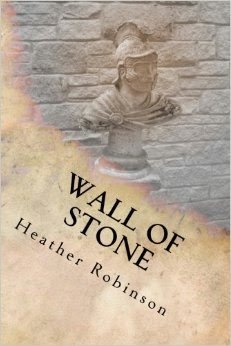
Wall Of Stone By Warminster Author Heather Robinson

Wall Of Stone, a Roman historical novel by Warminster author Heather Robinson*, is available via Amazon, as a paperback (£6.05) or as a Kindle edition (free to read!).

It is AD121 and Legate Maxinius’s Twentieth Legion is becoming demoralised by the covert tactics of the Picts, rebel warriors coming down from the north of Britannia to incite trouble between the invading army and the local Brigante people. Fearing an uprising and with growing frustration at Rome’s lack of support, the legate ignores orders from Emperor Hadrian to consolidate his position without advancing and decides, at the peril of his career, that his legion must act by flushing out the rebels, shattering the peace of the area in the process. Wall of Stone follows the fate and fortune of two legionaries from the Twentieth Legion which intertwine with those of a local Brigante family.

“A very well researched and beautifully written book.”

“Wonderful descriptive elements of both characters and the era.”

“Riveting right from the start. Well written and very expertly researched with a gripping story line.”

238 pages.
ISBN: 978-1500464776
Publisher: Create Space.
First published 26th July 2014.

To see the Amazon page for Wall Of Stone, click here.

*Heather Robinson is also a presenter on Warminster Community Radio (and its Admin Manager). 

Down Under Poetry Combined Humour, Anguish And Observation

Thursday 15th July 2004

Danny Howell writes:

It’s a long way from Australia to England, but Mick Leigh who originally comes from Port McQuarie in New South Wales, made himself very much at home in Warminster last Thursday evening, when he was the special guest at Posh Cups And Poetry, a social event held in Harridges Coffee Lounge, off the south side of the Market Place, Warminster.

Organised by Janet Trott, on behalf of Christ Church, Warminster, the evening featured poems chosen from seven of Mick’s published collections. A buffet was provided in between two sessions which were attended by over 30 churchgoers.

Janet said “Christ Church is closed at the moment, while major refurbishment is being carried out, and we are holding our services elsewhere, and I felt the congregation needed a social occasion to bring us back together. I had heard Mick giving a poetry reading at Warminster Library, about 18 months ago, and I thought he would be ideal for this.”

Ideal he certainly was, as his relaxed style and down-to-earth philosophy reflected the tone and inspiration of his poetry. He began by reading two children’s poems, A Nip In Time and Wally’s Birthday, which being rather funny, got the evening off to a good start with lots of laughter.

He continued with a poem about Ayers Rock, and then Meetings, which was followed by Albatross.

In between reading the verses, Mick took time to explain how he always carries a notepad with him, in which he jots down ideas when he gets the muse of inspiration. He said “I write short, sharp things on the spur of the moment. When someone upsets me I usually end up writing a poem about them. Sometimes I write a complete poem in its final format straight away but other times I write something and it looks clumsy so I refine it and it changes.”

Mick has been writing poetry for the last ten to fifteen years but previously had a whole string of different jobs including truck driving and teaching.

A keen conservationist, he has spent most of his life in the Australian outback, writing verses about the animals that live there, usually in a humorous way, especially for children. These particular verses include Maurice The MozzieJoe Blake The Snake, and Wally The Wallaby.

The second half of the Posh Cups And Poetry evening began with a member of the audience, David Martin, reading Ginger Beer, at Mick’s request. A reference in the poem to breaking wind, caused much laughter and everyone listened intensely as Mick explained the joy of language and how playing about with words can be such fun.

A very topical poem, about contrasting lifestyles, brought home the current crisis in the Sudan, with its haunting words: “Woman in the desert, suffering silently, if I was a rich man I’d rather be with you.”

This was followed by a poem about anguish – “love lost is a sharp knife.” Mick said “It’s about that wretched thing called love. I fall in and out of love all the time but I don’t know why I bother. I’m super sensitive.”

The session continued with three very different poems. The first was about a wedding bouquet he found thrown in a dustbin, the second was Will You Come To My Funeral, and the third was Night Forest, which took a long time to write, and refers to the “scurry hurry badger” and “the sigh of a falling star.”

To end the evening he read a rap-like poem about emails which was entirely made up of computer jargon, and Language Please which featured the wonders of Australian slang.

Mick Leigh now lives at Winsley, near Bradford On Avon. His latest anthology, The Big Book Of Bonza Poems, is published by the London Press, and features 47 rhyming works, with illustrations by an aboriginal artist.

If you want to know more about Mick Leigh and his poetry, check out his website: www.mickleigh.com

Mick Leigh reading his verses at the
Posh Cups And Poetry evening held at
Harridges Coffee Lounge last Thursday.

Photograph taken by Danny Howell.

Warminster In The 20th Century By Celia Lane And Pauline White ~ A Book “Full Of So Many Mistakes”

September 1999

Warminster In The 20th Century by Celia Lane and Pauline White, published by Warminster History Society. September 1999.

Review by Danny Howell (Warminster’s Resident Local Historian):

In 1995 the Warminster History Society decided to produce a book documenting the last 100 years in Warminster, as a way of celebrating the millenium and bringing Daniell’s History Of Warminster (1879) up to date. A commendable thought but oh, oh dear, what must have seemed a very good idea at the time has turned out to be very much like the Curate’s Egg – only good in parts. Indeed, Warminster In The Twentieth Century, by Celia Lane and Pauline White, could well be subtitled “A Catalogue Of Errors!”

To start with, people’s names are, all too often, given incorrectly. Diana Turner, of the Baby Shop in George Street, is “Diane” (page 377), Major John has had his surname pluralised to “Johns” (page 171), the Reverend J.J. Daniell is shortened to “Daniel” (page 309), Ernie Weeks, the Station Road cafe proprietor has become “Weekes”; George Mundy, the Manager of the Capital & Counties Bank, is referred to as “Munday” (page 331); and Mr. A.Bazley of Boreham Farm is mistakenly Bazeley (page 197). These are just six of the many mispelt first names and surnames that crop up in this book.

Place names suffer just as badly in the hands of Lane and White. The Teasels residential estate is, according to them, the “Teazles” (page 97), Hillbourne Close (as signposted at Copheap Lane) is recorded as “Hillborne” (page 184), and Oxendean has become “Oxendene” (page 233). Sadly, these are not the only examples.

Perhaps it’s being trivial to refer to this type of error, annoying as it is to the descendants and families of the people, or the residents of the places concerned, but if Lane and White can’t get these right, can they be relied on to be accurate with other things? Unfortunately they can’t.

In the section on the Police, we are told, on page 218, that “In 1882, Sergeant Enos Molden was shot dead by John Gurd at the entrance to Longleat and was buried at Christ Church.” What rubbish! Sergeant Molden was shot on 12th April 1892, and is buried at St Denys’ (The Minster) Churchyard, where his grave is marked by a memorial stone complete with an informative epitaph. How did Lane and White allow this double-gaff to get into print? Well, they acknowledge Paul Sample’s booklet The Oldest And The Best, The History Of The Wiltshire Constabulary 1839-1989, in their list of references. Paul Sample made the mistake and Lane and White simply copied it, thus compounding it. They obviously accepted their written sources at face-value and didn’t bother to check the information.

Lane and White have a lot of trouble with dates throughout their book. 1967 is given (on page 12) as the year Gateway opened, when it actually opened in 1964! We are told (on page 327) Mr O’Malley took over Everett’s grocery shop, at 4 Market Place, “around 1923/4.” Wrong again! Had our two historians done a little research they would have discovered that O’Malley acquired the business in November 1919. Strange too that Lane and White, who are members of the Warminster History give 1972 (on page 12) as the year the History Society was formed. Wrong yet again! The inaugural meeting was actually held in 1970. And so on. There really are far too many mistakes concerning dates in this book.

Worse still, there appears to be some distortion of the truth in places. For example, the list of Council Chairmen and Mayors (page 404) credits Peter Gough serving as Mayor for one term only (1988/89). He was, in fact, a Mayor on two occasions; an even more remarkable achievement when you consider how he overcame his disability. He died during his second term (1991/92), but this is not mentioned. Maybe the authors thought the circumstances of his death a bit too much for their readers and decided the best way of not having to mention this was to simply put he was mayor only once.

Similarly, in the section on doctors, we are not told of Dr Payne’s fall from grace (even though the reason for his resignation was a big talking-point in Warminster during the 1990s). There is, of course, a danger in recording the misdemeanours of people still alive, and Lane and White must have chose to shy away from such things. Unfortunately though, there is another danger arising from that – history is portrayed through “rose-coloured spectacles” and not really as it was.

The “unsavoury” aside, it has to be said another of the book’s downfalls is that most of the information in the book is very scant or patchy. No doubt the authors will say there wasn’t enough space to go into detail, but if that was the case perhaps it was foolish to try and chronicle 20th century Warminster in a single volume. The result is certainly a very incomplete account. Some subjects fare better than others but throughout, the lack of anything “concrete” all too often gives the wrong impression. For example, in the chapter on schools, in the section on New Close School (page151), we are told when the school opened in 1952 a Mr. H. Brodie was the head, and a few sentences further on, we are given some information by Mr. A. Folker, who was the head from 1979 to 1984. Readers could perhaps get the impression that Folker succeeded Brodie as headmaster. No mention of made of Harry Hicks who was the headmaster during the 1960s and was probably the best-loved and most well-known of all the New Close headmasters. New Close School can probably consider themselves lucky to have been given half a page in this book; Princecroft School, for example, were given no section of their own in this chapter. Why not? Were they accidentally left out or didn’t Celia Lane and Pauline White have anything worthwhile to say about Princecroft School?

The chapter on industry and employment is also similarly choosy on what is included and what is left out. Several pages are devoted to two of the town’s building firms (Culverhouse Bros. Ltd. and R. Butcher & Son) but other builders in Warminster (Gaisford, and Ponton, for example) are not given the same treatment – Ponton is not even mentioned in the book. About half a page is devoted to gloving, with Jefferies, Dents and Holman & Byfield’s being given all of 18 lines. Other glove makers in Warminster, for example, Osmond & Son, are not mentioned. Readers are told that Beswicks left the town in the 1980s but readers are given no information as to what Beswicks manufactured, or where they were, etc. And again, mistakes are made. We are told (on page 171) that the Warminster Timber Company closed in 1961 – it actually closed in 1962.

The section on shops in the town centre is a huge let-down. The uses of the premises and the various shopkeepers, through the years, is very hit and miss. And whole areas are left out completely – Three Horseshoes Walk, Chinn’s Court and the Cornmarket precincts are not included for investigation. Lane and White, in some instances, have failed to take into consideration changes in the numbering of premises (Market Place numbers have been altered at least three times), consequently the authors get themselves into a muddle more than once.

There are other strange anomalies throughout the book too. References to “now” in the text depend on the moment when the various bits of information were gathered during what must have been the five years it has taken Celia Lane and Pauline White to compile the contents of the book. “Now” can be 1995, 1996, 1997, 1998 or 1999. What a pity, the “now” references couldn’t have been ironed out during the final edit, that’s if there was one. Annoying as all this is, it is, however, the amount of the mistakes in the book that really let readers (and more importantly researchers) down.

You really have to ask yourself how a book of local history, by two leading members of the Warminster History Society, came to be full of so many mistakes – well in excess of 150 in fact. We know they simply copied errors from other books, but was this the only reason? Could one of the factors be that neither of these women are “Warminster folk”, but only came here to live “fairly recently,” and, in consequence, couldn’t have been sure if what they were putting into print was accurate or not?

Celia Lane and Pauline White would have been well advised to have let someone with a knowlege of Warminster’s past read their manuscript before they went to press. Perhaps then a lot of the mistakes could have been picked up on and corrected. The President of the Warminster History Society, Jack Field, has recently been regaled as “having an encyclopaedic knowledge of Warminster’s past,” but one wonders whether he was shown Lane’s and White’s efforts, otherwise how did all their gaffs make it to the final script. Who, if anyone, was responsible for editing this book? The services of an editor would not only have eliminated the errors but also prevented the patchiness of the contents from being unleashed on the public. Warminster In The 20th Century suffers badly because of this.

On a pedantic note, the purists will tell you that the 20th century didn’t end until 31st December 2000, but the History Society chose to “jump the gun” and publish in the autumn in 1999, which meant they had to complete their half-cock effort 18 months before the century had expired. Consequently, any of the great events which happened in Warminster, rounding off the century, were not included; for instance, the re-opening of the Athenaeum, and the big fire in the Market Place. What a pity they couldn’t have used the opportunity to well and truly bring the history of Warminster up to date – something they aspired to in the first sentence of their acknowledgements at the start of the book. It would have been really inspiring if they had concluded their book with, say, a chapter, on how they saw Warminster at the end of the 20th Century. Now that would have been a piece of local history.

At nearly £20 a time the book is rather an expensive price for, as we have noted, a catalogue of errors. Luckily this reviewer didn’t buy a copy but was able to loan one from someone who was given it for Christmas. We’ll leave the last part of this review to them. They said “I’d like to throw it in the waste bin but I can’t because my wife gave it to me for Christmas and I dare not upset her. I won’t be reading it though. Even the information I gave Celia Lane has been written up wrongly in the book. I’ve disassociated myself entirely from it.”

Celia Lane and Pauline White have shown that local history is definitely not safe in their hands. Give their book a miss. What ever you do, don’t rely it on it for accurate reference. It will surely go down in history as one of the most erroneous local history books published in recent times.
error: Content is protected !!