Skyfall Over Trowbridge

Friday 23 November 2012

Glenn Head has witnessed something in the sky above Trowbridge. He writes ~

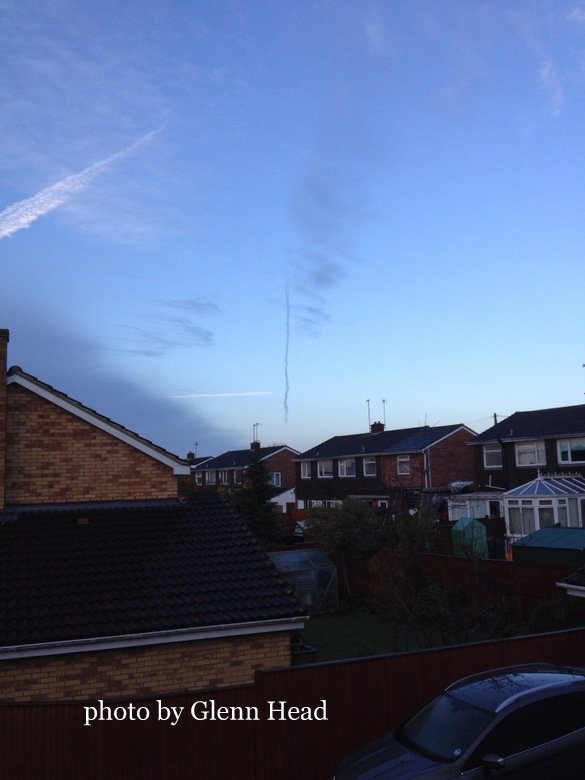
At around 8.00 a.m. on 23rd November 2012, I awoke and opened my bedroom blinds to be presented with a blue sky, dotted with benign clouds. I smiled, wiped the sleep from my eyes and noticed an incongruous gash in the western sky. At first, I thought something had landed on the window, the leavings of a passing bird perhaps, but I was wrong.

I looked closer. I picked up my iPhone, turned on the camera, opened a window and took the shots shown:
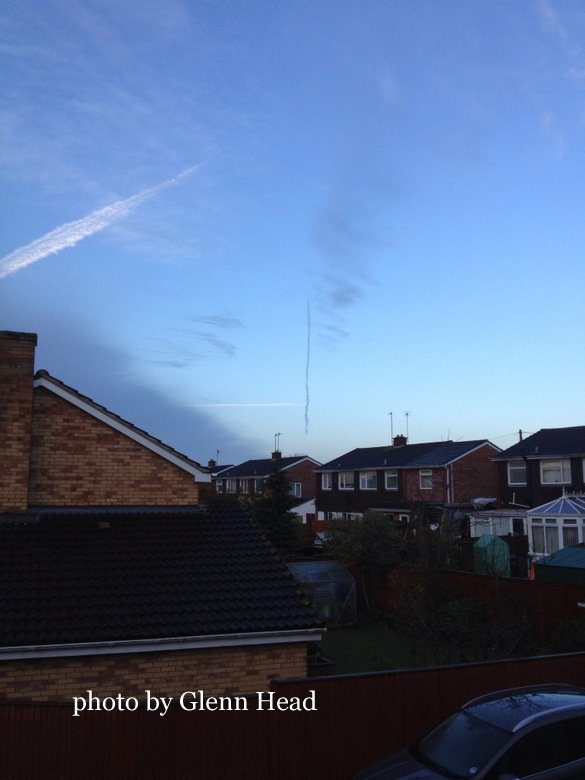
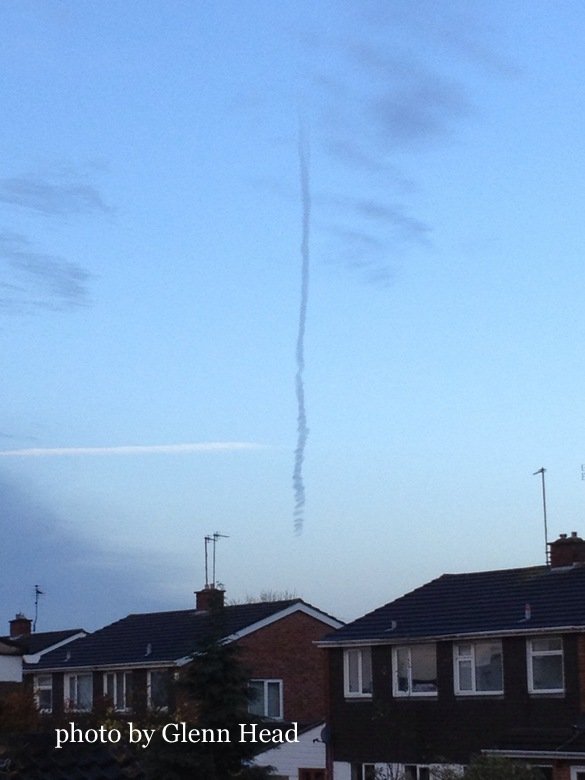
I did not see or hear whatever had created the dark line in the sky. I presumed it had only just come into being, because it had not yet dispersed. To me, the mysterious dark gash brought to mind images of something plummeting to the hard Trowbridge earth. I wondered whether there had been a crash, or maybe a part of a plane had broken off unbeknownst to the pilot.

After a couple of minutes the wisps dispersed, the misty mark tilting like the tower in Pisa, before slowly disappearing into the ether.

I turned on the TV to catch the local news. Surely any major air incident would be reported there? But… nothing. So the mystery deepened.

What was it? Had something dropped from the sky? Or could it be that I photographed the remnant of a contrail from an odd angle, itself lit unusually so as to appear numerous shades of grey instead of the usual white?

Who knows? Perhaps we’ll never know? Quite interesting nevertheless.

Do you have any ideas as to what Glenn saw, or do you know for sure what this was in the sky? Let us know at dannyhowell.net  ~ email us on dannyhowellnet@gmail.com

A One-Armed Man’s Fear Of Premature Burial

Tuesday 21st November 1911

(First published in the Warminster Wylye Valley And District Recorder, No.3., December 2005)

Strange But True – A One-Armed Man’s Fear of Premature Burial

Bishopstrow House, on the eastern outskirts of Warminster, is now a luxury hotel, but was built in 1815 for William Temple, the lord of the manor of Boreham, as a grand residence for himself and his family.

During the latter years of the 19th century and the early years of the 20th, the house was let by the Temples to Captain Burchall Helme, who was fatally struck by a steam train while walking across the railway line, north of Bishopstrow House, in 1893. A regular guest of Captain Helme at Bishopstrow House in the late 1800s was Thomas Douglas Murray, of Iverplace, Iver, in Buckinghamshire. His wife was the sister of Captain Helme’s wife. Mr. Murray, who only had one arm, died on the 21st of November 1911, leaving £28,288 gross, £23,652 nett.

Murray was obviously worried about the possibility of premature burial, because he left some explicit instructions in his will.

“He directed that on his apparent death his body shall be kept in a well-warmed bed for 36 hours thereafter. His body shall then be placed in a coffin in a warm room with the windows partly opened, and watched for four days and nights or until definite signs of decomposition have set in. During this period the tests given in a pamphlet by Sir Benjamin Ward Richardson, The Signs And Proofs Of Death, shall be applied, and during this period a bell shall be attached to his wrist which can be easily audible within and without the room. When decomposition has set in, a surgeon shall completely sever the spinal cord high up in the body, and the coffin may then be lightly fastened but shall not be screwed down until the twelfth day after death. His remains shall then be cremated either on the downs near Stonehenge or the downs near Battlesbury Hill or Scratchbury Hill, Warminster, or if impracticable, then at Woking, the ashes to be scattered to the four winds of heaven.”

Raining Wheat (Ivy-Berries) Upon Warminster

From The Warminster Herald, Saturday 1 June 1878:

Cox, in Magna Britannia, tells another wonder:- “In the year 1696 or thereabouts, it was a report in Bristol and thereabouts, that it rained wheat upon Warminster, and six or seven miles round, and many believed it. One Mr Cole, being curious to find out the truth of the odd phenomenon, procured several parcels of it and upon diligent examination of them by the magnifying glass, judged from the taste, figure, size, and smell, that they were ivy-berries, driven by a strong wind from the holes and chinks of houses, churches, and other buildings where starlings, or other birds, had laid, or dropped them. But if so, “tis strange that they should fall in so great quantities in so many places.”

Calf With Six Legs At Woolverton

From The Warminster Herald, Saturday 9 April 1870:

On the farm of Mr. Chas. Burfitt, at Woolverton, near Mere, there is to be seen a live calf with six legs. It was born on 26th March. One of the legs comes out of the back between the shoulders, and hangs down on one side of the animal. It is about the proper proportionate length, but from its point of connection on the back down to the knee there is no bone; the other part of the leg, and the hoof are complete and well formed. Out of this leg, from between the knee joint and the hoof, appears the sixth leg, which is diminutive and has an uncloven hoof.