From The Minster And Church Life In Warminster by the Reverend Henry Robert Whytehead, published in 1911:
FOREWORD
The following short history of Church Life and Church Work at Warminster is written in order that people may have a conveniently small record of events which are of interest to so many in this Church town.
It is hoped that a large number of copies may be sold, and as each one will bring in a clear profit of 6d., the total realized by the book will amount to a considerable amount.
It is proposed to make this sum the beginning of a Minster decoration scheme, to be expended as the Vicar, Wardens, and the Congregation may agree upon.
“The History Of Warminster,” written by Rev. J. Daniell, and lately republished by Mr. A. H. Coates, “Journal” Office, Warminster, at 2/6, contains much information of much interest, and I have been very considerably indebted to this book.
H. R. W.
THE PARISH CHURCH OF WARMINSTER
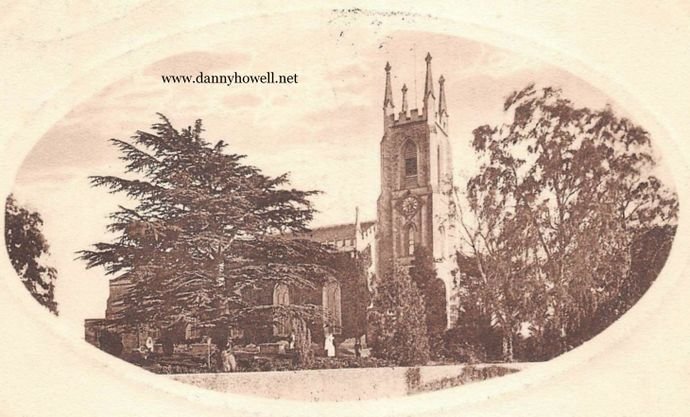
It would seem that the main centre of the population of the old Warminster of Saxon times, must have been near the present Parish Church, for the first Church dedicated to divine worship, stood but a few yards west of our church yard. But the Saxon Church cannot have existed for more than two or three centuries, as in the East side of the North transept of the present Minster there is yet to be seen, in situ, a small semi-circular arch of the XI Century, which is a proof that we worship now, where our forefathers worshipped as far back as the Norman times. The town, however, has ever since lengthened out eastwards, in one long street, gradually leaving the Church as practically the last building at the west end of the Parish. The cause of this movement was probably the need of houses of refreshment for travellers, and stabling for the great and ever-increasing numbers of horses, in the days when all traffic and commerce was carried on by panniers, coaches, and waggons. The coming of the Great Western Railway has arrested this eastward progress to some extent, although the attraction of the higher ground still causes a slow advance of house building in that direction. But the Minster remains the ecclesiastical centre, and near it in more modern times have been erected, Lord Weymouth’s Grammar School [1707 A.D.], and St. Boniface Missionary College [1860 A.D.], together with St. Denys’ Home, (a community of Anglican Sisters), with its High School for girls, and Orphanage.
Sir Arthur Blomfield, A.R.A., says that there appears to be a gap of about 300 years, in the architectural history of the Minster, i.e., between the little Norman arch in the N. transept and the XIV century work of the tower. Then came the XV century chancel and transepts; and lastly the S. aisle of the chancel, called the Lady aisle, originally a chantry chapel, built by the family of Mauduit, in the reign of Henry VII. Nothing appears to have been done to the church for many years after this, and the whole must have fallen into a lamentable state of decay, for in 1626 an order was made to repair the old building, which (as the order says) “weeps many a tear for her decayed house, especially when the wind is in the west.” In 1660 the first gallery was put up in the N. transept, and after that date, as the population of the town increased, gallery after gallery was erected, until the year 1724, when almost the whole of the old building, west of the tower, was barbarously pulled down, and an extraordinarily ugly nave was built on the old foundations, which, with its many galleries, accommodated 1250 persons. This nave (still remembered by the older inhabitants), was quite out of character with the ancient tower and eastern portion of the church, and entirely marred the beauty and proportions of the old work still left.
In the year 1886, under Sir Arthur Blomfield, this modern nave was pulled down, and an endeavour was made, not to reproduce exactly what the old Gothic nave might have been, but (preserving the remains of the original side walls, and the south porch), to erect a building which should have the effect of bringing out the beauties of the older parts of the church. The result of this work, carried out at the cost of £12,500, has been the erection of a church of which all the inhabitants of Warminster are justly proud, and places it high in rank among the larger parish churches of Wiltshire. The Minster was re-opened on February 21st, 1889.
The organ, built by England, 1792, A.D., was originally the gift of King George III and Queen Charlotte to the Cathedral of the Diocese, but being found of insufficient power, it was bought by the inhabitants of Warminster at the cost of £400 for their church. It is an instrument of exceptionally beautiful tone.
The Altar Plate at present belonging to the Minster, consists of one large silver Flagon without date or lettering (XVIII century), weight, 71 ozs. 18 dwts.; two silver Chalices, 1682 and 1750 A.D., 9 oz. and 10 oz.; two silver Patens, 1706 and 1761 A.D., 9 oz. and 11 oz.; two silver Plates of 9 oz., 1844 A.D.; a modern Chalice and Paten of silver gilt; and two extremely beautiful Italian silver gilt Vases (used only for decoration) of the XVIII century, given to the Church under the will of the late Mrs. Torrance, of Norton Bavant, who contributed very generously to the last restoration of the Minster. The whole of this Plate is exhibited annually at Easter, when at Evensong it is placed on the altar.
The very good oak work of the roof of the church, and of the benches, was faithfully carried out under the direction of Sir Arthur Blomfield, by the late Mr. Gaisford, builder and contractor, of the town. The stone work was wrought by Messrs. R. Strong, and the stone-carving by Mr. Hems, of Exeter. The organ has been quite lately enlarged and reconstructed at the cost of £550, by Messrs. Vowles, of Bristol.
The Minster has received many valuable gifts. The richly carved marble pulpit was presented by George and Maria Bayly Vicary, in memory of their parents, George and Frances Vicary. The eagle lectern was also a gift of George Vicary, in memory of his sister Fanny. The great W. window was placed by William Langley Feltham, in memory of his father and mother. The Font, of Hopton stone, and the pavement around were given as a memorial of Ellen Louisa Jones, for thirteen years a mother to the girls of the Orphanage of Pity in the town, as is recorded on a handsome tablet of marble and opus sectile, placed on the south wall above.
Most visitors will notice, with some surprise, the square wooden erection at the entrance of the Lady Aisle. It is a faculty pew, and is the private property of Mr. Halliday, of this town. It was once one of the most widely-known objects of interest in the Church, in consequence of litigation in court after court, and of the final attempt by some of the inhabitants to get rid of it by burning. However, the law decided that it must remain where it is, and although it cannot but be an eye-sore, it possesses at any rate some pleasing Jacobean carving. The altar now in the Lady Aisle was the gift of J. H. Markland, Esq., of Bath, in 1851 A.D., and the altar rails, which originally were presented by the Langley family for the chancel, 1850 A.D., have been re-erected in the aisle.
There is some valuable altar linen belonging to the Church. One of the fair white linen cloths with its beautiful lace, was the gift of a former Lady Heytesbury, and a piece of very ancient Flemish lace of fine design, which is placed upon the purple superfrontal of the altar cloth in the Lady Chapel, and was the gift of the Misses Langley of Leamington.
There is still of course room for further improvements and enrichment of the Minster. Only a small proportion of the windows contain stained glass. The reredos has never been completed, and much needs colour, and its empty niches should be filled with figures. But above all improvements in the Church, the greatest would be the completion of the chancel screen. The design, made by the architect, Sir Arthur Blomfield, may be seen hanging in the south porch; and whenever this is carried out the Minster would be ennobled at once. A small screen [Mr. Ponting, the cathedral architect, recommends here a wooden one] dividing the Lady Aisle from the transept, and veiling the faculty pew, would also be a great adornment.
Of all the Vicars of Warminster, Sir James E. Philipps, Bart., canon of Salisbury, has impressed his energy most indelibly upon the Church life of the town. It was during his incumbency of thirty-eight years that the Minster ceased to be described as “perhaps the ugliest church of the diocese,” and became a dignified church among those of the first rank in Wiltshire. During his ministry St. John’s was built; and he was also the founder of the College of St. Boniface and of the Community of St. Denys, of both of which he is still the warden. He moreover established the Cottage Hospital, one of the most cherished and useful institutions of Warminster. His predecessor, the Rev. Arthur Fane, had made a lasting mark in the town, by the foundation of the Church Elementary Schools, by the recovery of the ancient Chapel of St. Laurence from neglect and decay, and by re-establishing there the daily services of Matins and Evensong; and also by the foundation of the Wilts Reformatory, which has never been in so high a state of efficiency as at the present time. The lads attend the Minster on Sunday morning a hundred strong, in military order. It will be seen, that this beautifully placed country town has an unusual number of Institutions, and it is a striking sight on a Sunday to watch the various bodies wending their way to the Minster. The Mission Students in cap and gown, the boys of the Grammar School, the Sunday Schools, and the private schools, and the Sisters of St. Denys. In fact a Sunday visitor to Warminster sees at a glance that this is a distinctly Church town, just as clearly as if he had lived 400 years ago.
We are justly proud of our grave yard, in which stands one of the finest yew trees in the country. It may be 400 or 500 years old, and it is unusually perfect in form, having survived the ravages of centuries of gale and storm. What a kaleidoscope of historic scenes this old tree has witnessed! It saw the lighting of the great beacon fire on Cley Hill, which announced to the terrified neighbourhood, the sighting of the great Spanish Armada in the Channel. It must have seen Major Wansey’s rebel forces driven out of Warminster by Sir F. Doddington, and again the fierce conflict when Wansey having recovered his troopers, drove the King’s men out of Warminster and pursued them to Salisbury. Later in the history of the Great Rebellion, Major Wansey’s heart misgave him, and he threw his energy into the cause of his King. Warminster had in those times indeed a series of troubles, excitements, and anxieties. There is a tradition that Charles II, at the time of his flight from the fatal battle of Worcester, on his way to the sea, slept one night in Mr. Halliday’s house in East Street. Warminster in 1688 was the focus and centre of the stimulating and far-reaching events, which took place that year. Many of King James II’s troops were quartered in the town, and the infamous Kirkes’ regiment was posted at Bugley. There is much reason for believing that but for the accident of the sudden violent bleeding of the King’s nose, which kept him at Salisbury, a plot to assassinate him in his coach would have been carried out in the town, and if so, Warminster “might have been the scene of one of the darkest tragedies of English history.” [Rev. J. J. Daniell’s History of Warminster.] In the eighteenth century King George III visited Longleat, and was entertained with much magnificent hospitality by the Marquess of Bath. All the town trooped over to Longleat day after day to see the much-loved old King. One Warminster man, on being asked by the Vicar on his return, if he had seen the King, and what he thought of him, said “Oh yes I see’d him, and I don’t think so much of him either; why, they all told I, that he had for his arms a liond (sic) and an unicorned (sic), and I see’d his arms, and they were no better than mine.”
The late King Edward VII, when Prince of Wales, visited Warminster privately with his tutor. He attended service at the Minster, and the prayer-book which he used is kept as a treasured remembrance by a lady still with us. Perhaps among some of the most memorable public services of later years, have been that held in thanksgiving for the relief of Mafeking, and the funeral services of Queen Victoria, and of King Edward VII, when the Minster was crowded to its utmost capacity by a vast number of people of all classes and denominations. On the day of the Coronation of King George V, the Minster was once again filled by a representative congregation of members of the Urban Council, bodies of the Territorials, and the Schools, to do honour to our reigning Sovereign.