Wednesday 1st August 2018
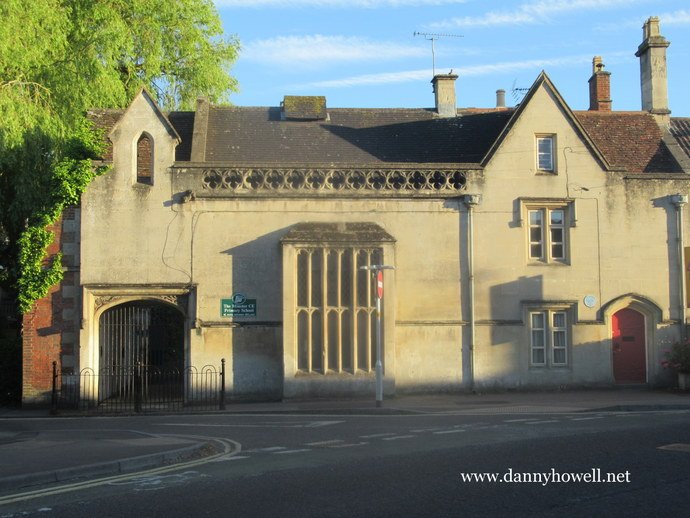
The Minster CE Primary School and No.7 Vicarage Street, Warminster. Photograph taken by Danny Howell on Wednesday 1st August 2018.
Wednesday 1st August 2018
The Minster CE Primary School and No.7 Vicarage Street, Warminster. Photograph taken by Danny Howell on Wednesday 1st August 2018.
Sunday 8th December 2013
There’s a colour photo on the front page of this week’s Warminster Journal (Friday 6th December 2013). The caption says it shows some of the children of the Minster Primary School (dressed as shepherds) with the Town Crier Phil Seddon, the Rev. Carole Owen, and Mayor Paul Batchelor. For some reason Paul Batchelor has disguised himself, or so it seems, as the Bishop of Ramsbury, complete with gown, mitre, staff, and a cross on a chain. Delusions of grandeur or the Journal proofreading department on holiday? Answers on a postcard please.
During the autumn of 1993, some of the pupils of the Minster Primary School at Vicarage Street, Warminster, were involved in a project concerning schools past and present in Warminster. Among the various activities was a walk in the town, courtesy of the Dewey Museum, looking at some of the buildings which had been used for educational purposes. Danny Howell wrote this report:
EMWELL CROSS HOUSE – First port of call was Emwell Cross House which was a boarding school in the late 1800s. It was run by the De Gruchy family who came to Warminster from Jersey in the Channel Islands. Professor John De Gruchy taught French and maths.
Mrs. Jane De Gruchy was in charge of the young ladies who boarded in. John De Gruchy died in September 1875 and is buried at Christ Church. His obituary said he had few equals as a teacher, that he was punctual, unassuming and kind. Mrs. De Gruchy continued to run the school until the 1880s and then resided there in retirement until her death on 14 November 1899.
EMWELL HOUSE – Emwell House, near the Obelisk, was a private school for both day and boading pupils. It was established in 1872 and the principal was John Wesley Still. His wife ran the girls’ and kindergarten departments.
The school curriculum included English, maths, French, German, science, carpentry, drawing, book-keeping, music, shorthand, scripture, history, physical drill and gymnastics. There were 10 acres of cricket and football fields, asphalt and covered playgrounds and a separate playground for little boys.
The school closed just before 1920 and was later a hotel run by M. Wright until the Conservative Club took over the premises in 1930.
MISSIONARY COLLEGE – The Missionary College of St. Boniface (originally known as the Mission House), at Church Street, was founded by the Vicar of Warminster, the Rev. Sir James Erasmus Philipps, and was formally opened on 5 October 1860. The name changed from the Mission House to St. Boniface College in 1871. The aim of the college was to train young men of little previous education but who were capable of becoming good workers in the missionary field.
The number of students in the early days was small and fluctuated. With ten or twelve students the college was self-supporting and there were places for 20. In 1866 there were just three students, a year later the average was seven, and in 1868 it was 13. Fees were £30 per year to approved students and the curriculum included Latin, Greek, maths, English literature and grammar. There was also practical instruction in carpentry, gardening, printing and bookbinding.
St. Boniface College is now part of Warminster School.
THE NATIONAL SCHOOL – The National School, at Church Street, opened in 1815 and was one of the first National Schools in this country, coming soon after the foundation of the Society for National Schools in 1811. It continued in this building until 1845 when it transferred to Sambourne (now Sambourne Church of England Primary School). James Joseph Shears and Ann Shears were the master and mistress at the National School in Church Street in 1830. William B. Francis and Edward Godfrey were the masters here in 1844.
LORD WEYMOUTH’S GRAMMAR SCHOOL – Lord Weymouth’s Grammar School was founded in 1707 as a Free School by Thomas Thynne, the first Viscount Weymouth, of Longleat. The central arched doorway, although slightly altered, was originally at Longleat House and was designed by Sir Christopher Wren. Thomas Arnold, who became an educational pioneer and the headmaster of Rugby School, was a pupil here. He died in June 1842. He was the author of numerous books. It is said he long cherished a happy fondness of the books in the school library at Warminster during his early schooldays.
The Fives Court at Warminster School is proclaimed to be “the oldest in existence in England that is still in regular use” and is thought to have been modelled on one that was at Winchester School. The Warminster Fives Court was certainly in existence in 1806 when it was mentioned in a letter by Dr. Arnold. The names of the fives players at Warminster were Squie, Skunk and Centre. The fives court required attention in June 1862 when it was said to be falling down owing to damage by heavy wire netting on top.
THE COUNTY SECONDARY SCHOOL – The building now used as the Youth Club, in the Close, was built in 1901 to house the Warminster County Secondary School (also known as the Technical School). It opened on 23 October 1901 with 5 pupils (four boys and one girl). Eustace Dent was appointed the headmaster on 5 February 1902. The school closed on 29 July 1931. During its last year there were 96 pupils (39 boys and 57 girls). Up until 1958 this building was used as the town library which moved to Portway House and then in 1981 the new library opened at Three Horseshoes Mall.
THE AVENUE SCHOOL – The Avenue School was built in 1931 and was the first new school to be built in Warminster for over a century. Harold Nelson Dewey, who had previously been the headmaster of the Close School became the headmaster of the Avenue School from the time it opened until his retirement from teaching in 1953.
When Kingdown Secondary Modern School (now Kingdown Comprehensive School) opened in June 1960 it had already become outgrown by the increase in population of Warminster, so the Avenue School was used as an annexe for Kingdown until Kingdown was enlarged in 1968. The Avenue School then became a primary school for younger pupils.
DEWEY HOUSE – The Town Council Offices at North Row were for many years used as a school. The main part of this building was constructed in 1704 as a Presbyterian Church for a congregation which previously used to meet in Beastleaze Meadow and later at another building in North Row.
A British School for Nonconformist children was established in 1827 at Ash Walk and nine years later it moved to North Row, into the schoolroom attached to a chapel built by the Congregationalists who separated from the Presbyterians in 1719. In 1868 the Presbyterian Church closed and the building changed hands, re-opening as the British School in 1870.
It remained a school until 1923 when its pupils were transferred to the Close School. Already in County Council hands by that time it (the Dewey House building) was later used as an annexe by the Avenue School and as a base for further education classes. In 1981, using money from the will of the late Harold Dewey (who died in 1971), the Town Council bought the property for use as offices. It is now named Dewey House after Harold Dewey.
The Minster pupils saw the measuring marks painted on one of the upright pillars. These were originally used by the much-feared Mr. Chappell who held woodwork lessons here. They were re-painted recently by local artist and signwriter Chico Holton. On the outside of the building is one of Warminster’s two Domesday plaques.
At the end of the trail, Town Clerk Joan Withey and her assistant Ann Andrews served the Minster school-children with orange squash and biscuits. A vote of thanks for an informative walk was given by teacher Chris Bell.
During the autumn of 1993, some of the pupils of the Minster Primary School at Vicarage Street, Warminster, were involved in a project concerning schools past and present in Warminster. Among the various activities was a walk in the town, courtesy of the Dewey Museum, looking at some of the buildings which had been used for educational purposes. Danny Howell wrote this report:
EMWELL CROSS HOUSE – First port of call was Emwell Cross House which was a boarding school in the late 1800s. It was run by the De Gruchy family who came to Warminster from Jersey in the Channel Islands. Professor John De Gruchy taught French and maths.
Mrs. Jane De Gruchy was in charge of the young ladies who boarded in. John De Gruchy died in September 1875 and is buried at Christ Church. His obituary said he had few equals as a teacher, that he was punctual, unassuming and kind. Mrs. De Gruchy continued to run the school until the 1880s and then resided there in retirement until her death on 14 November 1899.
EMWELL HOUSE – Emwell House, near the Obelisk, was a private school for both day and boading pupils. It was established in 1872 and the principal was John Wesley Still. His wife ran the girls’ and kindergarten departments.
The school curriculum included English, maths, French, German, science, carpentry, drawing, book-keeping, music, shorthand, scripture, history, physical drill and gymnastics. There were 10 acres of cricket and football fields, asphalt and covered playgrounds and a separate playground for little boys.
The school closed just before 1920 and was later a hotel run by M. Wright until the Conservative Club took over the premises in 1930.
MISSIONARY COLLEGE – The Missionary College of St. Boniface (originally known as the Mission House), at Church Street, was founded by the Vicar of Warminster, the Rev. Sir James Erasmus Philipps, and was formally opened on 5 October 1860. The name changed from the Mission House to St. Boniface College in 1871. The aim of the college was to train young men of little previous education but who were capable of becoming good workers in the missionary field.
The number of students in the early days was small and fluctuated. With ten or twelve students the college was self-supporting and there were places for 20. In 1866 there were just three students, a year later the average was seven, and in 1868 it was 13. Fees were £30 per year to approved students and the curriculum included Latin, Greek, maths, English literature and grammar. There was also practical instruction in carpentry, gardening, printing and bookbinding.
St. Boniface College is now part of Warminster School.
THE NATIONAL SCHOOL – The National School, at Church Street, opened in 1815 and was one of the first National Schools in this country, coming soon after the foundation of the Society for National Schools in 1811. It continued in this building until 1845 when it transferred to Sambourne (now Sambourne Church of England Primary School). James Joseph Shears and Ann Shears were the master and mistress at the National School in Church Street in 1830. William B. Francis and Edward Godfrey were the masters here in 1844.
LORD WEYMOUTH’S GRAMMAR SCHOOL – Lord Weymouth’s Grammar School was founded in 1707 as a Free School by Thomas Thynne, the first Viscount Weymouth, of Longleat. The central arched doorway, although slightly altered, was originally at Longleat House and was designed by Sir Christopher Wren. Thomas Arnold, who became an educational pioneer and the headmaster of Rugby School, was a pupil here. He died in June 1842. He was the author of numerous books. It is said he long cherished a happy fondness of the books in the school library at Warminster during his early schooldays.
The Fives Court at Warminster School is proclaimed to be “the oldest in existence in England that is still in regular use” and is thought to have been modelled on one that was at Winchester School. The Warminster Fives Court was certainly in existence in 1806 when it was mentioned in a letter by Dr. Arnold. The names of the fives players at Warminster were Squie, Skunk and Centre. The fives court required attention in June 1862 when it was said to be falling down owing to damage by heavy wire netting on top.
THE COUNTY SECONDARY SCHOOL – The building now used as the Youth Club, in the Close, was built in 1901 to house the Warminster County Secondary School (also known as the Technical School). It opened on 23 October 1901 with 5 pupils (four boys and one girl). Eustace Dent was appointed the headmaster on 5 February 1902. The school closed on 29 July 1931. During its last year there were 96 pupils (39 boys and 57 girls). Up until 1958 this building was used as the town library which moved to Portway House and then in 1981 the new library opened at Three Horseshoes Mall.
THE AVENUE SCHOOL – The Avenue School was built in 1931 and was the first new school to be built in Warminster for over a century. Harold Nelson Dewey, who had previously been the headmaster of the Close School became the headmaster of the Avenue School from the time it opened until his retirement from teaching in 1953.
When Kingdown Secondary Modern School (now Kingdown Comprehensive School) opened in June 1960 it had already become outgrown by the increase in population of Warminster, so the Avenue School was used as an annexe for Kingdown until Kingdown was enlarged in 1968. The Avenue School then became a primary school for younger pupils.
DEWEY HOUSE – The Town Council Offices at North Row were for many years used as a school. The main part of this building was constructed in 1704 as a Presbyterian Church for a congregation which previously used to meet in Beastleaze Meadow and later at another building in North Row.
A British School for Nonconformist children was established in 1827 at Ash Walk and nine years later it moved to North Row, into the schoolroom attached to a chapel built by the Congregationalists who separated from the Presbyterians in 1719. In 1868 the Presbyterian Church closed and the building changed hands, re-opening as the British School in 1870.
It remained a school until 1923 when its pupils were transferred to the Close School. Already in County Council hands by that time it (the Dewey House building) was later used as an annexe by the Avenue School and as a base for further education classes. In 1981, using money from the will of the late Harold Dewey (who died in 1971), the Town Council bought the property for use as offices. It is now named Dewey House after Harold Dewey.
The Minster pupils saw the measuring marks painted on one of the upright pillars. These were originally used by the much-feared Mr. Chappell who held woodwork lessons here. They were re-painted recently by local artist and signwriter Chico Holton. On the outside of the building is one of Warminster’s two Domesday plaques.
At the end of the trail, Town Clerk Joan Withey and her assistant Ann Andrews served the Minster school-children with orange squash and biscuits. A vote of thanks for an informative walk was given by teacher Chris Bell.
John Halliday, in a hardback exercise book he titled Warminster Notes, in which he compiled various handwritten notes about Warminster and district for local history slide shows he was giving during the 1980s, penned the following:
The junior section of the Minster School [Vicarage Street, Warminster], 1845-6, Gothic, with big bay window and openwork quatrefoiled parapet.
From The Parish Magazine, October 1901:
Miss Eliza Knott has this week commenced her work at the Vicarage Street Infant School. Miss Parker has achieved a very substantial improvement in the school, and the attendance has markedly improved; one day last week ninety-nine were present. Miss Parker leaves us with the very hearty good wishes of all who have worked under her, and with the gratitude of the little scholars.