Lord Weymouth’s Grammar School And Its Fives Court

Danny Howell writes:

Lord Weymouth’s Grammar School, Church Street, Warminster

Lord Weymouth’s Grammar School was founded in 1707 as a Free School by Thomas Thynne, the first Viscount Weymouth, of Longleat. The central arched doorway, although slightly altered, was originally at Longleat House and was designed by Sir Christopher Wren. Thomas Arnold, who became an educational pioneer and the headmaster of Rugby School, was a pupil here. He died in June 1842. He was the author of numerous books. It is said he long cherished a happy fondness of the books in the school library at Warminster during his early schooldays.

The Fives Court at Warminster School is proclaimed to be “the oldest in existence in England that is still in regular use” and is thought to have been modelled on one that was at Winchester School. The Warminster Fives Court was certainly in existence in 1806 when it was mentioned in a letter by Dr. Arnold. The names of the fives players at Warminster were Squie, Skunk and Centre. The fives court required attention in June 1862 when it was said to be falling down owing to damage by heavy wire netting on top.
Alcock ~ Inscription At St. Denys’ Churchyard, Warminster

Summer 1980

From “Parish Church of St. Denys’ Graveyard Survey”, Warminster: inscriptions recorded by students of Kingdown School, Warminster, Summer 1980:

IHS. Henceforth we give loving remembrance of Alice Alcock (of Byne House) for 60 years the dear wife and faithful helpmate of Charles Alcock (headmaster of Warminster Grammar School) beloved by her husband, children, and grandchildren, great grandchild, the pupils of the school, and by all who knew her. God called her Decr 19th 1918 in her 83rd year. Also of the above named Charles Alcock. God called him Novr 3rd 1922 in his 89th year.

Plot 1-92.

Lord Weymouth’s “Latin School” At Church Street, Warminster

1957

The Urban District Of Warminster Official Guide 1957/8 noted that:

Another building of interest is the Latin School, built in 1707 by Lord Weymouth, at which Dr. Thomas Arnold, the famous Headmaster of Rugby School spent his early schooldays. Dean Stanley relates that Dr. Arnold cherished a grateful recollection of the books in the old school library. Another famous pupil was Bishop Hampden.

The Grammar School, Warminster

Some notes by the Reverend Henry Robert Whytehead in the booklet The Minster And Church Life In Warminster, published in 1911:

The Grammar School
Everyone who visits the Minster must notice the interesting early XVIII century building known as Lord Weymouth’s Grammar School. An inscription over the beautiful doorway says “To the Glory of God, and advancement of religion and learning, this School was built and endowed by Thomas Lord Viscount Weymouth, A.D., 1707.”

Dr. Arnold, of Rugby, received his early education at Warminster. The School is maintaining a very vigorous life, under the Headmastership of W. F. Blaxter, Esq. The boys attend the Minster, in which the S. Aisle is allotted to them.

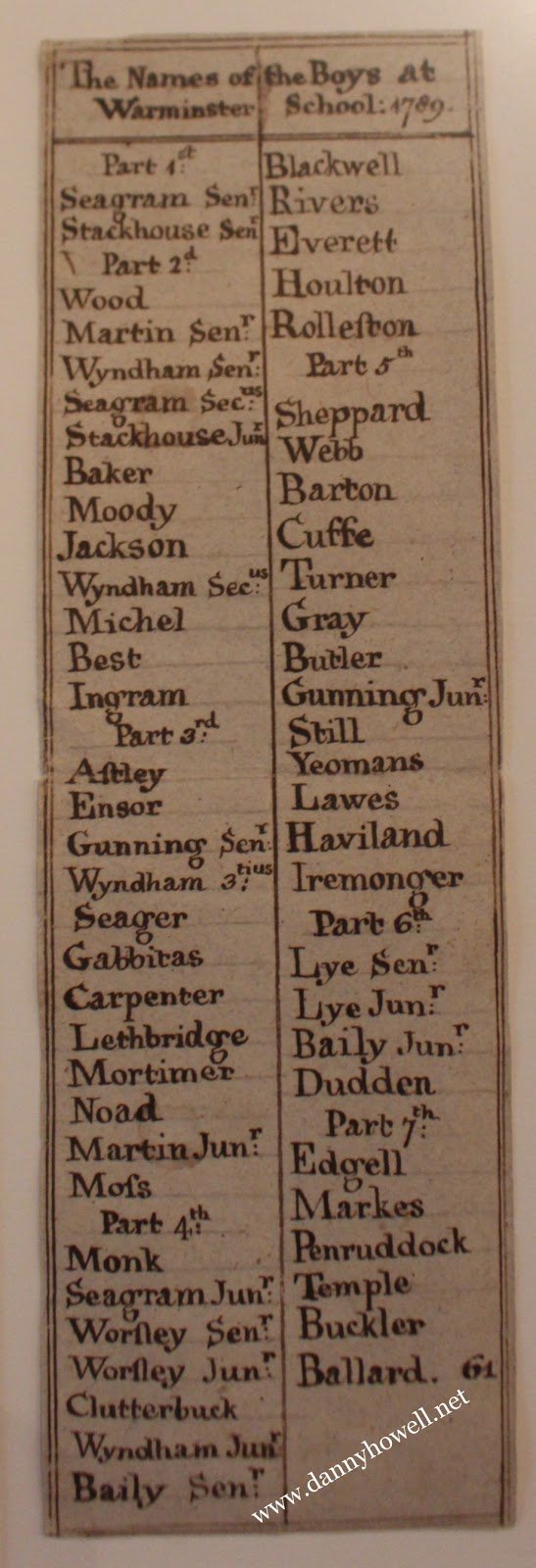
The Names Of The Boys At Warminster School: 1789

The Names Of The Boys At Warminster School: 1789.

List in the papers of the Wyndham family.

Part 1st:

Seagram Senr.
Stackhouse Senr.

Part 2nd:

Wood.
Martin Senr.
Wyndham Senr.
Seagram Secus.

Stackhouse Junr.
Baker.
Moody.
Jackson.

Wyndham Secus.
Michel.
Best.
Ingram.

Part 3rd:

Aftley [Astley].
Ensor.
Gunning Senr.
Wyndham 3tius.

Seager.
Gabbitas.
Carpenter.
Lethbridge.

Mortimer.
Noad.
Martin Junr.
Mofs [Moss].

Part 4th:

Monk.
Seagram Junr.
Worfley [Worsley] Senr.
Worfley [Worsley] Junr.

Clutterbuck.
Wyndham Junr.
Baily Senr.
Blackwell.

Rivers.
Everett.
Houlton.
Rollefton [Rolleston].

Part 5th:

Sheppard.
Webb.
Barton.
Cuffe [Cusse].

Turner.
Gray.
Butler.
Gunning Junr.
Still.

Yeomans.
Lawes.
Haviland.
Iremonger.

Part 6th:

Lye Senr.
Lye Junr.
Baily Junr.
Dudden.

Part 7th:

Edgell.
Markes.
Penruddock.

Temple.
Buckler.
Ballard.

61 [boys].

The School Rules For Lord Weymouth’s Grammar School, Warminster, 1784

The School Rules for Lord Weymouth’s Grammar School at Church Street, Warminster, in 1784:

1 – During Prayers there shall be silence and a devout attention.

2 – All shall walk to and return from Church in an orderly way, shall behave well there, and shall refrain from staring about, talking and whispering. Looks, posture, movements, should be under control.

3 – In school every boy shall work diligently, and shall speak quietly to himself, clearly to the master. He must spell correctly. No boy is to bully another, nor run about the yard in school hours. All shall refrain from lying, deceit, quarrelling, fighting, and pilfering. No one is to look out of the windows. Caps are to be worn in class.

4 – The dormitories shall be used for sleeping in only. There shall be no brawling nor disorder in them. In the morning, all shall rise when the bell rings.

5 – No one shall come into class with unwashed hands, or uncombed hair, or with his cap on.

6 – Dayboys shall be punctual and not be absent without leave obtained beforehand.

7 – In no circumstances shall a boy loaf about the town, but each boy shall go straight home quietly without making a disturbance. Boys should comport themselves reservedly towards passers-by and politely towards their inferiors.

8 – He who says Grace shall speak distinctly; all shall stand; silence shall be observed at meals.

9 – No one shall cut tables, doors, desks, or forms, or break down fences. No one shall ink or in any way dirty the walls or break windows. In winter, no cinders or other burning articles by which damage might be caused shall be thrown down in the School.

10 – On entering or leaving the School each boy shall close the door.

11 – During play there shall be no quarrelling. No one shall stay about the door or in the hall. There shall be no stone throwing. Anyone who goes out of bounds, even to the smallest degree shall suffer corporal punishment.

12 – At every time and place all shall refrain from pilfering or damage, and shall keep their tongues from evil-speaking, lying and slandering. Everything shall be kept clean. All shall avoid spoiling their hats, boots and other garments. All these laws shall be observed, and for any breach of them the penalty shall be exacted.

error: Content is protected !!