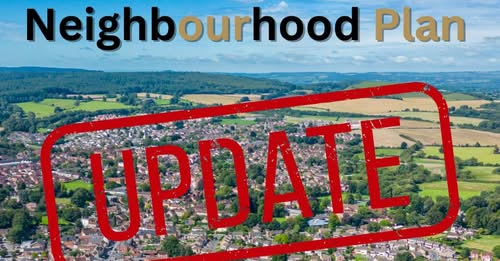
Kingdown School – “Shape Warminster’s Future” initiative from Warminster Town Council

Wednesday 11th March 2026

Shape Warminster’s Future initiative from Warminster Town Council.

Dear Parents/Carers,

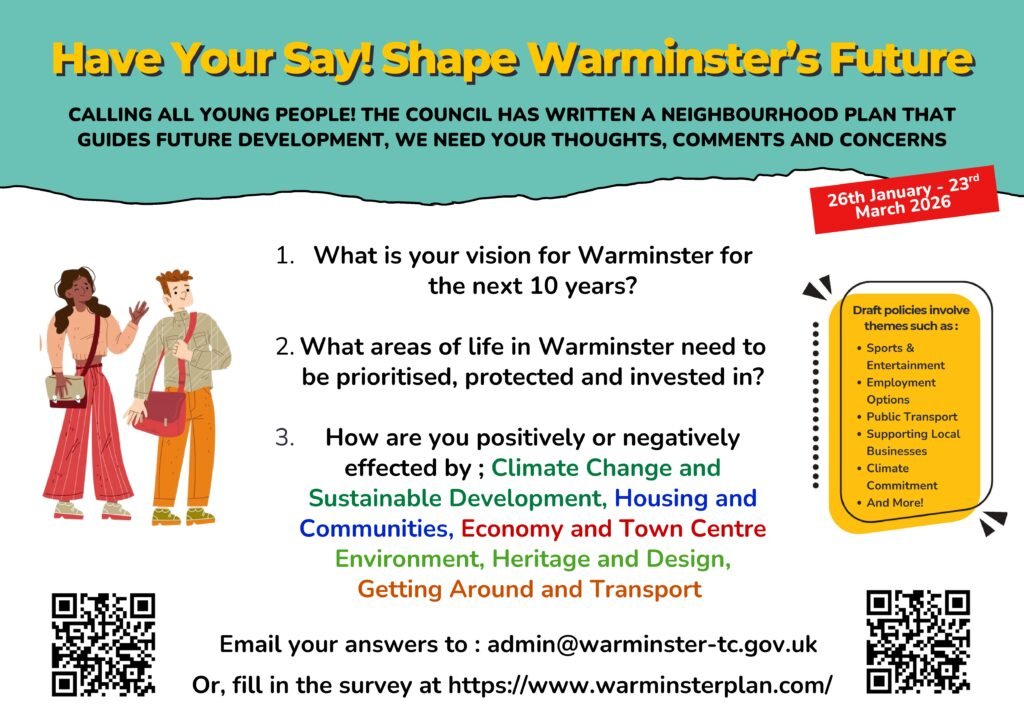
We would like to let you know about an exciting opportunity for students to have their voices heard in the Shape Warminster’s Future initiative from Warminster Town Council.

Students are invited to take part in a short survey by scanning the QR code provided. The survey gives young people the chance to share their views on what is happening in Warminster and what they would like to see in the future.

The survey covers a range of important topics, including:

  • Sports and entertainment opportunities
  • Employment options for young people
  • Public transport
  • Supporting local businesses
  • Climate commitments
  • And much more

This is a great opportunity for students to contribute their ideas and help influence decisions that affect their community.

Please encourage your child to take a few minutes to scan the QR code and complete the survey so that their voice can be included.

Thank you for your support.

Kind regards,

Kingdown School
Woodcock Road
Warminster
Wiltshire
BA12 9DR

t: 01985 215551

e: admin@kingdown.wilts.sch.uk

w: https://www.kingdown.wilts.sch.uk/

Commentary By Adam Banks On The Warminster Neighbour Plan

27th February 2026

Interesting commentary posted by Adam Banks on the Warminster Town Council Facebook page after the Town Council yet again promoted the Neighbourhood Plan Consultation:

Most people will not read eighty plus pages of planning policy. That is not because they do not care; it is because they have jobs, families and limited time. That is precisely why decisions of this scale cannot hide behind the phrase “public consultation.”

The core issue is not whether Warminster will grow. Growth is already embedded in the Wiltshire Core Strategy, and we have no realistic ability to reverse that. What matters is how much further we go beyond what is strictly required, and what precedent that sets for the future.

We are being told that allocating additional housing sites is “defensive planning”. The argument is that it is better to choose a site ourselves than have one imposed through appeal. That logic only holds if three conditions are met: that the allocations genuinely limit further speculative development; that the housing number is not quietly increased in the next cycle; and that infrastructure is delivered before or at least alongside the housing.

If those conditions are not properly enforced, what we risk instead is incremental drift. We allocate slightly more than the minimum required and immediately shift the baseline. We establish a greenfield precedent beyond the existing settlement boundary, making it harder to defend that boundary in future reviews. We rely on viability arguments that can reduce affordable housing percentages at application stage. We accept “proportionate” infrastructure contributions, which are negotiable and rarely guarantee delivery before occupation.

Over time, roads become busier, schools stretch capacity and health services absorb additional pressure. When the next Local Plan review arrives, that expanded footprint is treated as the new normal. What was once described as an exception quietly becomes the starting point for the next round of growth. Once a boundary flexes once, it becomes harder to defend next time.

At the same time, if infrastructure does not genuinely keep pace, nothing fundamentally changes in terms of healthcare provision, school places or road capacity. Waiting times remain long, classrooms remain full and congestion remains daily reality. The lived experience for residents can worsen, while developers complete schemes, sell homes and move on with their offshore tax haven bank accounts creaking under the strain of their vast profits. That imbalance is exactly why the sequencing and enforceability of infrastructure matters just as much as the headline housing number.

There is also a wider economic reality that needs to be acknowledged. This Plan can never and will never solve the fundamental problem of local people being unable to afford to buy a home. Building more high value open market houses on the edge of town does not automatically make homes affordable for first time buyers on local wages. In many cases it does the opposite. It sustains high land values, reinforces the existing price structure and feeds a system in which those with capital accumulate more assets.

If a significant proportion of new homes end up in the private rental sector, whether through buy to let investors or institutional landlords, the effect can be to strengthen the rentier economy rather than broaden ownership. More public money then flows into housing benefit and rental support, effectively transferring funds from taxpayers to private landlords. Without genuinely affordable products that are protected long term, increasing supply at the upper end of the market does little to address the affordability crisis experienced by local families.

There is also a financial dimension that should be spoken about openly. Having a Neighbourhood Plan increases the town’s share of Community Infrastructure Levy from 15 percent to 25 percent. For a development of around ninety homes, that uplift might amount to roughly ninety thousand pounds extra retained locally, depending on final build size and CIL rates. That is not insignificant, but nor is it transformative when set against the cost of preparing and reviewing a Neighbourhood Plan, which can run into tens of thousands of pounds in consultant fees, assessments and examination costs. The financial benefit is modest compared to the permanent physical change that allocated land represents.

We are also told that this strengthens our hand against developers. That may be true in theory. However, if Wiltshire fails its five year housing land supply, inspectors can still override local resistance on appeal.

So we should be honest about the gamble. This is not about whether development happens. It is about whether allocating greenfield land now makes resisting further expansion harder later. Many residents already believe Wiltshire Council and developers ignore local plans. That view does not come from nowhere; it comes from lived experience.

Consultations are posted online and documents run to dozens of pages. Very few people have the time to work through them line by line. A lack of detailed objections does not equal consent. Councillors need to listen actively and visibly, rather than relying on the absence of responses buried inside technical documents as evidence of support.

If the strategy is genuinely defensive, then the case should be set out clearly in plain language. Why this site. Why this number. How infrastructure will be guaranteed up front. How affordable housing percentages will be protected from viability reductions. How future boundary creep will be resisted.

Planning policy may be technical, but the consequences are physical and permanent. If the town is to expand, it should be because the case has been clearly proven and publicly understood, not because the system subtly nudges us towards accepting change without fully debating its long term impact.

An Update From EBBRAG For Completing The Warminster Neighbourhood Plan Survey

Wednesday 4th February 2026

Sent to members and supporters of EBBRAG, from the EBBRAG Committee:

Please find below a new update from EBBRAG. It concerns the latest process for the Warminster Neighbourhood Plan (NP). We apologise for the length of information contained but we believe it is necessary for you to complete the Town Council NP survey. 

Note once completed and submitted you can not resubmit or change the content, so take care before submitting!

Regards EBBRAG.

Neighbourhood Plan Consultation – Why Your Response Matters

The draft Warminster Neighbourhood Plan (NP) has been approved to enter the next stage of the NP process, called Regulation 14. This requires the Town Council (TC) to ask residents to comment on the draft NP through an online survey.

EBBRAG attended the extraordinary TC meeting on 19 Jan 26 where the next stage was approved. EBBRAG wrote to each councillor before the meeting objecting to the inclusion of Home Farm & The Yew Tree pub (called site selection) in the draft NP and asked for their withdrawal from the plan.

During the meeting, four EBBRAG members raised further objections based on fact and logic. All the councillors (including 3 East Ward councillors) approved, without debate or question, the draft NP’s move to the next stage.

EBBRAG apologies for the length of this update but its contents are important for you to understand.

TC draft NP Survey dates

You can complete the survey from Monday 26 January 2026 until midnight on Monday 23 March 2026.
You do not have to answer every question, nor do you need to provide detailed comments to submit a response. A simple yes or no is sufficient per question.

Key Issues You May Wish to Consider

You are, of course, free to complete the TC survey using your own views. EBBRAG has, however, compiled the following facts and topics that you may find relevant and helpful when answering the questions if you wish to. It is important, however, you register your insistence that Home Farm and Yew Tree are removed from the draft NP.

1. Scale of Development Coming to Warminster

Current known developments planned for Warminster to 2042 (recently increased from 2038) include:

  • Jubilee Gardens (WUE): up to 1,550 houses (initial phase 1,000 to 2026)
  • Cley Hill View (Not part of the WUE): 227 houses
  • Ashley Coombe: 77 houses (speculative)
  • Westbury Road: 205 houses (speculative)
  • Home Farm: 135 houses
  • Grovelands: 68 houses
  • Total: 2,262 new houses
    (This does not include small developments or infill.)

2. Population Impact Office of National Statistics (ONS) average household size in 2024 was 2.35 people. Therefore:

  • Current population of Warminster: 18,000
  • 2,262 homes = approx. 5,300 new residents
  • This represents  almost a one-third increase in Warminster’s population.

Where are the new residents coming from?

3. Traffic and Cars Based on 2024 National Travel Survey data, 100% of new households represent 34% with two or more cars, 44% with one car and 22% with no cars.

The conservative estimate is Warminster by 2042 will have to contend with an estimated 2,525 additional cars.

Traffic congestion is already severe at peak times, especially:

  • East Street
  • Boreham Road
  • Woodcock Road
  • Westbury Road
  • Weymouth Street
  • Particularly around school opening and closing times

4. Education Capacity Department for Education averages show 2,262 new houses generate:

  • 566 new primary school places
  • 294 new secondary school places

No clear plan exists for where or how these places will be provided.

5. Medical and Other Infrastructure There is no confirmed plan showing how increased demand for:

  • GP, dental and medical services (Although note the Avenue Surgery is extending into the old Boots Pharmacy apparently)
  • Schools
  • Roads and traffic management
  • Emergency services
  • Shops and employment

will be met. Responsibility is repeatedly deferred to external county or national bodies, without evidence of delivery, cost or completion.

6. Water, Sewage, and Flooding Based on 2024 ONS averages, 5,300 new residents will require:

·       Over 791,000 litres of additional water per day

·       Which produces over 713,000 litres of wastewater per day.

·       Pumping stations in Warminster are already at capacity and discharge into the River Wylye during high-flow events.

·       Flood storage areas downstream are already operating beyond capacity.

 7. Impact on the River Wylye

The River Wylye is a globally recognised rare chalk stream that is hydrologically linked to the River Avon (a Special Area of Conservation) and is already highly phosphate sensitive.

Despite this, the draft NP does not demonstrate that there is a solution for the problem, that mitigation will be in place and wastewater systems can cope with the additional 713,000 litres of wastewater per day produced. This does not cater for infill and brownfield development.

Further, the draft plan fails to show legal environmental protections are being met.

8. Loss of Green Space

The draft NP emphasises protecting green spaces, yet site selection directly undermines this.

For example, Home Farm, as the principal site selected, is a historic, beautiful, rural site outside the settlement boundary and is not required based on current the Wiltshire housing need figures of 90 houses published in September 2023. It is also believed the medieval village of Boreham was founded on Home Farm fields.

Development would permanently affect countryside views, wildlife, recreation and wellbeing for those in East Warminster.

9. Highway Safety

The proposed Home Farm access is just after a blind bend on Boreham Road (leaving Warminster), which is highly dangerous and many accidents have occurred in recent years close to the proposed entrance.

For this reason, the same proposed access was rejected by both Highways and a Planning Inspector in 2019, with the additional comment that a significant wall will need to be demolished. This in turn would have a detrimental effect on the historic vista of Boreham Road.

10. Concerns About the NP Process

The process to date has raised concerns regarding poor communication with residents (who knew of the survey?), ignoring earlier survey results (61% of respondents opposed Home Farm inclusion), limited engagement with major local employers (Bishopstrow Hotel and GEA) and reliance on an unaccountable consultant at public expense costing an estimated £33,000 so far (£16,000 from Warminster Council tax!)

Are we, the residents, getting value for money from our council taxes?

Finally If You Are Short on Time

If you do not wish to answer every question, you may also wish to include a statement such as:

If the draft Neighbourhood Plan continues to include site selection, which I am strongly against, I will consider whether the Town Council has genuinely listened to residents. This in turn may well affect my support for the Plan at referendum.

To access the draft Town NP please highlight, then right click and open with this link.  

To access the NP survey, please highlight the following link, then right click and open with  https:www.smartsurvey.co.uk/s/3KNZGD/.

As David Attenborough has stated on his recent programme: Make space for nature and a greener town is a healthier town.

Any problems, confusion or concerns don’t hesitate to contact us.

EBBRAG.

info@ebbrag.com
www.ebbrag.com

Housing Site Allocation Must Be Removed From The Draft Warminster Neighbourhood Plan or EBBRAG Will Encourage Warminster Residents To Vote Against The Plan

Tuesday 27th January 2026

From the EBBRAG website and Facebook page:

A message from EBBRAG –

Housing Site Allocation Must Be Removed From The Draft Warminster Neighbourhood Plan or EBBRAG will encourage Warminster residents to vote against the Plan

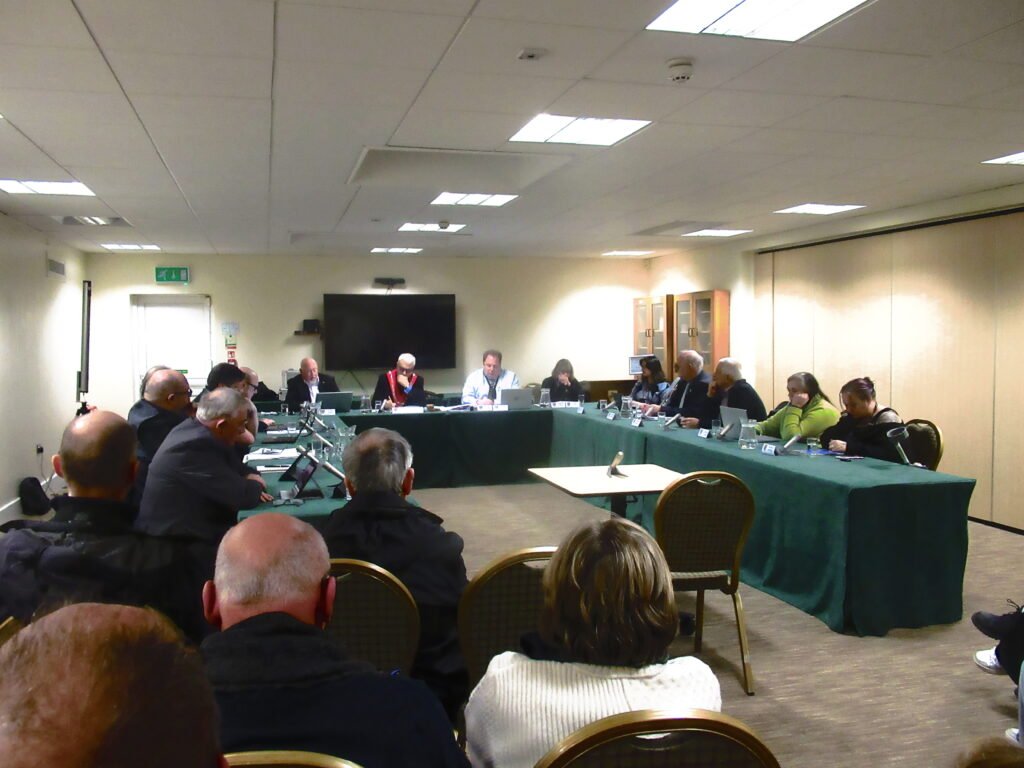
Several EBBRAG Committee members attended the Town Council (TC) Extraordinary Full Council meeting on 19 January 2026, where councillors voted to move the draft Neighbourhood Plan (NP) to the next stage of consultation (called Regulation 14).

This stage invites residents to comment on the draft plan through a public survey, which was released yesterday. Completed surveys must be submitted by midnight on 23 March 2026. Your response matters — this is one of the few opportunities for residents to influence what happens next. The survey close date allows a more measured response.

What concerns us:

The draft plan includes site selection for new housing on top of the significant further development in Warminster without the necessary infrastructure in place.

Wiltshire Council’s own document, Planning for Warminster (September 2023), states that only 90 additional houses are required up to 2038, due largely to phosphate pollution affecting the River Wylye.

Despite this, the draft plan supports building more homes. Why not accept infill of 10 houses a year until 90 have been achieved rather than decimate a beautiful, unique and historic rural area on the outskirts of Warminster and outside the settlement boundary?

What happened at the meeting:

Before the meeting, EBBRAG sent a detailed letter to every Town Council member, setting out logical reasons why site selection should be removed from the plan. Unfortunately, the letter was not referenced at all during the meeting.

During the meeting, councillors asked few meaningful questions concerning the content of the plan and did not debate any aspect.

The Steering Group lead made the following claims, which we believe are misleading:

The plan will stop speculative development for five years.

This does not address what happens after five years, nor does it explain how ongoing or proposed speculative developments including Ashley Coombe, Westbury Road, Cley Hill View, Groveland’s + Jubilee Gardens (totalling around 2,144 homes) will be controlled.

The Town Council Clerk has confirmed that speculative planning applications submitted to Wiltshire Council fall outside the Neighbourhood Plan and will be considered through the normal Wiltshire Council process, not the Town Council.

The Town Council can impose conditions on selected sites.

In reality, the Town Council has no power to enforce these conditions. Past experience in Warminster shows that when developers fail to meet conditions, enforcement often falls away. The draft plan for Home Farm even mirrors the layout and access point of a planning application that was totally rejected in 2019 by a Government Appointed Planning Inspector.

What EBBRAG is doing:

EBBRAG is preparing guidance to help residents complete the survey effectively and will share this shortly. You are, of course, welcome to complete the survey independently, but we believe that using the evidence we have gathered can help strengthen your response.

EBBRAG has made contact with residents from Ashley Coombe and Westbury Road, with the intention of combining our objections to further development without supporting infrastructure into a very strong opposition.

Please feel free to contact us through our website www.ebbrag.com or through the EBBRAG Facebook page www.facebook.com/groups/389576351110879 or Instagram www.instagram.com/ebbrag_warminster/ if you have any concerns or worries. You can also email EBBRAG: info@ebbrag.com

Our aim:

Our goal is simple: to remove site selection from the draft Neighbourhood Plan, preventing further large-scale development until adequate infrastructure is in place. In addition, phosphate pollution and flooding are taken seriously and controlled or mitigated.

While we cannot advise residents how to vote in any future referendum, and we firmly believe there is much good in the plan, if site selection remains in the plan, EBBRAG may encourage residents to vote against it.

EBBRAG

email: info@ebbrag.com

website: www.ebbrag.com

“Political Charade” – Warminster Town Council Extraordinary Meeting

Friday 23rd January 2026

From the EBBRAG website – www.ebbrag.com – EBBRAG’s report of the Full Council Meeting of Warminster Town Council, last Monday evening, which saw the launch of the Warminster Neighbourhood Plan 2 for public consultation:

Warminster Town Council Extraordinary Meeting, Monday 19th January 2026

“Unfortunately last night’s Town Council meeting was no more than the political charade we could have expected it to be. Blind and ill-informed compliance by most of the councillors to an agenda set by an influential few, is how it came across to me.” – an angry comment from a member of the public after the meeting.

Warminster Town Council held an Extraordinary meeting on 19th January 2026, to vote on progressing the Neighbourhood Plan to Regulation 14. In plain English this means a discussion of whether the current process moves to its next phase of a formal public consultation on the draft plan document.

You may have missed the widespread publicity of this meeting, as there was none! They put the agenda on their Council agendas/minutes page one week ahead but that was all, they didn’t publicise that the meeting was taking place. So that’s why only 17 adult members of the public attended. Could it be the Town Council didn’t really want any public there?

Nick Parker, spoke as someone who has lived in Warminster for 28 years. He highlighted the exceptional level of housing development Warminster is undergoing and how the further 90 houses at Home Farm are not justified and indeed against Wiltshire Council Planning documents for Warminster. Warminster is already meeting its housing requirement and needs a coherent strategy for infrastructure to catch up. Will the inclusion of unsustainable housing development on the fields of Home Farm and elsewhere be the single issue which causes residents to reject the Plan altogether?

Tania Peacock also spoke about factual errors the Council had made regarding land in the Cannimore/Folly Lane area owned by her family, which has been classified as Local Green Space within the plan. She highlighted how the plan does not even get the name of this area correct, due democratic process has not been followed, there are spurious claims that there is public support for this land to be open space from a survey which was for a totally different purpose, the space is in fact a private fenced field and not as claimed an open space and the Council claims to have agreement from the landowner which is disputed and which the Council cannot evidence ever happened.

Alastair Wright flagged how there is a legal requirement for Wiltshire Council to produce more detailed flood risk assessments before they allocate any houses in Warminster outside of the West Urban Extension but this has not been done. There are sewage overflows currently on Woodcock Road and Boreham Road which suggest the sewage system in that area is at capacity, but this is not recognised within Warminster’s flood risk assessments. Mr Wright also highlighted problems with the classification of the open spaces and rural buffer corridors within the plan. Finally, he highlighted that the Home Farm site is outside the settlement boundary and as the maps cut off at this point, the important historic setting in that area is also excluded.

Jeremy Kelton, who has lived beside the river Wylye for 14 years, also highlighted issues around flooding and how building on Home Farm would remove its ability to act like a flood plain in winter and force the groundwater elsewhere. He reminded the council that we have had two “once in a generation” floods in a decade in 2014 and 2024.

Nick Tilt who lives near to the proposed entrance to the Home Farm site and whose family have lived in Warminster for over 60 years, outlined how the inclusion of Home Farm would be contrary to a number of national planning policies. In particular 109 which relates to road safety given the development’s need for a westbound right turn ghost lane on a road which is already too narrow at that point. The resultant damage to several mature trees, a length of unique historic wall and removing the rural character with suburban lighting. The harm to Bishopstrow Conservation Area also being contrary to 135c in the NPPF.

But the Councillors seemed not to be listening. They didn’t appear to want to listen. They were determined to proceed with Regulation 14 and put the draft out for consultation, yet they know it has flaws and contains things unnecessary and not wanted. They must know the flaws put acceptance of the Plan in jeopardy and if the Plan is rejected it will cost £1,000s in taxpayers’ money.

One EBBRAG supporter commented afterwards, “I was of a view our Councillors didn’t take on board the speeches from the public, particularly the selection of Home Farm for housing allocation, and it seemed not one of the Councillors had anything to say about the matter.

They could have called for a postponement, held a discussion, and then said they would pull things out or make amendments before putting the Plan out for consultation. They didn’t.

Even though the speakers raised many issues and in some cases calling out major flaws in the process, the Council made no comment or held no proper debate among themselves about what was said. Councillor Andrew Davis (who is not only a Warminster East Ward Councillor but also a Wiltshire Councillor) put several questions to the Mayor, Cllr Andrew Cooper who was chairing the meeting but I don’t think anyone present fully understood what Councillor Davis was trying to say. It was notable that when speeches from the public were being made, at least one Councillor seemed more occupied messing about with his phone than listening to voters.

When the Chair asked Councillors to speak, there was a deadly silence to begin with. Only a couple of Councillors commented and their comments were really questions. The speeches from the public made important points about the river Wylye and raised serious concerns with how flood risk is being dealt with in Warminster. Flooding is not being recorded at a Wiltshire level. Even though some Councillors have professed an interest in this area, they had absolutely nothing to say at this meeting.

The Council also failed to mention that one of the Neighbourhood Plan Steering Group has resigned, Could it be that this person cannot support a draft plan that allocates unsustainable housing development? Why hasn’t the public been told?

Our Councillors always say they are available to chat, but what do they actually do? the meeting was just an exercise for the Council to tick boxes and go sailing ahead despite the consequences.

We urge Warminster residents to vote against this flawed Neighbourhood Plan to show “the influential few” that Warminster has had enough of large scale over-development of our town.

Draft minutes of the meeting including text of the speeches submitted is on the Warminster Town Council Website. We include text of the speeches below. Al Wright spoke from his extensive knowledge of the issues without verbatim notes.

Nick Parker spoke as a resident of Warminster for 28 years.

While there is much that is positive in the draft Neighbourhood Plan, the site selection is a serious mistake. If left unchanged, it risks the Plan being rejected by residents, wasting public money and damaging the Council’s reputation.

Warminster is already experiencing an exceptional level of housing development including Grovelands, Cley Hill View, Ashley Coombe, Westbury Road and Jubilee Gardens. In that context, the proposed 90 houses at Home Farm and two at the Yew Tree are neither required nor justified. Their inclusion risks becoming the single issue that causes residents to reject the Plan altogether.

There are clear signs that supply has outpaced demand. Homes at Jubilee Gardens are not selling, with councils elsewhere now purchasing them for their own needs. This shows that Warminster is already meeting its housing requirement.

The scale of development is staggering, yet it is proceeding without a coherent strategy for infrastructure, roads, healthcare, schools and drainage. The Neighbourhood Plan is intended to prevent speculative development, yet it will not be adopted until the end of this year, leaving Warminster exposed in the meantime.

Wiltshire Council’s Planning for Warminster document of September 2023, on which this Plan should be based, clearly explains why housing numbers in Warminster were restricted. That reasoning remains valid.

The draft inclusion of Home Farm and the Yew Tree fails to address the reasons these sites were rejected by a Planning Inspector in 2020. Nothing material has changed since then, and housing need is being met elsewhere.

This decision rests with you. Local feeling about Home Farm has been seriously underestimated, and approving this Plan unchanged risks losing both a valued part of Warminster and public confidence in the Neighbourhood Plan itself.

We have already seen irreversible damage to the west of Warminster at Jubilee Gardens and Cley Hill View. Please do not repeat that mistake in the east, for development that is simply not needed.

Speech by Tania Peacock

Good evening. I am Tania Peacock. I am here because Warminster Town Council is at a crossroads between the law and a documented falsehood. You are now formally “on notice” that the evidence for LGS 1.1 Folly Lane is built on factual errors that cannot be carried into the 2026 Plan.

The Clerk previously stated that if errors were shown, the designation could be removed. I am presenting five fatal evidence failures:

  1. The Petition: The Council relies on 729 names as “support.” However, this petition was originally gathered to object to a separate housing development. To repurpose those signatures to tell a Government Inspector they represent real support for a Local Green Space designation is legally misleading.
  2. The Law: This site was never in the original draft plan. The Council bypassed the mandatory 6 week public consultation required to add it, meaning the public never had a legal window to object.
  3. The Consent: The previous Examiner was told the landowners agreed. Your own FOI response now admits the Council holds no records of contact with my father. You cannot claim “agreement” with a resident you never spoke to.he Description: The Council described a private, fenced field as “Rehobath open space for all by the water.” This was a factual inaccuracy regarding the land’s physical state, designed to meet criteria that the land does not fulfill.
  4. The Deeds: The Council calls this land “Rehobath.” I am handing over the Legal Title Deeds today which show the historical and legal identity of this site as Cannimore. Land Registry as “Land lying North of Cannimore”. The name “Rehobath” is a nickname for a neighbouring private house, it is not the name of this land. By simply “copying and pasting” a neighbour’s house name from the 2016 plan, the Council has failed in its duty of due diligence.

Furthermore, your 2023 survey is “Unsound.” Using data from people walking on a Public Footpath to justify a Green Space on a private field is a mapping error that no Inspector will accept.

It appears the Council has relied on the narrative of a third party that contradicts the Legal Deeds and the Official FOI record. A planning policy built on a neighbour’s house name instead of a Legal Deed is a Material Error of Fact.

Closing: No Independent Examiner will ignore these documented factual errors. If you vote to retain LGS 1.1 “Rehobath” Folly Lane tonight, you are knowingly adopting a flawed evidence base. To protect the integrity of the 2026 Plan and your own reputations, I ask that you remove LGS 1.1 tonight. I request that the minutes specifically record that the Legal Title Deeds have been handed to the Council tonight.

Speech by Jeremy Kelton

Although Home Farm is labelled Flood Zone 1, in reality it behaves like floodplain. In winter it holds water, it connects directly to the River Wylye, and it feeds groundwater into the river— which is how chalk streams flood.

Building here would force water elsewhere. Hard surfaces increase runoff and groundwater pressure, risks not shown on national flood maps but well known in Warminster.

All water from the town flows into the River Wylye. In 2024, residents saw the river completely change colour as phosphate-rich silt from the WUE entered this protected chalk stream.

We have now had two “once-in-a-generation” floods in a decade, in 2014 and 2024, and they are getting much worse due to climate change. In 2024 GEA’s factory in Watery Lane flooded, homes in Bishopstrow were inches from flooding, Park Cottages flooded, and Boreham roundabout became impassable to emergency vehicles and full of sewage coming down Woodcock Road.

Approving this without a full catchment-wide assessment would pass flood and pollution risk onto existing homes and a protected river.

Speech by Nick Tilt

This statement refers to the inclusion of Home Farm as a potential site for housing development within the Warminster neighbourhood plan.

There are significant highway safety concerns relating to the proposed location of the access road, required visibility splays and weight of traffic arising from the development of Home Farm.

This development would result in an unacceptable impact on highway safety, contrary to NPPF paragraph 109. Boreham Road is constrained rural road with blind bends and high vehicle speeds, carrying cars, buses, HGV and military traffic. There have been at least five recorded accidents in recent years within close proximity to the existing Home Farm lane.

The access depends on the creation of a westbound right-turn ghost lane on a carriageway that is already too narrow. This will necessitate carriageway widening into the conservation area, endangering the root systems of seven mature trees and a narrowing of the westbound lane at a bend further increasing risk at the most hazardous point of the road.

Achieving visibility standards would require a 30-metre splayed access cut through an existing 100-metre high stone wall, causing further harm to heritage assets which along with the road safety concerns have been key reasons for 3 previous government inspector refusals of earlier planning applications of this site.

The associated road markings and additional street lighting (the area is very dark at night reinforcing its very rural character) would result in a more suburban level of lighting which would fail to sustain or enhance the significance of the Bishopstrow Conservation Area causing clear harm to its setting and character, contrary to NPPF paragraph 135 section (c).

The above concerns relating to the development of Home Farm are not new and have been publicly available information for several years and should have been key considerations against site selection and allocation. On this basis, Home Farm should not have been included in the Warminster neighbourhood plan and any future development applications should, as they have in the past, be refused.

The scale of highway intervention required to make this access function would itself cause unacceptable highway risk and heritage harm, which is not outweighed by any public benefit.

Notes:

NPPF Paragraph 109 is the criterion used at decision-making to assess whether a proposal can be refused on transport grounds.

NPPF paragraph 135 section (c): provides the decision criteria against which proposals should be judged – including character, landscape setting, heritage, safety, and overall quality. c) be sympathetic to local character and history, including built and landscape settings.

www.ebbrag.com

An Open Letter To Warminster Town Councillors From EBBRAG

Friday 16th January 2026

An open letter written by Nick Parker, the Chairman of EBBRAG (the East Boreham Business And Residents Action Group), sent to Warminster Town Councillors on behalf of EBBRAG members:

16th January 2026

Extraordinary Town Council Meeting – Monday 19 January 2026

Good morning,

As a Town Councillor you are requested to attend an Extraordinary Town Council Meeting on Monday 19 January 2026, at which Members will be asked to approve the draft Neighbourhood Plan (NP) 2 for Regulation 14 public consultation.

We apologise for the timing of this letter; however, the issues raised are of critical importance to the ultimate acceptance of the Neighbourhood Plan by the residents of Warminster and warrant your urgent attention before any resolution is made.

East Boreham Business and Residents Action Group (EBBRAG) represents a rapidly growing body of residents opposed to development at Home Farm, East Warminster. At a public meeting held on Saturday 10 January 2026, 137 residents attended, with a further 20 apologies (including one from Cllr Davies). Dr Murrison, one East Ward councillor and two non-ward councillors were present and contributed constructively.

Since that meeting, EBBRAG’s database has expanded by 57 email contacts in a single day and continues to grow by an average of five new contacts per day. Engagement through social media has tripled in the past fortnight. The group’s membership now rivals the vote totals achieved by some councillors at the most recent Town Council election.

Opposition to development at Home Farm was unanimous. More broadly, there is overwhelming resistance to further speculative and planned development in Warminster in the absence of essential supporting infrastructure. In response, EBBRAG is now formally coordinating with other resident groups across the town who share these concerns.

While EBBRAG recognises and values the substantial work that has gone into the revised Neighbourhood Plan, the plan has been prepared in a context of limited community engagement, as reflected in the informal survey results. With 61% of respondents opposed to development at Home Farm, there is a clear and serious risk that inclusion of this site will lead to rejection of the Plan at referendum, potentially influencing wider voting behaviour.

The consequences of such an outcome would be significant both financially and reputationally for the Town Council and would undermine the considerable progress made to date.

EBBRAG firmly believes that the inclusion of Home Farm and the old Yew Tree public house is unnecessary. Warminster’s housing requirement remains relatively modest at 90 houses until 2038; the rationale for lower allocations is clearly set out in Planning for Warminster (September 2023), and housing commitments within the West Urban Extension continue to increase (for example, Cley Hill View’s 227 additional homes alongside Jubilee Gardens), with further windfall developments likely.

We therefore urge the Town Council, in the strongest but most constructive terms, to withdraw site selection from the Neighbourhood Plan review before proceeding to Regulation 14. This measured step would safeguard the integrity of the Plan and protect the extensive work already undertaken.

Removing site allocations now would also allow resident groups to focus on addressing speculative planning applications through the appropriate planning processes, rather than relying on a Neighbourhood Plan timetable that will arrive too late to prevent the applications currently emerging.

Taking this approach, consistent with the reasoning applied at Ashley Coombe, (which now faces a speculative application for 77 homes and where Westbury Road is understood to have re-emerged), would send a clear and positive message that the Town Council is listening to its residents and is prepared to act decisively in their best interests.

Thank you.
EBBRAG

Council Tax Increase For Waminster Residents

Wednesday 7th January 2026

Press release from Warminster Town Council:

Warminster Town Council has decided Council Tax for the 2026-2027 financial year as it looks to maintain a good value service for residents.

Members resolved on the Warminster Town Council budget and precept representing an increase to the precept of £94,360 to maintain a balanced budget following a Full Council meeting on Monday 5th January 2026.

This represents an increase for a Band D property from £218.66 to £229.61 per annum. This works out as an increase of £10.94 a year, or 21 pence a week.

As typical properties in Warminster are Band C or below and some households receive discounts, the actual increase for most households will be slightly less.

Cllr Andrew Cooper, Mayor of Warminster, said: “Warminster Town Council continues to invest in the town. This is a sustainable budget that puts the council in a strong position to continue to serve the local community and maintain a good value service for residents.”

The town council sets only a small part of Wiltshire’s Council Tax; the majority of the Council Tax charged goes to Wiltshire Council, with other sums going to the Police and Crime Commissioner, the Fire and Rescue Authority, and to support adult social care in the county.

Warminster Town Council’s main responsibilities include the Lake Pleasure Grounds, play areas, public toilets, CCTV, green spaces, markets and events including the Warminster Remembrance Parade and Service and Christmas Lights Switch-on.

For more information contact Warminster Town Council, Tel: 01985 214847 or email: admin@warminster-tc.gov.uk

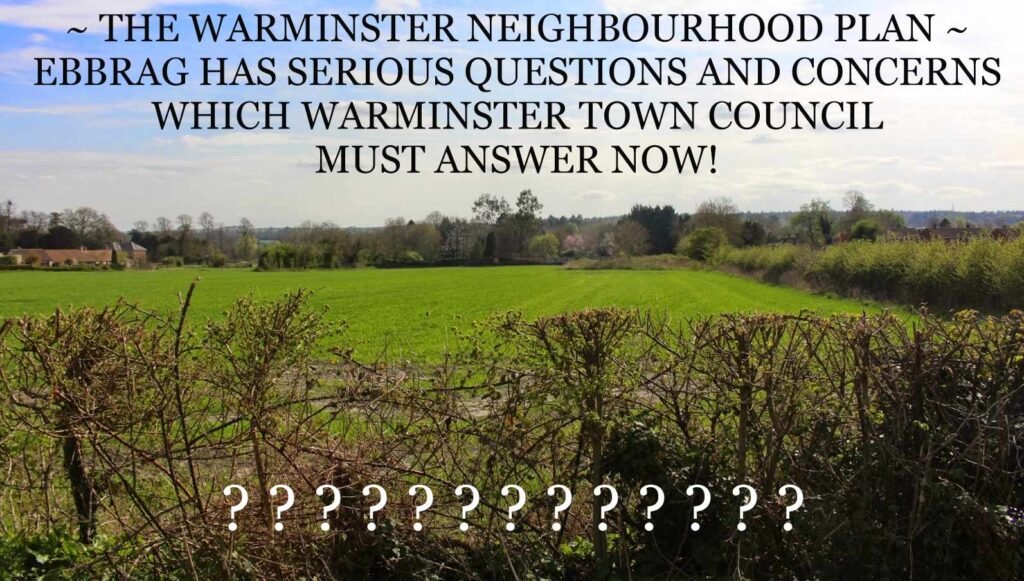
The Warminster Neighbourhood Plan ~ EBBRAG Has Serious Questions And Concerns Which Warminster Town Council Must Answer Now!

Friday 2nd January 2026

From the Facebook page of EBBRAG (the East Boreham Business And Residents Action Group):

THE WARMINSTER NEIGHBOURHOOD PLAN – EBBRAG HAS SERIOUS QUESTIONS AND CONCERNS WHICH WARMINSTER TOWN COUNCIL MUST ANSWER NOW!

(Written by an EBBRAG supporter, but more importantly, a resident of Warminster town)

Key PRINCIPLES of a Neighbourhood Plan

A Neighbourhood Plan should be a “community led’ process at every stage.

An approved Neighbourhood Plan, which identifies sites for development approved by a 50% local “yes” vote, offers a town some protection from “speculative” planning applications for a period of five years.

.A review of existing evidence should be undertaken including

Conservation area appraisals and statutory lists (listed buildings, historic, environmental record and scheduled ancient monuments)

Asking consultants to produce options before consulting the community is poor practice.

(taken from guidance on good practice in relation to developing a neighbourhood plan ‘Quick Guide to Neighbourhood Plans’) Ref : Dave Chetwyn MA., MRTPI, IHBC, Finest.M- Managing Director of Urban Vision Enterprise CIC and a Design Council CABE Built Environment expert. Other roles (present and former) ; Planning Chair with Civic Voice, Vice Chair of the National Planning Forum, Vice Chair of the Historic Towns Forum, Planning Adviser to Locality and Heritage Specialist on Crossrail , Head Planning Aid England, UK Chair of the Institute of Historic Building Conservation. He has advised and participated in various Government groups, reviews and Parliamentary select committees on planning, heritage, urban design, economic development, state aid and community engagement. Chartered member of the Royal Town Planning Institute, full member of the Institute of Historic Building Conservation and a fellow of the Institute of Leadership and Management.

Our fundamental issues:

– We feel decisions, well intentioned though they may have been, have largely been made behind closed doors and without meaningful reference to the community of Warminster.

– Bellway Homes are poised to submit a “speculative” planning application.

– In putting forward Home Farm as a potential site for development, historic barriers to building there for environmental, heritage and practical reasons have not been given sufficiently thorough consideration. The site has been turned down several times previously for very sound reasons.

– If allowed to go ahead, development of Home Farm land will forever change an area much loved and used by residents from across the town and wider afield by ramblers and hikers, dog walkers, horse riders, cyclists, historians, nature lovers and people who just enjoy the sensational views from Battlesbury, Middle and Scratchbury Hills.

On their website, the Town Council describe the Neighbourhood Plan process as “a community -led project by Warminster Town Council and local volunteers to shape the future development in Warminster.”

“The neighbourhood Plan gives you, the community who live here and who know Warminster best, a real voice.”

The legal point “Community engagement is a requirement of planning legislation, including for Neighbourhood Plans. It is essential in developing consensus and creating community support. Failure to engage communities at an early stage is one of the main causes of conflict later in the planning process.” Ref : Dave Chetwyn

TIMELINE

The current plan – which is still legally valid was made in 2016 and is now being reviewed. Work on this review began as far back as 2022. This week, whilst actively “researching” the neighbourhood plan, I came across an old Facebook feed @JohnBakeNewsW1:

The revised plan will need to look ahead, as far as 2036, and address important local issues.

During 2022, members of the Warminster community volunteered to support the town council, and other professionals, in beginning to update the Neighbourhood Plan.

As we move into 2023, we still need the local community to be fully involved and help ensure the Neighbourhood Plan reflects your views.

Interestingly, there were 0 comments in response to this post!

Summer 2025

As someone who is not a regular Facebook user, I did not become aware of anything to do with the Neighbourhood Plan until this summer, when my husband stumbled across a reference to an “informal consultation” about sites being proposed for housing development. By this time an original FIFTEEN sites had already been reduced to just THREE, for residents to comment on : Home Farm/Land East of Dene, Yew Tree public house and Ashley Combe.

This was about a week before the deadline for people to submit their thoughts online. We have lived in Warminster for 10 years, go into town regularly, use the library and yet were completely unaware of any Neighbourhood Plan. This gives rise to the questions:

How serious were the Town Council about the Neighbourhood plan being “community led”?

How proactive and effective have they really been at publicising and engaging the local community?

They may have been well intentioned but the reality is, many people didn’t know about it.

We set about informing as many people as we could about this informal consultation, as quickly as we could, including residents and local businesses. It was clear that this all came as a bolt out of the blue for most of the people we contacted – including the Manager / Director of Bishopstrow Hotel – a significant employer and local business adjacent to the proposed site.

The results ultimately revealed that 61% of respondents did not want building at Home Farm.

August 2025

Following the results of this informal consultation, members of EBBRAG were invited to a meeting hosted by the Town Council, ostensibly to raise concerns and ask questions.

Despite being told by representatives of the Town Council and their team of consultants (incidentally paid for with public money), that their aim was to be open and transparent, we came away with many questions unanswered and a distinct feeling that the decision to promote Home Farm as a site for development had pretty much been made already (albeit, not “officially”).

We also discovered at the meeting that the Ashley Coombe site had been removed from the Neighbourhood Plan process and with Yew Tree public house only offering the possibility of a build of 2 or 3 homes, the Home Farm site was left as the only remaining site.

This does give rise to another question:

Why were other sites not brought back in for consideration at this stage?

November 2025

Bellway Homes launched an online public consultation, with a daytime “drop in” session for residents of Warminster to comment on their proposal for development of land at Home Farm, following a broad leaflet drop to households across the town.

Their outline plan is pretty much the same as the plan we were shown at the meeting in August by the Town council, just with added detail relating to the specific type and layout of the dwellings.

At the “drop in”, Bellway Homes were quite open about the fact that they had already engaged in a pre- planning exercise and were intending to enter a full “speculative” application in early 2026, effectively putting them outside the Neighbourhood plan process.

Incidentally, the developer – Rubix- interested in the Ashley Coombe site also initiated a consultation about their proposed development at about the same time.

This gives rise to the questions:

What protection does the Neighbourhood Plan process really give against “speculative” applications by developers? Does it unintentionally encourage them?

Going forward to 2026

1. It is highly likely that Bellway Homes will submit a formal planning application for the Home Farm site early to mid 2026.

It is perhaps worth mentioning they do not have a great reputation as a builder, both in terms of the quality of the houses they build, nor in their delivery of agreed mitigations for reducing identified potentially negative “impacts” of their developments.

IT IS VITAL TO FORMALLY OBJECT TO THIS DEVELOPMENT IF YOU ARE AGAINST IT, EITHER INDIVIDUALLY OR BY PUTTING YOUR NAME BEHIND EBBRAG OBJECTIONS.

2. The official public referendum for/against the Neighbourhood Plan is likely to be early 2026.

IT IS VITAL TO MAKE YOUR VOICE HEARD BY EXERCISING YOUR RIGHT TO VOTE.

PLEASE NOTE, EBBRAG IS NOT a small group of residents who just object to a development “in their back yards”. IT IS a group of people who care passionately about the potential scarring of, and impact forever on, one of Warminster town’s most beautiful landscapes and historically sensitive areas, currently enjoyed by many residents from across the town and visitors alike.

EBBRAG would love to hear from you, contact EBBRAG:

email: info@ebbrag.com

website: www.ebbrag.com

Development Of Farm Land In Warminster Sparks Concern

Friday 2nd January 2026

From the Facebook page of EBBRAG (the East Boreham Business And Residents Action Group) ~

From The Wiltshire Times (Senior Correspondent John Baker) Friday 2nd January 2026:

Development Of Farm Land In Warminster Sparks Concern

Residents in Warminster have voiced growing concerns as developers press ahead with proposals for two farmland sites just as the town’s Neighbourhood Plan Review reaches its final consultation stage.

The Warminster Neighbourhood Plan (WNP) Review, a community-led framework designed to protect local heritage, safeguard green spaces and guide future development, is now nearing completion following three years of preparation.

An eight-week public consultation on the full draft plan is due to begin at the end of January 2026. Following this, the plan will be submitted to Wiltshire Council for independent examination in the summer, before being put to a local referendum. A majority vote in favour would be required for the plan to be formally adopted.

However, many residents have voiced concerns that the process may not progress quickly enough to prevent farmland being used for housing development sites.

Developers including Bellway Homes and Rubix Land are already advancing proposals on sites previously considered by the town council during earlier stages of the plan’s development.

At Home Farm on Boreham Road, Bellway Homes is proposing up to 135 new houses. Meanwhile, at Ashley Coombe, Rubix Land is continuing to pursue a development scheme despite the town council withdrawing its support after updated surveys raised concerns about land levels, underground services and potential odour issues.

More than 320 residents have voiced their opposition to the developments ahead of the Neighbourhood Plan Review public consultation being launched.

Around 100 residents attended a public meeting over the summer to discuss the Ashley Coombe proposals, while the East Boreham Business and Residents Action Group (EBBRAG) has launched a campaign to strongly oppose development at Home Farm, holding meetings and mobilising support online.

EBBRAG members Gwyn and Anne Evans said: “Development of this land was unequivocally turned down by a Government inspector in 2020. Despite this, our local town council has included this complex site as a singular option for development, for residents of Warminster to vote on at referendum, even though 61 per cent voted against this in its informal survey.

“To add more fuel to the fire of opposition, Bellway Homes, with the full knowledge of the town council, are poised to submit a ‘speculative’ planning application. Local residents are outraged at how a supposedly democratic and ‘community led’ process can be willingly compromised in this manner.

“We feel decisions, well intentioned though they may have been, have largely been made behind closed doors and without meaningful reference to the community of Warminster.”

Bellway Homes says its Home Farm scheme is needed to help meet local housing demand. The developer has stated that 40 per cent of the homes would be affordable, with provision for multi-generational living, and that more than half of the 5.9-hectare site would be retained as public green space.

Residents raised questions about the plans at a public consultation on November 19, with formal feedback accepted until December 5. The group is urging locals to formally object to the housing proposal.

At Ashley Coombe, Rubix Land is promoting a revised proposal for 77 homes, now accessed solely via Ashley Coombe after removing a previously included parcel of land near Fanshaw Way. The developer says it remains committed to the site, despite the withdrawal of the WNP Review Steering Group support.

In a statement, Rubix said: “Whilst the WNPR Steering Group has withdrawn support for this revised scheme, Rubix considers it offers a suitable and acceptable alternative.” The company is seeking further feedback from the community on design, green space and connectivity.

Meanwhile, Warminster town councillor Phil Keeble has urged residents to take part in the upcoming consultation on the Neighbourhood Plan, saying: “The draft plan has been prepared by local representatives with the input of hundreds of residents. Your feedback is vital to inform the final plan we submit for formal examination and adoption.”

Further information about the Neighbourhood Plan consultation is available from Warminster Town Council on 01985 214847, by emailing [admin@warminster-tc.gov.uk](mailto:admin@warminster-tc.gov.uk), or via [www.warminsterplan.com](http://www.warminsterplan.com/).

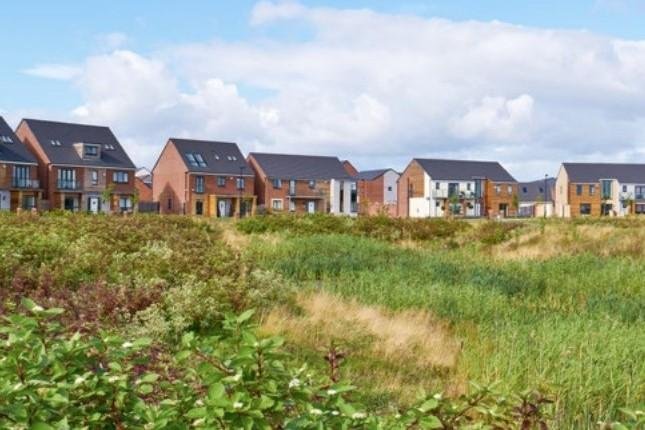
Picture shows an artist’s impression of how the new houses on the farmland will look. Image from Wiltshire Council.

http://www.swindonadvertiser.co.uk/…/25731692…/

For further information about the Home Farm development please contact EBBRAG (the East Boreham Business And Residents Action Group:

email: info@ebbrag.com

website: www.ebbrag.com

Warminster Neighbourhood Plan Draft Consultation Starts In January 2026

Wednesday 12th November 2025

Consultations held by landowners/developers are separate from the official Town Council Plan.

Press release from Warminster Town Council:

𝐒𝐡𝐚𝐩𝐞 𝐘𝐨𝐮𝐫 𝐓𝐨𝐰𝐧’𝐬 𝐅𝐮𝐭𝐮𝐫𝐞: 𝐍𝐞𝐢𝐠𝐡𝐛𝐨𝐮𝐫𝐡𝐨𝐨𝐝 𝐏𝐥𝐚𝐧 𝐃𝐫𝐚𝐟𝐭 𝐂𝐨𝐧𝐬𝐮𝐥𝐭𝐚𝐭𝐢𝐨𝐧 𝐒𝐭𝐚𝐫𝐭𝐬 𝐉𝐚𝐧𝐮𝐚𝐫𝐲

The Warminster Neighbourhood Plan draft is almost ready. We’ll need your input:

• 𝐖𝐡𝐚𝐭: Full Draft Neighbourhood Plan available for review

• 𝐖𝐡𝐞𝐧: Eight-week consultation starts end of January (dates TBC)

• 𝐖𝐡𝐲: The Plan aims to protects green spaces and heritage, sets housing policies, and helps manage and direct development to suitable areas. Our Plan gives our community the strongest legal weight in influencing planning decisions.

⚠️ 𝐈𝐌𝐏𝐎𝐑𝐓𝐀𝐍𝐓: Consultations held by landowners/developers are separate from this official Town Council Plan.

For further information: https://bit.ly/4hZ87JQ