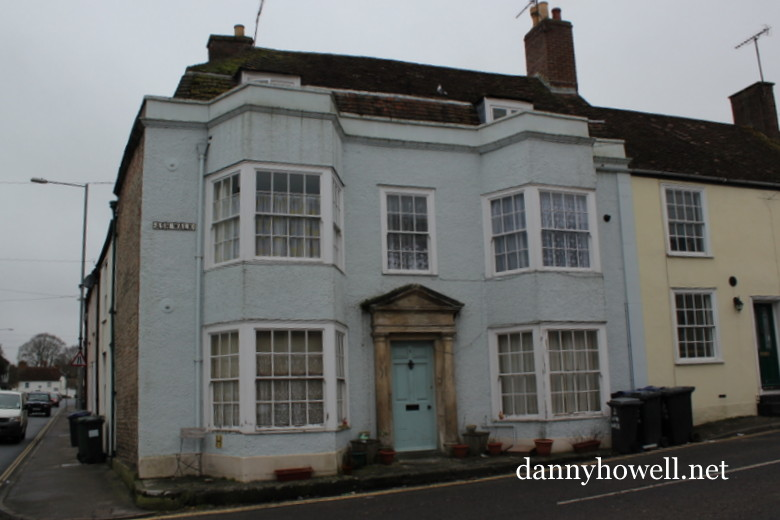
Four photographs of No.1 Ash Walk, Warminster, taken by Danny Howell on Sunday 3rd February 2013, showing a chair outside, on the corner with Silver Street.
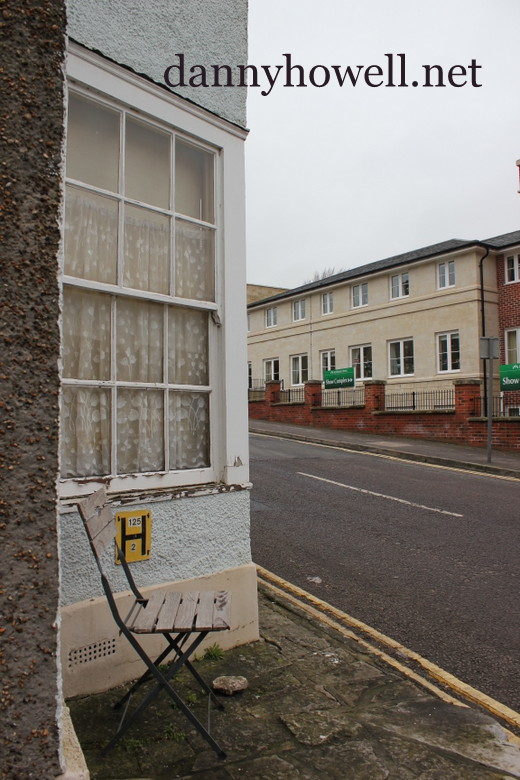
Imber Court on the opposite side of the street.
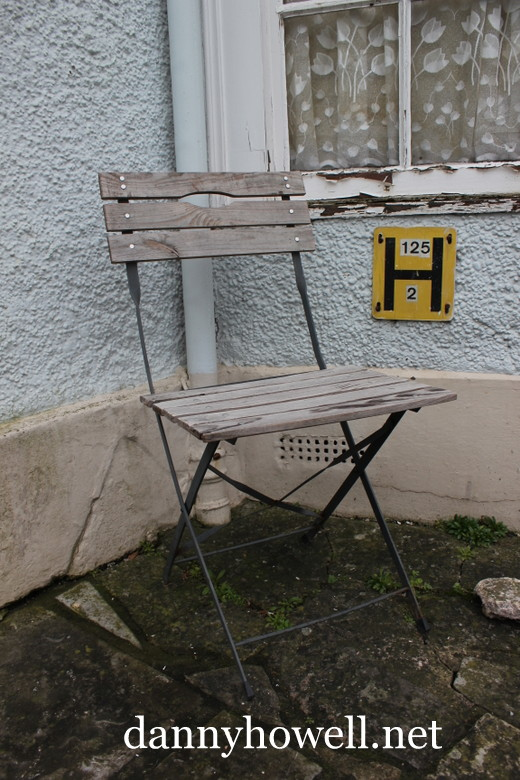
The chair outside.
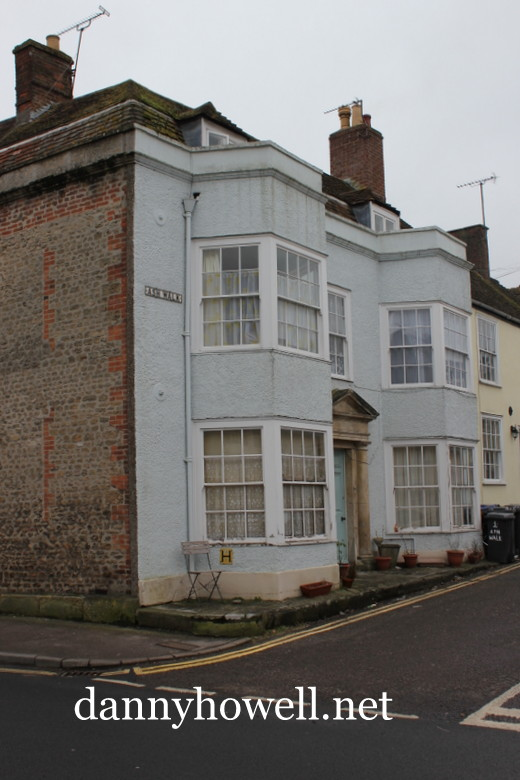
Four photographs of No.1 Ash Walk, Warminster, taken by Danny Howell on Sunday 3rd February 2013, showing a chair outside, on the corner with Silver Street.
Imber Court on the opposite side of the street.
The chair outside.
The Warminster Town Centre Conservation Area Assessment (Informative Document), published in March 2007, noted:
Ash Walk and Dorothy Walk. To the east of the main street area are two smaller lanes that are narrow and partly free from vehicular access, thereby allowing the free flow of pedestrians. Historically, Ash Walk would have served as the main access to the Manor House, which no longer exists, but that would have been closely associated with the Minster Church. The large house known as Warminster Court, now surrounded by a late 20th century housing estate, is also accessed from the lane. Whilst it also allows limited traffic into the rear of Warminster School, the lane is a no-through road and is, therefore, a peaceful footpath for users between the Church and School and the junction of Silver Street and George Street. Hedgerow and some stonewalling mark much of its route along the school’s curtilage.
Reg Cundick and Danny Howell in the book The Inns And Taverns Of Warminster, published in November 1987, stated:
The Church House Ales
During the 15th century it was customary for people of the outlying parishes to attend the mother church for festivals of Christmas, Easter and Whitsuntide (particularly the latter). Ales were brewed at the Church House to provide refreshment for the large congregations attending the festivals. The profits from the sale of the ales went to the Church; and in Warminster some of the revenue (until about 1600) was made available to the Chapel of St. Laurence. Church Ales were abolished after the Reformation but the practice continued in Warminster until the 1800s.
Both the Inclosure Award and the 1801 Survey Of Warminster list the Church House. It was situated in front of the Parish Church of St. Denys’, between the great yew and the road to Bath. It was demolished in 1813 and had been used for some years previously as a house for the sexton. The land the Church House occupied is now part of the churchyard.
A cottage in Ash Walk, opposite the main gateway to the churchyard, was then purchased and demolished, making way for the building of a new house for the sexton. The brewing of ales was transferred to here. A notice in 1814 advertised: “A Church Ale at the Sexton’s House”. The practice terminated in 1826.
From the Wylye Valley Life magazine, issue No.21, Friday 8th March 1985:
Planning Application, Warminster
Warminster Bowling Club; for construction of new changing rooms and a bar at their Ash Walk ground.
1985
The Old Police Station, Ash Walk, Warminster
Bruce Watkin, in 1985, wrote ~
The old police station, now Christian Science Church, in Ash Walk off George Street, is mid-19th century Bath stone.
Extract from The Changing Face Of Warminster by Wilfred Middlebrook, published in 1971:.
Back at the Minster Churchyard at the beginning of Dorothy Walk we find Ash Walk leading the way direct to the heart of the town via George Street. Once called the Ashes or Asheys, from the house at the church end that belonged to the Blake family in the sixteenth century, there is no through thoroughfare for wheeled traffic, wooden posts enforcing a footpath at the church end. It has also been called ‘Sloper’s Walk’; Simon Sloper, once owner of Black Dog Wood, lived in a house on Ash Walk.
There are several references to the Sloper family in the 17th century Quarter Sessions records. For example, in July 1607, it was recorded that a ‘cooking stoole!’ was needed in the town of Warminster, to be made and maintained by Simon Sloper. Thirty years later, in 1637, the Jury at Warminster present “that they have neither a cucking stool (ducking stool) nor pillory in Warminster, and that William Sloper must maintain and put them up.†It seems as though the present century has no monopoly in procrastination, for in 1647 comes: “We present that we have noe stocks in the towne of Warminster in default of William Sloper†(ordered to be provided before August under penalty of 40/-). In 1650 the presentment to the Jury states “that their church is mightily in decay insomuch that the pishoners (parishioners) are afraid to assemble there,†and in 1669 we find “Simon Sloper Junior presented for not setting up a Pillory and Cookinge Stoole in Warminster.†They must have been a kind-hearted lot, these Slopers of Ash Walk.
The Warminster Bowling Club, which moved here after the 1914-1918 War, borders Ash Walk at this end, with the grounds of Lord Weymouth’s Grammar School on the opposite side. The Bowling Club was first started in 1895, chiefly through the keen-ness of a few members from the north of England. At first, Warminster Cricket Club allowed them to use part of their ground, but this proved unsatisfactory, and in May 1908 they opened a new bowling green in an adjoining field; Mr. T. H. Harraway laying them a most excellent green. After the First World War the club transferred to the Lake Pleasure Grounds, but soon settled finally on the splendid green in Ash Walk.
A fair ground once adjoined Ash Walk, on Angel Field, and in July 1821 a big celebration was held there for the Coronation of George The Fourth. An ox and two sheep were roasted in the fair ground, on a day that started with bell-ringing and ended with fireworks and a bonfire, while four thousand loaves were distributed to such poor persons who were in Angel Field at precisely eleven o’clock. School children were given a pint of beer and a dinner in the Market Place.
A British School for Girls was first established in Ash Walk, then moved in 1837 to the Common Close, and again in 1874 to the Old Unitarian Chapel in North Row. The imposing stone building near the George Street end of Ash Walk was for seventy-four years the town Police Station, built in 1857 on the site of two cottages that were destroyed by fire. When the police moved to their new premises in Station Road in 1932, the building was taken over by the Christian Science Society.
Extract from The Changing Face Of Warminster by Wilfred Middlebrook, published in 1971:Â
The changing face of Warminster is strikingly apparent as one traverses Ash Walk, for here, where the Manor House of the Mauduits once stood, is a large new housing estate called Manor Gardens. Not so many years ago, the Manor Guest House, as it was then called, stood well-hidden in spacious grounds; the Manor House is still well-hidden, but now by a cunningly arranged house-planning scheme, and it is now the office quarters of Sykes International Limited, the specialist poultry breeders.
In the Domesday Survey of 1086 it was recorded that “the King himself holds Cuerminter. King Edward formerly held it.†Thus was Warminster declared a Royal Manor, with a population of some six hundred. The Manor of Warminster remained in the Crown through the reigns of William The First and William The Second, Henry The First, and Stephen; Henry The Second later granting the Manor of Warminster to Robert Mauduit from Normandy.
It was to William Mauduit, many years later, that Henry The Third chartered a yearly Fair in Warminster, to be held on the vigil, the festival and the morrow of St. Laurence. The Mauduit family terminated in male descent in the reign of Richard The Second and by this time the original Manor of the Lordship of Warminster had shrunk to meagre dimensions. Portions of the parish separated from the Manor were still called manors, these being Smallbrook, Boreham, Furneaux, Sambourne, Newport (Portway) and others.
Finally, Lord Mervyn Audley (who was beheaded in 1631) sold the Manor of Warminster to Sir Thomas Thynne (grandson of the founder of Longleat) who had married his sister, Mary Audley. Thus a large part of Warminster became a part of the vast Longleat Estate.
The present Manor House was built in 1790 by a farmer called Randall, who held the remains of the Mauduit mansion under lease from Lord Bath. He pulled down the greater part and rebuilt the house as we know it today, standing on a gentle elevation that once commanded a fine view of the town and countryside. Now it is drowned effectively in a sea of bricks and mortar.
When farmer Randall pulled down the old Mauduit mansion, several old silver coins were found under the floors, and a small carved figure in jet, which later passed into the possession of the Hallidays of East Street. On the wall of what was probably part of the Chapel Of St. Nicholas was found a crude painting of the Crucifixion. According to Daniell, the Chapel Of St. Nicholas in the Manor of Warminster was founded and endowed by the Mauduits. It was a private chapel, for the sole use of the family and large household of the Mauduits.
Extract from The Changing Face Of Warminster by Wilfred Middlebrook, published in 1971:Â
The changing face of Warminster is strikingly apparent as one traverses Ash Walk, for here, where the Manor House of the Mauduits once stood, is a large new housing estate called Manor Gardens. Not so many years ago, the Manor Guest House, as it was then called, stood well-hidden in spacious grounds; the Manor House is still well-hidden, but now by a cunningly arranged house-planning scheme, and it is now the office quarters of Sykes International Limited, the specialist poultry breeders.
In the Domesday Survey of 1086 it was recorded that “the King himself holds Cuerminter. King Edward formerly held it.†Thus was Warminster declared a Royal Manor, with a population of some six hundred. The Manor of Warminster remained in the Crown through the reigns of William The First and William The Second, Henry The First, and Stephen; Henry The Second later granting the Manor of Warminster to Robert Mauduit from Normandy.
It was to William Mauduit, many years later, that Henry The Third chartered a yearly Fair in Warminster, to be held on the vigil, the festival and the morrow of St. Laurence. The Mauduit family terminated in male descent in the reign of Richard The Second and by this time the original Manor of the Lordship of Warminster had shrunk to meagre dimensions. Portions of the parish separated from the Manor were still called manors, these being Smallbrook, Boreham, Furneaux, Sambourne, Newport (Portway) and others.
Finally, Lord Mervyn Audley (who was beheaded in 1631) sold the Manor of Warminster to Sir Thomas Thynne (grandson of the founder of Longleat) who had married his sister, Mary Audley. Thus a large part of Warminster became a part of the vast Longleat Estate.
The present Manor House was built in 1790 by a farmer called Randall, who held the remains of the Mauduit mansion under lease from Lord Bath. He pulled down the greater part and rebuilt the house as we know it today, standing on a gentle elevation that once commanded a fine view of the town and countryside. Now it is drowned effectively in a sea of bricks and mortar.
When farmer Randall pulled down the old Mauduit mansion, several old silver coins were found under the floors, and a small carved figure in jet, which later passed into the possession of the Hallidays of East Street. On the wall of what was probably part of the Chapel Of St. Nicholas was found a crude painting of the Crucifixion. According to Daniell, the Chapel Of St. Nicholas in the Manor of Warminster was founded and endowed by the Mauduits. It was a private chapel, for the sole use of the family and large household of the Mauduits.
Information gleaned from a Warminster Town Guide, 1971:
Official street parking is allowed in Ash Walk.
Residents at Ash Walk, Warminster, in 1933:
Walter Siminson, Holmwood, 1 Ash Walk, Warminster.
Bertie Richard Kerr, 2 Ash Walk, Warminster.
John Martin Box, Homelands, Ash Walk, Warminster.
Mrs. Mundy, 4 Ash Walk, Warminster.
Rowland Ede, 4 Ash Walk, Warminster.
S. W. Pinnell, 5 Ash Walk, Warminster.
James Oldnall, 6 Ash Walk, Warminster.
George Saville, 7 Ash Walk, Warminster.
Ernest Richard Moores, 8 Ash Walk, Warminster.
Major Mansel Witherby Mortimer, Manor House, Ash Walk, Warminster.
Miss Bendle, 10 Ash Walk, Warminster.
Sidney Day, carpenter, 11 Ash Walk, Warminster.