Arn Hill, Warminster ~ A Treasure Trove For The Botanist While Larks Sing Merrily Overhead

The Warminster Official Guide, issued under the auspices of Warminster Urban District Council, published August 1936, noted:

Arn Hill, which adjoins [Copheap], is one of the chief attractions of the town. The Golf Club owns the summit, and to compensate for this the Marquess of Bath has presented the wooded hillside to the town as a Recreation Ground. The extensive panoramas enjoyed from here across the wooded valleys towards the encircling hills of the Plain and Mendip country are remarkable for their delicate beauty and ever-changing colours. The downland offers treasure trove to the botanist in the form of an unusually large number of native British orchids. Hiding flowers in profusion make the turf aromatic, while larks sing merrily overhead.

Arn Hill And Its Vistas

From The Warminster Official Guide And Souvenir 1928 (penned by Victor Strode Manley):

Arn Hill, Warminster
The woods on the south face of Arn Hill (about 11 acres) at an altitude of about 550 feet above sea level, and adjacent to the town, were generously given to the town by the Marquis of Bath in 1920. They have been ribboned with paths and provided with seats and shelters. The panoramas unfolded from here are magnificent, carrying the eye down into the valley where the grey tower of the Minster (St. Denys) presents a picturesque scene.

Over all looms the majestic and shapely Cley Hill, over 800 feet above sea level, a detached eminence imposing and impressive. It is conspicuous from all the country around for ten miles or more, which accounts for it being the rallying-ground for Alfred’s army before the decisive battle with the Danes at Ethandune (Edington). From it flow those tricklets of streams which go to swell the Wylye at Bishopstrow. It has been entrenched as a British hill fort and a huge burial mound crowns the summit, from which flared the beacon announcing the Spanish Armada. Longleat Park forms the background.

Warminster town, centred by St. Lawrence spire, is seen on a rise running for a mile high and dry above the meadows, leaving the Minster in splendid isolation. Christ Church looks down on the town from another high hill, and away in the distance are the green hills hiding the Deverill Valley and Shearwater, whose streams also join the Wylye.

Shifting the scene to the west we look over the open Somerset country, and on clear days it is possible to discern the houses in Frome seven miles away. Cranmore Tower at Shepton Mallet and Turner’s Tower near Bath are often visible, in fact the view extends nearly to Bristol. Under changing effects of sunshine and shadow it is a delight to watch different gradations of distant vistas, the sun brightening into colour and vivid details then fading into featureless grey.

From the north side of Arn Hill the scene changes to the last lap of Salisbury Plain, where the line of rounded hills push out in emulation towards the Wylye Valley, each a hill fort with trenches and burial mounds. Their undulating outlines seem wild and desolate, yet with a compensating grandeur, and on nearer acquaintance they are very pleasant, bespangled with innumerable multi-coloured flowers giving out an aromatic odour, the hunting ground of honey bees. The valley forms a striking contrast, with its confusion of trees and muffled hedgerows.

A Pistol Unearthed At Arn Hill, Warminster

Victor Strode Manley, writing in 1923, in his “Regional Survey Of The Warminster District’ noted:

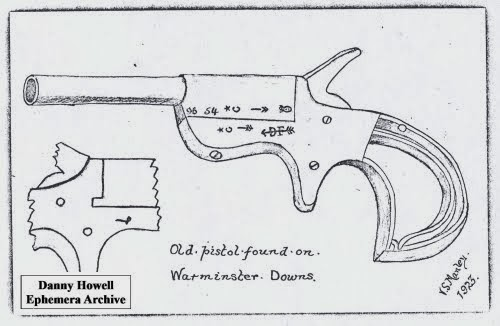
“Item 121 – Pistol from Warminster Downs. I have placed this in the top case of the Museum in the Town Hall [Warminster]. It was unearthed on Arn Hill a few years ago. The sketch, actual size, will show the marks which might fix the date. A clay pipe is on the right side. The wood of the handle is missing. (Perhaps my sketch is a little enlarged). When it is double cocked the trigger can be swung round. Conan Doyle has mentioned that special dogs were kept at Salisbury to track down robbers on the Plain.’

Illustration of an old pistol found on Warminster Downs, drawn by Victor Strode Manley in 1923.

Addenda: Small Pistol. – Illustrated opposite. Mrs. Ethel M. Richardson in her book “Wiltshire Folk’ (1934) p.123, par.2., refers to Mr. H.J. Doel, of Quarry Farm, Purton, Wilts, who gave her “two tiny pistols.” “His father-in-law had used them when driving to market in the old days; they were prettily chased, and the work of a Gloucester maker.”

V.S.M. [Victor Strode Manley] thus suggests the pistol shown opposite was that of a farmer and not a highwayman. The route from the old Warminster Corn Market, for some farmers, passed across the Downs along Nun’s Path.

Town Improvements For Warminster Include Widening And Making Good The Nun’s Path

Friday 16th December 1921:

An article titled Town Improvements, published on Friday 16th December 1921, made the following references to the Nun’s Path, Warminster ~

When some couple of years ago the Marquis of Bath presented to the town a portion of the Downs [Arn Hill] facing the Westbury Road, Mr. Harraway, who was chairman of the Urban Council [Warminster UDC] at the time, suggested that a great improvement would be effected if the site was laid out so as to make it more attractive and accessible to the general public. Circumstances did not favour the carrying out of the work at that time, but the desire a few months ago to find work for some of the unemployed led to the suggestion being revived, and, as it is generally known, the Arn Hill Improvement Scheme was adopted by the Council and application was made for a grant from the Government’s relief works funds for the carrying out of the work.

Although at the last meeting of the Council it was reported that the necessary sanction to the grant had not yet been received, the work has, nevertheless, been proceeding, under the direction of Mr. Lawton, and is now nearing completion; and everyone who has seen what is being done is, we believe, of the opinion that it will effect a real town improvement.

The approach to the “Nun’s Path” from Westbury Road has been made into a good hard pathway, whilst for a considerable distance the “Nun’s Path” has been widened and made good. Before the steep ascent of the path is reached a convenient shelter has been erected, whilst from that point, in an easterly direction, a new pathway has been made on a terrace some way up the slope, crossing along under “The Firs” and joining the existing pathway (now considerably widened) across the steep incline formerly known as “Smokey Hole” to the old limekiln road. The pathway from thence along under the south side of the Downs to the top of Elm Hill, has, by the consent of the Golf Club, been also cleared and widened, and when completed there will be a firm footpath of a good width from the top of Elm Hill right across to the “Nun’s Path.”

. . . . . Altogether the alterations being carried out have not only found work for a number of those who would otherwise have been unemployed, but the improvements effected will be a valuable addition to the amenities of our ancient town.
Warminster Lime Kiln (At Arn Hill) And Adjoining Field To Let By Tender

Friday 9th July 1886

To be let, by tender, the Warminster Lime Kiln [at Arn Hill] and Field adjoining, for a term of Seven, Fourteen, or Twenty One years. It is now and has been for many years past in the occupation of Mr. R. Butcher. Tenders are to be sent to Henry Trollope. No.3 Silver Street, Warminster, on or before the 9th day of August next. H.T. does not bind himself to accept the highest or any tender. – Silver Street, July 9th, 1886.

The Lime Kiln And Part Of The Quarry At Arn Hill, Warminster, 1838

The Warminster Enclosure Award, 1838, lists Ann Tavender as the occupier of the lime-kiln and part of the quarry at Arn Hill, also a nearby garden, plantation and paddock. The copyholder is Elizabeth Shirley.

error: Content is protected !!