Thursday 30th October 2025
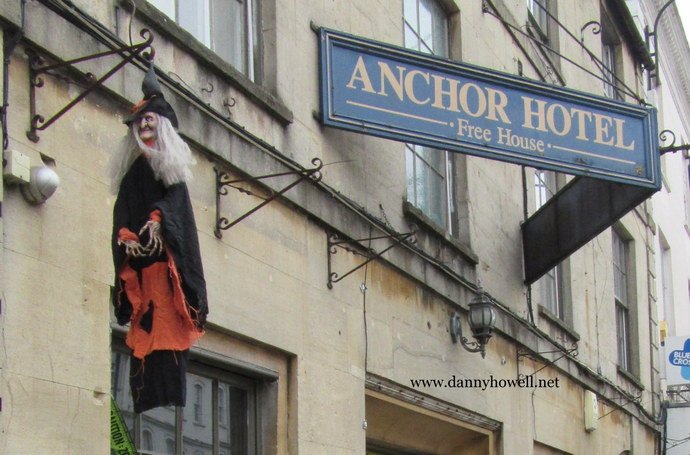
A photograph I took 9 years ago, on 30th October 2016, of a witch on the wall of the Anchor, Market Place, Warminster.
Danny Howell writes:
Writing in the 1920s, Victor Strode Manley, who not only was a teacher at Sambourne School, but was also a keen local historian, mentioned a possible witch in Warminster. In his ‘Regional Survey Of Warminster And District’ (unpublished) he made a reference to a woman who lived in a little thatched cottage on West Street. He noted that her name was Tilly Flaherty and that she was a reputed witch. He gave no other details and we are left to wonder at what time period Tilly Flaherty lived and as to why she was thought of by others as a witch.
But we do have some historical information regarding witchcraft in Warminster in the 17th century – information re-published in the early 1970s by Wilfred Middlebrook, another of Warminster’s amateur local historians.
He wrote: In days gone by, witchcraft was as prevalent in Warminster as in any other part of the country, and there are several cases of witchcraft or complaints of witchcraft in the records of the county of Wilts., the Great Rolls of the seventeenth century Quarter Sessions.
In 1650 a Warminster woman complained to the Justices that a neighbour called her a “bun’ or witch.
And some 37 years previously: In 1613, at Marlborough Quarter Sessions, Margaret Pilton of Warminster was accused of being a witch by Avis Glasier. During Lent the two women met at the house of William Mathew at “Borom,” [Boreham, on the east side of Warminster], where Avis had gone to take a breakfast to her betrothed husband. As the two women walked back to the town of Warminster – probably along Smallbrook Lane, or across the neighbouring fields [on which the Prestbury housing estate was built in the 1960s] – “Margrett did desire the said Avyes to gyve her her soule or spirit,” promising that Avis would live twenty years the longer and recover her health. Avis refused but the witch “drew her home to her house and made her drinck [drink] some of her drinck,” and said if Avis told her friends she should live longer in her pains, and made her promise to send for her before she departed this world.
Some weeks later, in July, Avis sent for the alleged witch Margaret Pilton. Margaret ordered everyone out of the house and asked Avis whether she had told anyone. “And then she said Margrett departed from the sayed Avyes and after her departure she said Avyes fell into a mervellouse Traunces as thoughe ye should have departed strayghte.”
It sounds as if the marvelous “traunce” was some sort of trance that put Avis into a death-like state.
The story was sufficient for Margaret Pilton to appear in court, on a charge of witchcraft.
Margaret Pilton’s version of events when she was examined by Edward Ludlowe on 27th July 1613 was that she was being kind enough to treat Avis for an abscess. Margaret explained that as she and Avis walked home from Boreham, Margaret asked Avis the cause of her sickness which proved to be an abscess or “imposthume,’ and “it was impossible for Avis to recover from it.” At her house in Warminster Margaret gave her friend a medicinal drink “as shee did drincke of herselfe”; on departing, Avis entreated her to come if she should send for her.” In other words, Avis was ill and sent for her. Margaret denied asking Avis for her soul.
There doesn’t seem to be any record of whether Margaret Pilton was found guilty of being a witch or not. No mention is made of any sentence in the published report of the court, though at that time most towns were equipped with a ducking stool (also called a cucking stool or a cooking stoole) for dealing with witches. Ducking stools were also used to punish women who were considered “scolds” or spreaders of untrue gossip. Basically, the punishment was really about including humiliation.
The ducking stool consisted of a wooden chair attached to a see-saw like beam. The alleged witch was held in the chair by an iron band so that she could not get out. A magistrate could say how many times a suspected witch could be ducked into the water. If she drowned she was proclaimed not guilty, but she was of course then dead. If she didn’t drown, but “floated” then she was deemed to be at work with the devil and proven guilty. If found guilty a witch could be executed in various ways, including hanging, or being strangled or crushed and then burnt. The destruction of the body was to ensure a witch couldn’t come back to life.
A man called Simon Sloper was responsible for providing and keeping in good repair a ducking stool in Warminster. Simon Sloper was the owner of Black Dog Wood and he lived in a house along the narrow road we now call Ash Walk. In the first half of the 17th century, the present Ash Walk was called Sloper’s Walk.
Wilfred Middlebrook wrote: There are several references to the Sloper family in the 17th century Quarter Sessions records. For example, in July 1607, it was recorded that a “cooking stoole’ [ducking stool] was needed in the town of Warminster, to be made and maintained by Simon Sloper. Thirty years later, in 1637, the Jury at Warminster present “that they have neither a cucking stool nor pillory in Warminster, and that William Sloper must maintain and put them up.” It seems as though the present century has no monopoly in procrastination, for in 1647 comes: “We present that we have noe stocks in the towne of Warminster in default of William Sloper” (ordered to be provided before August under penalty of 40/-). In 1650 the presentment to the Jury states “that their church is mightily in decay insomuch that the pishoners (parishioners) are afraid to assemble there,” and in 1669 we find “Simon Sloper Junior presented for not setting up a Pillory and Cookinge Stoole in Warminster.”
Wilfred Middlebrook concluded: “They must have been a kind-hearted lot, those Slopers of Ash Walk.”
I suppose the question we must ask ourselves now, if Warminster had a ducking stool for dealing with alleged witches, where was it used? On the River Wylye perhaps? Or some pond in Warminster? It is known that ducking stools were not always permanent features but were often on wheels so they could be taken to the bank of any chosen river or pond.