The following notes are from Water Mills Of The Wylye Valley by Anthony Houghton Brown, 1978.
Upton Mill, Upton Lovell.
History:
A mill worth 20s. is recorded for Uptone in the Domesday survey (VCH, 2, no.132). After that nothing is heard of it until 1439 when William Reynolds of Ubeton, miller, was fined at the Sherrifs turn (Jackson, 1871, 115) although in 1379 the Poll Tax returns record a fuller at Upton Lovell, once again there is no proof that he was using a mill (VCH, 4, 122).
In 1601 the Marquess of Winchester sold property to John Rylye including ‘all those griste milles and water courne milles . . . in Upton Lovell.’ Although this sounds like a great number of mills, it may have amounted to no more than two pairs of stones in one building. The family held the mills until at least the end of the 17th century, for in 1694 Henrietta Maria Ryley leased the grist mills to William Hitchcock. Three years later she leased them to James Fleman (WRO, 682, 50).
The mills then appear to pass by marriage to the Clare family, for we find Thomas Clare letting them to Benjamin Carter of Boreham, miller, in 1710. Thomas Clare’s wife is named as Henrietta Maria. In 1761, William Clare leased ‘ . . . two grist mills or water grist mills . . . formerly in the tenure of Thomas Shergole’ to trustees for a year (WRO, 682/50). After this, references are made to one mill only, as in 1773 when Upton Mill is shown on Andrews and Dury’s map.
In the early nineteenth century, the character of milling in Upton Lovell changed completely, for the mill was bought by the Everetts to become another one of their cloth factories. Eventually it was the largest water mill in the valley.
In 1807, a later William Clare let the mill with house, orchard, and an extra piece of land to John Gale Everett of Heytesbury. The lease included permission to demolish the mill and build a factory. The entry fine was £1,300. In 1810, Everett bought the freehold of the mill ‘ . . . which premises are now converted into a factory(WRO, 682).’
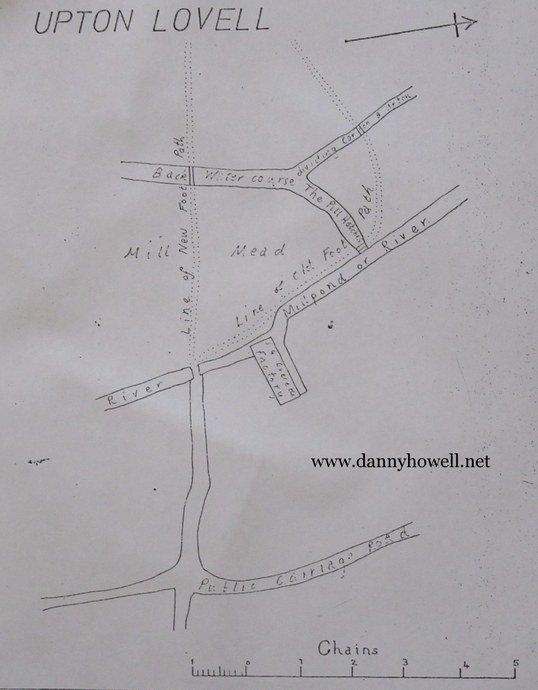
Upton Mill, from a footpath diversion order of 1820
(WRO, 682/50).
The Everetts, first John Gale and then Joseph, continued to run the mill until 1840.
By 1833 they were employing 400 hands, including outworkers. They had steam and water power, each of 20 h.p. The steam engine came from Boulton and Watt in 1822. After 1846, the factory was let to a succession of firms. In 1882, George Dean enlarged the powerloom sheds and fitted a new steam engine.
William Walker, a Trowbridge man with four factories there, bought the mill in 1886 and ran it as the Upton Lovell Manufacturing Company. In 1898 the mill was seriously damaged by fire and had to close. Walker wrote: ‘No finer beavers were ever made than those I made at Upton Lovell (Rogers, 1976, 247-8).’
The mill was partially restored in 1906 when the West Of England Leather Cloth Co. took it over (Middlebrook in litt, 1976).
In 1910 a German owned firm of hatters set up there, but were forced to close on the outbreak of the Great War. During that war tin helmets were made there, this being the last use that the buildings were put to. Most of the buildings were demolished soon after 1918. Finally, the factory chimney was demolished in about 1933.
Topography:
Despite its size, the mill stood in a completely rural context at the western end of a small village. Many of the workers came daily from Westbury and Trowbridge, and so the size of the village was not greatly affected. Behind the mill were arable fields and the meadows lay in front. A footpath ran across them to Corton. The village lays just off the turnpike and the mill was less than 2 miles from the railway station at Codford.
The Building and Site:
This is one of the demolished mills for which we have photographs, and so we are able to say something about its appearance.
The main building was of brick, but from remains on site, it would appear to have had a stone foundation at least. It was L-shaped, with one arm of four storeys. The other was of three with a well lit loft. The windows look as if they were metal framed under a shallow brick arch.
The main works entrance was on the first floor as at the Old Weaving Shed at Wilton. There were a number of ancillary buildings and the main chimney stack was square.
The site now forms part of a large private garden. Although the water courses are still relatively clear, the actual site of the building has been converted into rock gardens. The most conspicuous features that remain are two large wheel pits. They are 10′ wide and grooves indicate a diameter of c.11′ for the breastshot wheels which were undoubtedly of iron; this is the only mill in the valley known to have used two wheels in modern times.
One relic of the earlier mill that has survived is a mill stone of peak type set into the path of a cottage immediately opposite the mill site.