Recollections Of An Old ‘Un
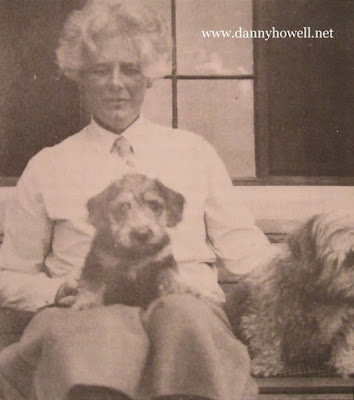
Nancy Bouverie, pictured circa 1930,
with two of her dogs, Whisky and Soda.
Miss Nancy Pleydell Bouverie, who died on 30th October 1972, aged 87, and is buried near the north-east corner of Heytesbury Churchyard, left the following written memories, which she called Recollections Of An Old ‘Un. They provide a picture of Heytesbury from 1911 to 1950, a period interrupted by two World Wars, and portray the way life was in the village. This is what Nancy recalled:
“In 1911 we came to Heytesbury, three sisters and a brother and all the furniture. It was carted up from the Station by Mr Pike and his merry men who were such a help that I shall be eternally grateful. Everyone was kind to us young things and when we found that we had everything necessary in the house except matches to light the lamps we went down to Miss Daly’s (now Mr Davis’ shop) who not only provided the matches but offered to light the lamps for us.”
“The first excitement was the arrival of the mail cart from Bath, an old gentleman and his little white dog sitting on the box. In those days Her Majesty’s mail was too precious to be trusted to those new-fangled railways and was transported by horse and coach. The postman came from Bath in the morning, as far as Wylye, and collected the letters on his return in the evening; and the letters were delivered in London the next day without fail and all for a penny.”
“The village in those days was, of course, much quieter, with only the occasional cars going through. We had to amuse ourselves more and there were lots of activities. One activity was polo. Heytesbury had quite a good polo team which played in Mr Osborne’s field. People brought their own ponies and a good time was had by all.”
“There were some funny habits in the village, as there still are; Margaret Lady Heytesbury was a bit of a character and disapproved of the draught in the church, well known to all of us. When it was particularly bad she sat under an umbrella.”
“The declaration of war, in 1914, stands out in my memory. There was only one telephone in the village, at the Estate Office. There was always a large crowd there on August 3rd and 4th, waiting for news. They included an old man called Twabeard, who was so called because he had a two-pronged beard. He became a great friend though I never discovered his real name.”
“Then the war broke out and we all worked hard in the Red Cross detachment tent in the village; every afternoon we all gathered and weaved straw mattresses for the sick and injured recruits encamped at Sherrington. Otherwise they had to sleep on the ground. We went in rota to wash the sick before they were sent to the base hospital. They appreciated that because the Sergeant-Major only allowed hot water when the ladies came. For the next few years the detachment was dispersed all over the country.”
“The next great event was the declaration of peace and the joyful celebrations. The highlight was the cricket-match between the ladies and gentlemen. The star of the match was Miss Dolly Maslin (later Mrs Frank Whitfield) who, wearing a very long fashionable hobbled skirt and high heels, ran with a floppy hat in one hand and the bat in the other. She made ten runs (top score) and carried her bat. There was a large bonfire as near the top of Cotley Hill as we had the energy to carry the wood. From the top we could see bonfires on the top of every hill above every village as far as the horizon.”
“The first year that women had the vote was memorable though not at all appreciated by the men folk. Before this they had a great time having magnificent fights protecting their candidates. Old Mr Bill Field told me that he and Mr White, the blacksmith, were escorting the Conservative candidate, Mr Challoner, down the High Street one night and Mr White hit several people whom he could not even recognise in the dark. There were many black eyes the next morning but nobody bore any grudges.”
“After the War one of my sisters married and we had to move from the Vicarage and we built Bunters and moved there. Bunters was on the site of an old Army camp used during the War and was a jungle of nettles, barbed wire and rubbish. Even now an occasional 1914-18 bottle or bullet is found when ploughing the field next door. We moved, carrying our effects in a horse and cart, assisted by the donkey and cart for carrying odds and ends like chickens, and with a baby donkey running behind.”
“Time passed happily and we came to the Second World War. At the tender age of 55 I was made the head of the Defence Committee, set up to defend the village, composed mostly of old men and useless women. Every able-bodied man had been taken for the army or the Home Guard. We were told that any holes in the road were to be filled immediately. The only labour available was the old men in St. John’s Hospital and the women – willing but weak.”
“There were other precautions. I moved my beehives, under order, near the road so that if the German tanks came I was to tip them over to sting the Germans and hold up their advance. Of more use was the cave dug in the bank and filled with incendiary bombs which were to be thrown into the road when the enemy came.”
“Heytesbury House was full of revolting biscuits and valuable books from London. There were other large food piles.”
“In those days Queen Mary was a frequent traveller through the village as she was living at Badminton and I remember that she was once held up in the village street by George Rendell’s cows coming home to be milked. She smiled and bowed to all of us who were waving to her.”
“We had three bombs in the Park which did no damage but the blast behaved in a peculiar way as Bunters, some way from the village, was shaken to the foundations and the walls cracked; but down in the village, Miss Joyce Bartlett thought that a reel of cotton had fallen off the dresser. Three bombs fell by Knook Camp, of which I still have several bits (quite harmless).”
“I have less dangerous recollections of the war. Some German soldiers walked up and down Warminster Market Place and nobody took the slightest notice; in fact they were Englishmen from the Ministry testing out the alertness of the population.”
“We were having a Civil Defence exercise once and some joker told the pensioners of St. John’s Hospital that they would not be safe without their gas masks and so they all went down to church wearing top hats, red cloaks and gas masks.”
“Peace came again and life reverted to normal except for more cars and more houses. Great changes have come to the village, some good, some bad. The post takes two days to get to London for four pence but Heytesbury is still Heytesbury.”